Peugeot 208 in Ireland: the wet belt, the chain warranty, and the motor tax trap
On the petrol 208 the timing belt runs inside the engine oil, and Stellantis now pays for the repair in certain cases. The diesel has its own acknowledged fault. What to check, what the motor tax really costs, and why the published CO2 figures for 2019 and 2020 cars cannot be trusted.
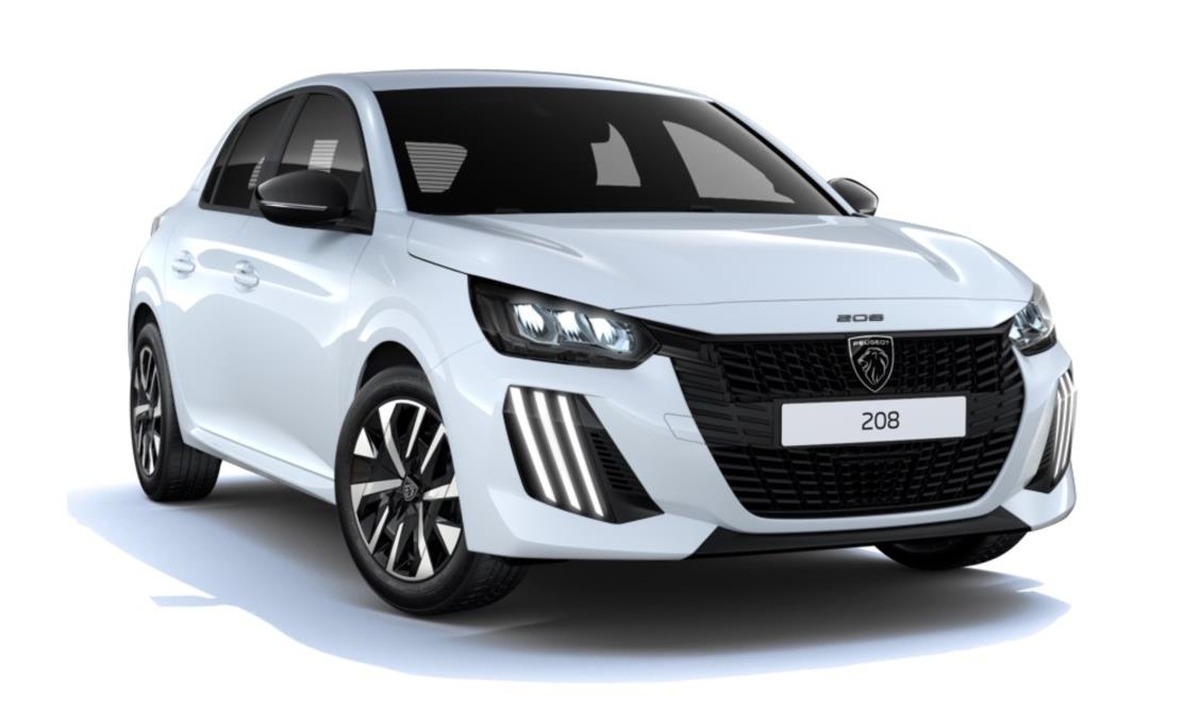
The Peugeot 208 is one of the most common small cars on Irish forecourts, and the single most important thing to know about it has nothing to do with trim levels or wheel size. It is what drives the camshafts.
On the petrol 208, the timing belt runs inside the engine oil. When that belt degrades it does not usually snap - it dissolves, and what it leaves behind is what destroys the engine. Stellantis has now acknowledged the problem and pays for the repair in certain circumstances. The diesel, which most buyers assume is the safe choice, has a separate acknowledged fault of its own.
This guide covers what to check, what the motor tax actually costs, and where the published figures for this car cannot be trusted.
The wet belt: what actually goes wrong
The 1.2 PureTech three-cylinder petrol - the engine in the overwhelming majority of Irish 208s - uses a toothed belt that runs submerged in engine oil rather than in a dry housing. The design reduces friction. It also means the belt lives in a chemically hostile environment, and it ages badly when the oil is old, the wrong specification, or diluted with unburnt fuel from a lot of short, cold journeys.
The failure sequence matters, because the early symptom is routinely misread:
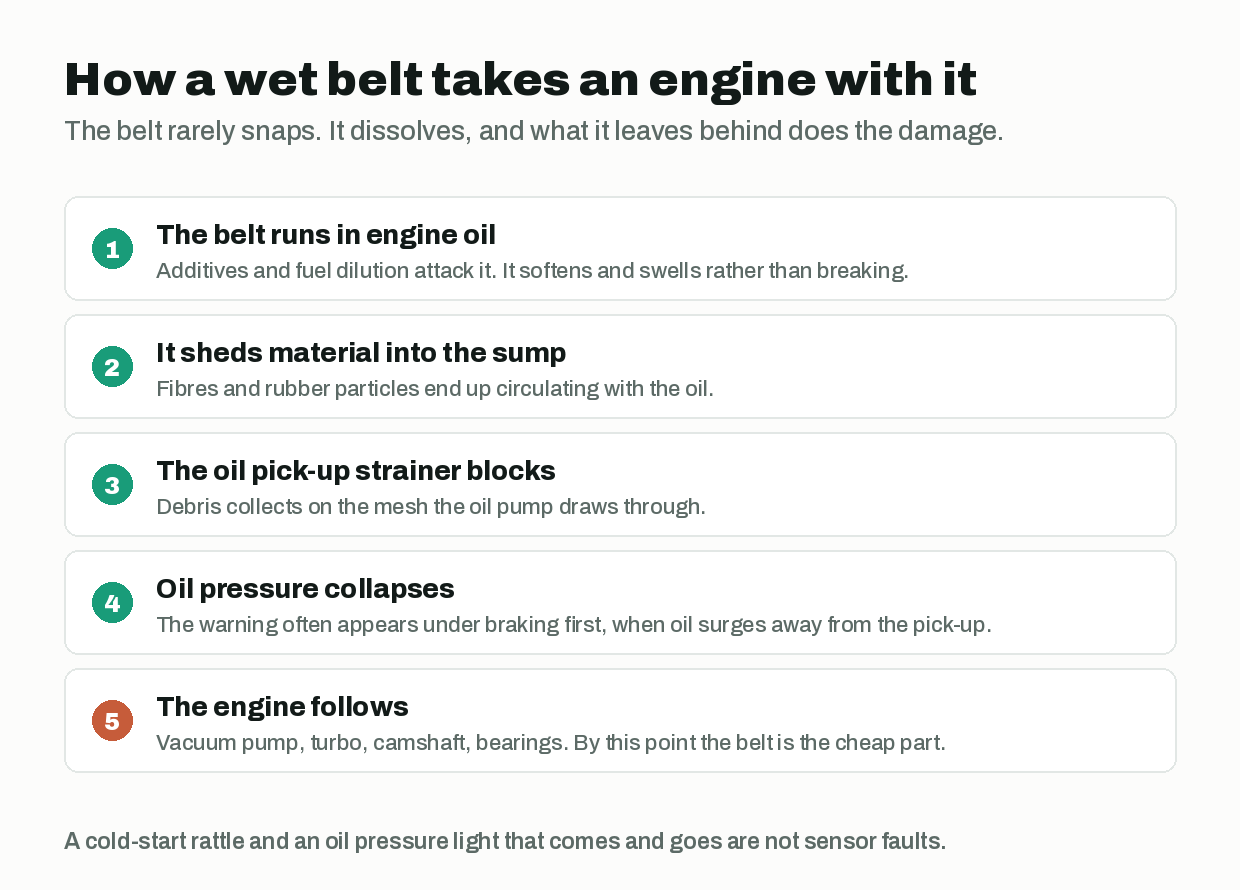
That fourth step is the one to commit to memory. An oil pressure warning that appears under braking and then goes away is a classic sign of a partially blocked pick-up strainer: braking makes the oil surge forward, away from a pick-up that can no longer draw enough through the mesh. It is frequently diagnosed as a faulty sensor, and the car is handed back.
Reported failures are not confined to high mileage. Independent specialists describe cases well under 100,000 miles, some in the 40,000 to 50,000 mile range.
What interval should it be done at?
Here is something worth knowing before anyone quotes you a figure: Peugeot does not publish one. Its own PureTech support page says only that the interval is specified in the vehicle’s service booklet. Every number you will see online is therefore second-hand.
Secondary sources broadly agree the original specification was around ten years or 175,000 to 180,000 kilometres, and that this was later revised to roughly six years or 100,000 kilometres. Independent workshops that see the failures go shorter still, commonly recommending 60,000 to 100,000 kilometres, or five to six years, particularly on cars used for short runs.
The practical answer for a buyer: treat any 208 petrol with no belt record and more than about 100,000 kilometres as a car that needs the job doing, and price it accordingly. And when the belt is done, the sump should be dropped and the oil pick-up strainer inspected at the same time. Replacing the belt while leaving a strainer full of old belt debris in place solves nothing.
The Stellantis compensation programme
In May 2025 Stellantis announced a compensation policy for earlier PureTech 1.0 and 1.2 engines covering excessive oil consumption and premature timing belt degradation. The headline terms are 100% of parts and labour, up to ten years or 180,000 kilometres, with retroactive reimbursement for repairs already paid for.
Two conditions do the work: the car must have been maintained to the manufacturer’s schedule, and the diagnosis and repair must go through the authorised network. A car with gaps in its service history is exactly the car that both needs the programme and may not qualify for it.
One caveat, stated plainly because it matters here: the rollout began in France and Spain and has been extending across Europe progressively. Peugeot Ireland does not publish its own page for the petrol programme. Check eligibility for the specific car through a Peugeot dealer rather than assuming it applies.
Which engines have the belt, and which do not
Essentially every petrol 208 from the 2019 launch through to roughly 2023 is a wet-belt car. A third-generation 1.2 with a timing chain arrived from 2023, paired with the 48V mild-hybrid system, and both generations were sold alongside each other for a period. That means a 2024-registered petrol 208 cannot be assumed to be one or the other - it has to be checked on the individual car.
The electric e-208 has no belt and no chain concern at all.
The diesel is not the safe option people think it is
The usual advice is to avoid the wet-belt petrol and buy the 1.5 BlueHDi instead. That advice is incomplete.
Peugeot Ireland publishes its own warranty extension page for the 1.5 BlueHDi, for camshaft chain breakage. The terms are 100% of parts and labour up to ten years or 240,000 kilometres, with reimbursement available for qualifying repairs already carried out.
That is an Irish-facing page from the manufacturer for an Irish-market car, and it changes the shape of the decision. On a 208 the question is not really petrol or diesel. It is: what has been done to the timing drive on this particular car, and is there paperwork for it?
Motor tax, and why the 2019 and 2020 cars are a trap
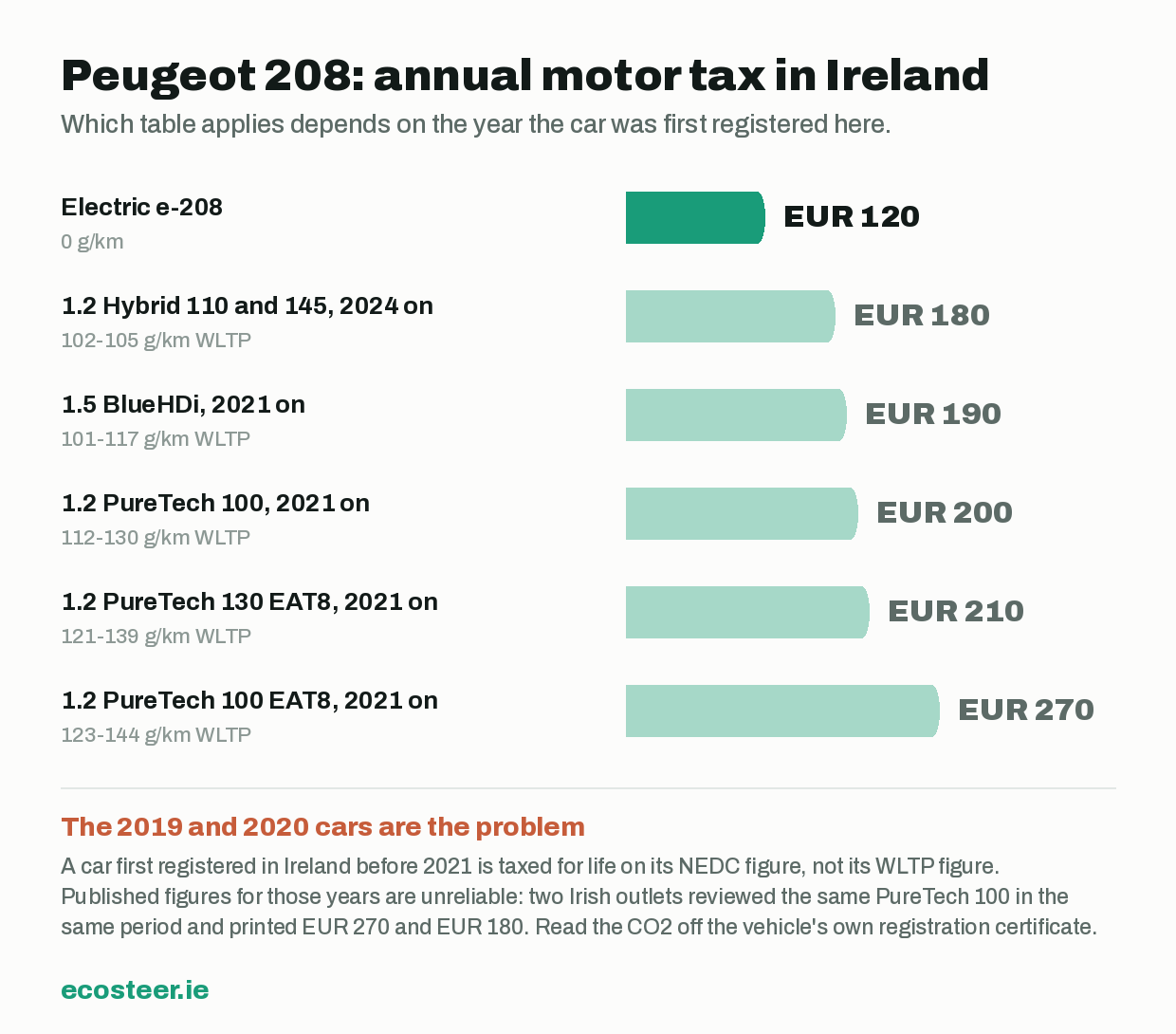
For a car first registered in Ireland from 1 January 2021, the figures are straightforward and come off the WLTP table. The awkward part is that CO2 varies with trim and wheel size, so several versions straddle a band boundary - a PureTech 100 is quoted between 112 and 130 g/km WLTP, which is the difference between €190 and €200. The individual car’s figure decides it.
For cars registered here before 2021 the situation is worse, and this is the single most useful thing in this guide.
Those cars are taxed for life on their NEDC CO2 figure. But 2019 and 2020 was exactly the period when brochures and reviews began printing WLTP figures, often alongside a tax band derived from the older NEDC number. The results are genuinely contradictory. Two Irish motoring outlets reviewed the same PureTech 100 in the same period: one printed 123 g/km and a tax figure of €270, the other printed a WLTP economy figure beside a tax figure of €180. Both cannot be right.
So: for any 191, 192, 201 or 202 car, do not take the CO2 figure from a review, a brochure or a dealer advert. Read it off the vehicle’s own registration certificate, or check it on the motor tax or Revenue VRT enquiry systems. It is a thirty-second check that can be worth €90 a year for as long as you own the car.
What else to look at
Recalls worth a VIN check
Four EU recalls are relevant to this generation. Applicability is always VIN-specific, so a dealer check on the individual car is the only real answer:
- Engine failure and fire risk (March 2025) - cars built October 2022 to December 2024 with the naturally aspirated three-cylinder PureTech. Damaged oil jet cooling nozzles can lead to engine damage, stalling and oil reaching the exhaust.
- AdBlue and emissions diagnostics - cars built January 2020 to October 2022. A software fault means the warning light may not illuminate when the urea injector malfunctions.
- Steering tie rods - cars built March 2020 to October 2022. Locking nuts possibly not tightened correctly at assembly.
- Fuel leak - cars built January 2019 to March 2020. High-pressure pump attachment under-torqued.
The driving position
Peugeot’s i-Cockpit puts a small steering wheel below the instrument display rather than in front of it. Some drivers get on with it immediately; for others the wheel rim sits directly across the speedometer and no seat adjustment fixes it. On manual cars the space beside the clutch pedal is also tight. This is not a fault, but it is a genuine reason to sit in the car before you commit, not after.
If you are looking at the e-208
Battery and range figures for the electric 208 are confusing because the claimed range changed without the battery changing. The 50 kWh car was homologated at 340 km at launch and later quoted at 362 km. Later cars use a 51 kWh pack (48.1 kWh usable) claimed at up to 409 km, and the current version is quoted at up to 433 km.
Real-world figures from Irish testing are more useful. A 2020 road test reported around 300 km in normal use and closer to 200 km on a full day of motorway driving. A 2022 test of the 362 km car reported about 280 km as realistic. DC charging peaks at 100 kW throughout the generation, and a heat pump became standard from 2022 - worth having in an Irish winter.
The high-voltage battery warranty in Ireland is eight years or 160,000 kilometres, with a 70% minimum capacity threshold. Ask for a battery health report, and inspect the CCS charging port physically - damaged pins are an expensive repair.
The short version
- Petrol: ask for belt paperwork. No record plus high mileage means the job is due, and the sump and strainer should be done with it.
- Diesel: ask about the camshaft chain and check the Peugeot Ireland warranty extension applies.
- Either: a service history from the authorised network is worth real money here, because it is what qualifies the car for the manufacturer programmes.
- Pre-2021 car: read the CO2 off the registration certificate, not off an advert.
- Electric: get a battery health figure and look at the charge port.
The 208 is a good small car. It is just a car where the paperwork is worth more than the paint.
Comments
No comments yet — be the first to join the conversation.