Kia Niro Ireland Buyer's Guide: Motor Tax, the Clutch Actuator Recall and Which Drivetrain to Pick
One badge, three completely different cars. We put the Irish motor tax figures for the Kia Niro hybrid, plug-in hybrid and EV side by side, explain the clutch actuator fire-risk recall, and set out which drivetrain actually suits which driver.
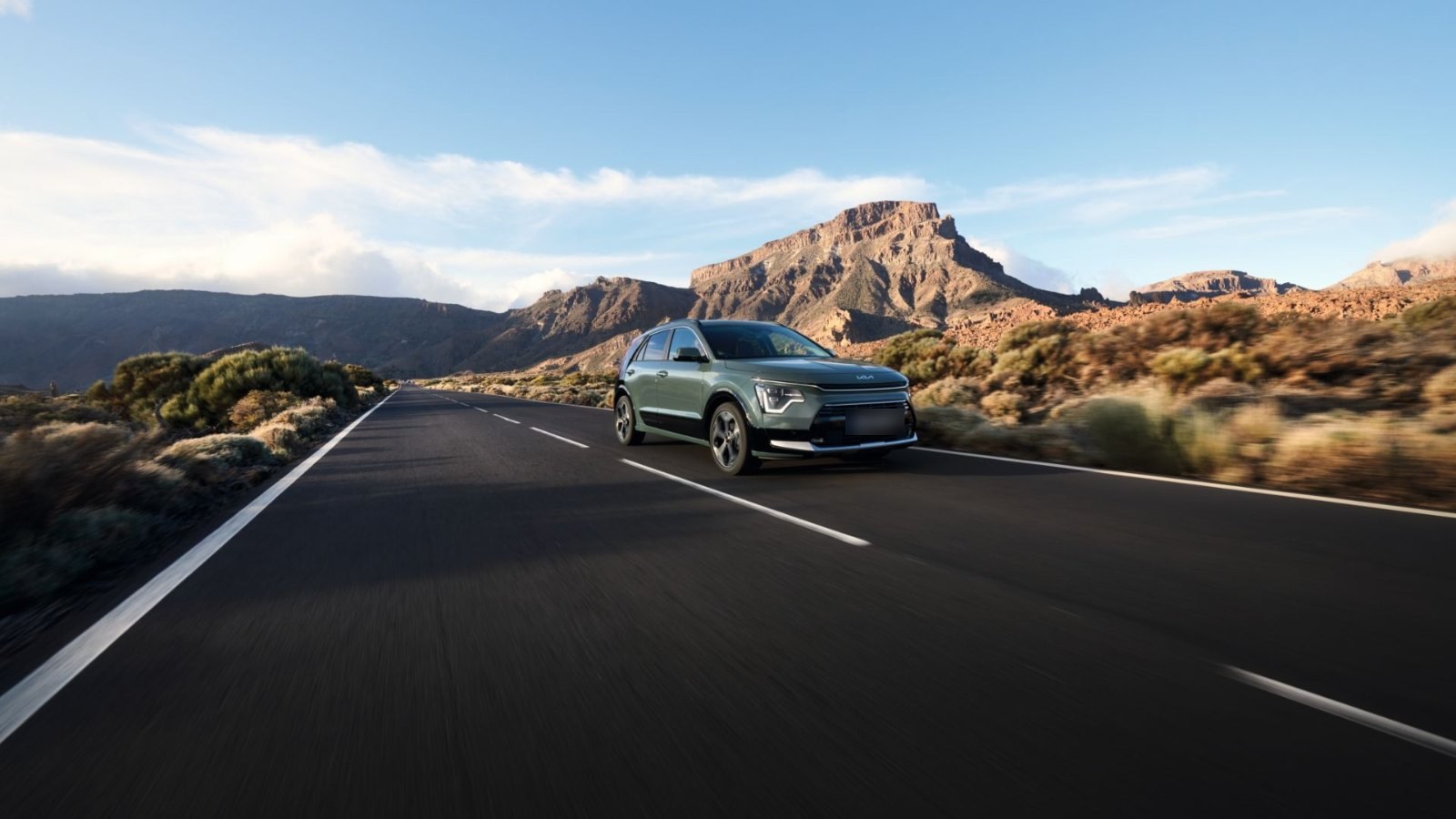
The Kia Niro is one of the few cars on the Irish used market sold in three completely different drivetrains under the same name. A self-charging hybrid, a plug-in hybrid and a full electric car, same badge, same shape, very different ownership. Two buyers can each own "a Niro" and have nothing in common in what they pay to tax it, what they pay to run it, or what can go wrong.
That is convenient for Kia and confusing on a forecourt. This guide separates the three, puts the Irish motor tax figures beside each other, and covers the one recall you should check before you hand over money.
The three Niros, and how to tell them apart
The first generation ran from 2016 to 2022. It launched as a self-charging hybrid, the plug-in hybrid followed in 2017, and the e-Niro electric car arrived here in 2019. The second generation, on sale from 2022, carries all three again: hybrid, plug-in hybrid and Niro EV.
The badge on the boot is the quick answer, but the charging flap is the honest one. No flap, it is the plain hybrid. A flap on the front wing, it plugs in. On the electric car the flap sits in the nose.
One mechanical detail matters more than the badges. The hybrid and the plug-in hybrid both use a six-speed dual-clutch gearbox, not the CVT most people expect from a hybrid. The electric car has a single-speed reduction gear and no clutch at all. That difference is the reason the recall below applies to two of the three and not the third.
Kia Niro motor tax in Ireland
Ireland taxes cars registered from January 2021 on their WLTP CO2 figure and cars registered between July 2008 and December 2020 on the older NEDC figure. The two are measured differently, so a 2020 Niro and a 2021 Niro can show very different numbers on paper and still be the same car.
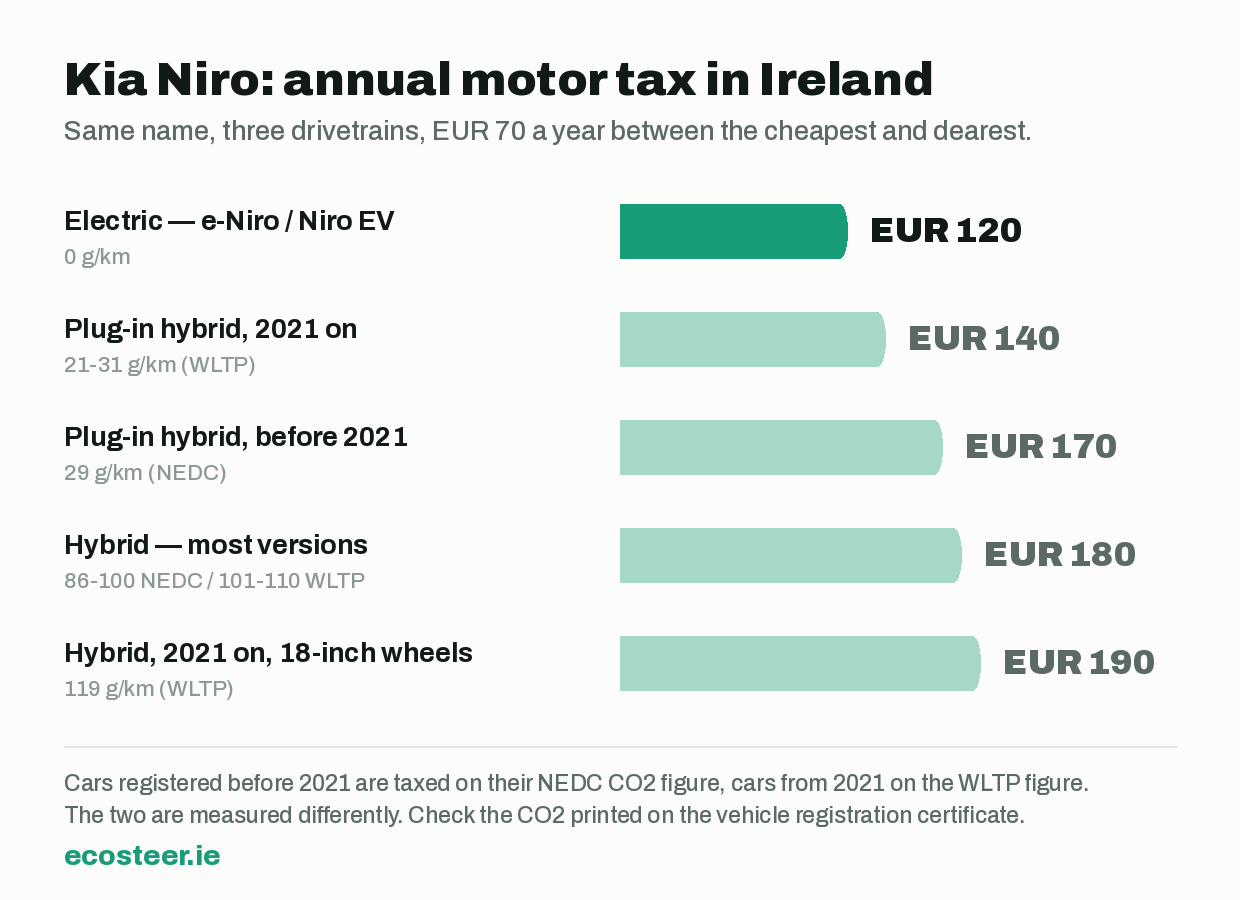
- Hybrid, registered before 2021 — 86g/km on 16-inch wheels, 100g/km on 18-inch, both NEDC. Both land in the same band: €180 a year.
- Hybrid, registered 2021 or later — 110g/km on 16-inch wheels, 119g/km on 18-inch, WLTP. Now they split: €180 on the smaller wheels, €190 on the larger.
- Plug-in hybrid, before 2021 — 29g/km NEDC: €170 a year.
- Plug-in hybrid, 2021 or later — 31g/km WLTP: €140 a year.
- Second-generation hybrid — 105g/km WLTP: €180 a year.
- Second-generation plug-in hybrid — 21g/km WLTP: €140 a year.
- e-Niro and Niro EV, every version — zero emissions: €120 a year, the lowest rate in the system.
Look again at the second line of that list. On a 2021-or-later first-generation hybrid, wheel size alone is the difference between €180 and €190. Same engine, same body, same everything else. It is a small sum, but it tells you how tight the bands are and why the number on the brochure is worth nothing next to the number on the vehicle registration certificate.
Check the CO2 figure on the VRC before you agree a price. Trim, wheels and options all move it, and one gram can move a band. We have seen the same pattern on the Volkswagen Golf and on the Mazda CX-5, where drivetrain choice alone was worth €140 a year.
The recall to check before you buy
This is the part that should decide whether you view a particular car at all.
Kia issued a recall covering the hydraulic clutch actuator on the Niro hybrid built between 2017 and 2022, and the Niro plug-in hybrid built between 2018 and 2022. Fluid can leak onto the actuator's circuit board, short it out and create a fire risk in the engine bay. The remedy is an inspection, replacement of the actuator where needed, and a lower-capacity fuse.
The electric car is not affected. No clutch, no hydraulic clutch actuator.
What to do with that: take the VIN from the windscreen or the VRC and ring a Kia dealer before you view. They can tell you in a minute whether the recall work has been carried out on that specific car. A seller saying "I never got a letter" is not an answer. Letters go to the registered keeper at the time, and a car that has changed hands twice may never have reached the current owner.
Which drivetrain actually suits you
The self-charging hybrid
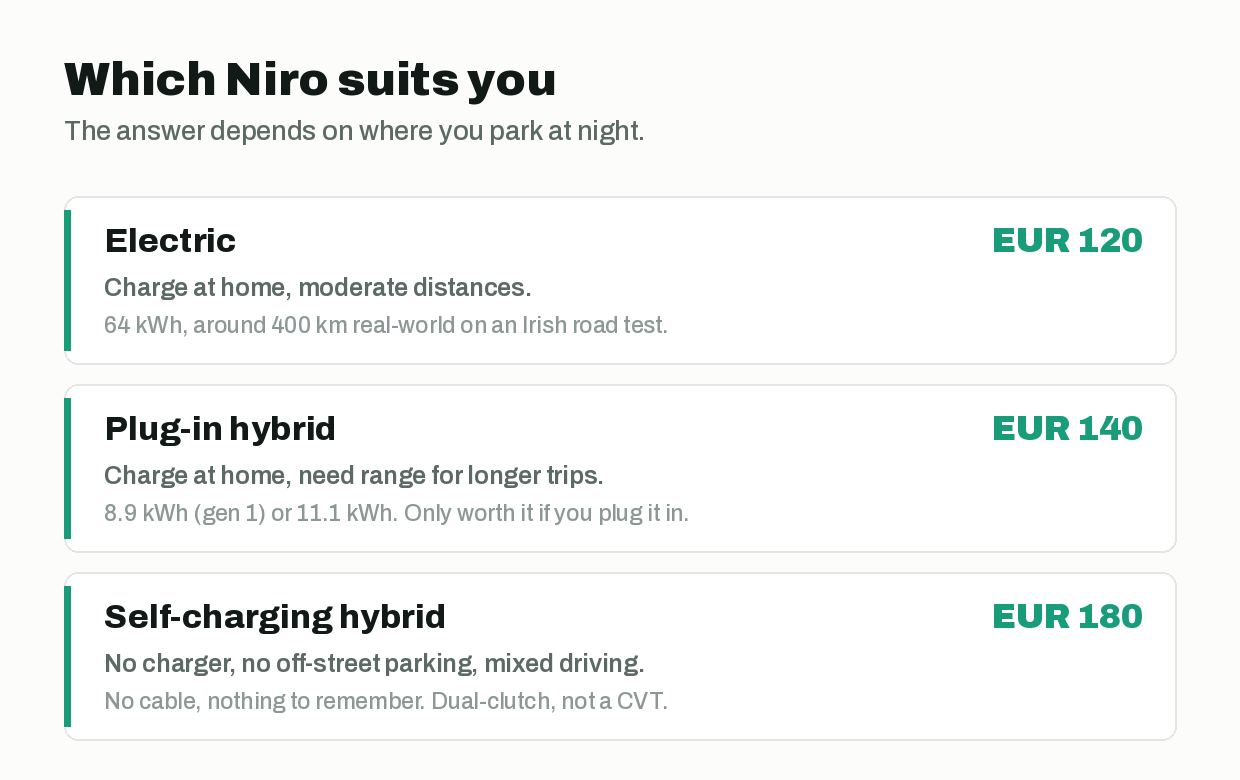
The simplest of the three and the one that asks least of you. No cable, no charging, no thinking about it. It suits mixed driving, and at €180 a year to tax it is cheap to keep on the road.
The second-generation car produces 141hp and carries a small 1.32kWh battery, which is there to smooth the petrol engine rather than to drive the car any distance.
The plug-in hybrid
This is the one that most often disappoints, and it is nothing to do with the car being bad.
The first-generation plug-in carries an 8.9kWh battery and around 48km of electric range. The second generation moved to 11.1kWh. Charged every night and used for a short commute, it does most of its work on electricity and the €140 tax is the icing.
Left unplugged, it is a hybrid carrying a heavier battery for nothing, and it will return worse economy than the plain hybrid you could have bought for less. The plug-in only makes sense if you have somewhere to charge it and the discipline to do it.
One practical limit on the second-generation plug-in: it charges at 3.3kW on AC only. There is no fast charging. A full charge takes roughly three hours, which is fine overnight and useless if you were hoping to top up on a break.
The electric car
The first-generation e-Niro with the 64kWh battery is the version most Irish buyers will come across. Kia claimed 455km WLTP; an Irish road test on real roads saw around 400km, which is a genuinely useful figure and unusually close to the official claim.
The second-generation Niro EV uses a 64.8kWh battery, 204hp, and takes DC charging at up to 100kW, which gets it to 80 per cent in about 45 minutes.
At €120 a year, every one of them sits at the bottom of the motor tax table. If your driving fits the range and you can charge at home, this is the cheapest of the three to run by a distance. If you are weighing an EV against a conventional car more generally, our Nissan Qashqai guide covers the same question from the other direction.
What to check on a used Niro
Recall paperwork first. On any hybrid or plug-in from 2017 to 2022, confirm the clutch actuator recall has been done. Do this before you travel to see the car.
Service history from a Kia network garage. Kia's warranty is long by industry standards, which is one of the reasons these cars hold value here — but a long warranty is only worth something if the servicing that keeps it alive was actually carried out and recorded.
On the plug-in, ask to see the cable and watch it charge. A plug-in that the previous owner never plugged in has a battery that has spent years at whatever state of charge it happened to be left at. Ask directly how they charged it and where.
On the electric car, ask for a state-of-health reading. Any EV specialist can pull it, and some Kia dealers will do it during a pre-purchase check. Dash bars are not a substitute for a percentage.
Listen to the dual-clutch gearbox at low speed. On the hybrid and plug-in, crawl in traffic and feel the first-to-second change. Hesitation, shunting or a shudder from rest is worth investigating before you buy, not after.
Check the CO2 on the VRC, not the advert. Half the adverts online quote a figure from a different trim.
Verdict
The Niro is a sensible car in all three forms, and the right answer depends entirely on where you park at night.
Charge at home and drive moderate distances: the electric car, €120 a year, and the lowest running costs of the three.
Charge at home but need the range for longer trips: the plug-in, €140, on the condition that you actually plug it in.
No off-street parking, no charger, mixed driving: the self-charging hybrid, €180, and none of the worrying.
Whichever one you land on, the clutch actuator recall check takes one phone call and applies to most hybrids and plug-ins of that era. Make it the first thing you do, not the last.
Frequently asked questions
How much is motor tax on a Kia Niro in Ireland?
It depends on the drivetrain and the registration year. The electric e-Niro and Niro EV are €120 a year. The plug-in hybrid is €140 if registered from 2021 and €170 if registered before 2021. The self-charging hybrid is €180, rising to €190 on a 2021-or-later first-generation car fitted with 18-inch wheels. Always check the CO2 figure on the vehicle registration certificate rather than the advert.
Is there a recall on the Kia Niro?
Yes. Kia recalled the hydraulic clutch actuator on the Niro hybrid built from 2017 to 2022 and the Niro plug-in hybrid built from 2018 to 2022, because leaking fluid can short the actuator's circuit board and create a fire risk. The fully electric version is not affected. Give the VIN to a Kia dealer to confirm the work has been done on a specific car.
What is the real-world range of a used e-Niro?
The 64kWh first-generation e-Niro was claimed at 455km WLTP, and an Irish road test on real roads returned around 400km. That is unusually close to the official figure by EV standards.
Is the Kia Niro plug-in hybrid worth it?
Only if you can charge it regularly. The first-generation plug-in has an 8.9kWh battery and roughly 48km of electric range, and the second generation has 11.1kWh. Charged nightly for a short commute it does most of its driving on electricity. Left unplugged it carries the extra battery weight for nothing and uses more fuel than the standard hybrid.
Does the Kia Niro hybrid use a CVT gearbox?
No. The hybrid and plug-in hybrid both use a six-speed dual-clutch automatic. Only the fully electric version dispenses with a conventional gearbox, using a single-speed reduction gear instead.
Looking for a used Niro?
Ecosteer lists used cars from across all 32 counties in one place, with petrol, diesel, hybrid and electric side by side and specialist tools for hybrid and EV buyers. That matters more than usual on a car like this, where the same model name covers three completely different things and the running-cost gap between them is the whole decision.
If you are selling rather than buying, private ads on cars under €3,000 are free on Ecosteer. Photos, description, national reach, no listing fee.
Comments
No comments yet — be the first to join the conversation.