Volkswagen Passat B8 Ireland Buyer's Guide: Motor Tax, the Belt, the DSG and AdBlue
Irish motor tax for every B8 Passat engine from EUR 140 to EUR 400, why you must not calculate the band from a brochure CO2 figure, the timing belt and water pump reality, which DSG needs servicing at 60,000km, and how to tell in thirty seconds whether a diesel uses AdBlue.
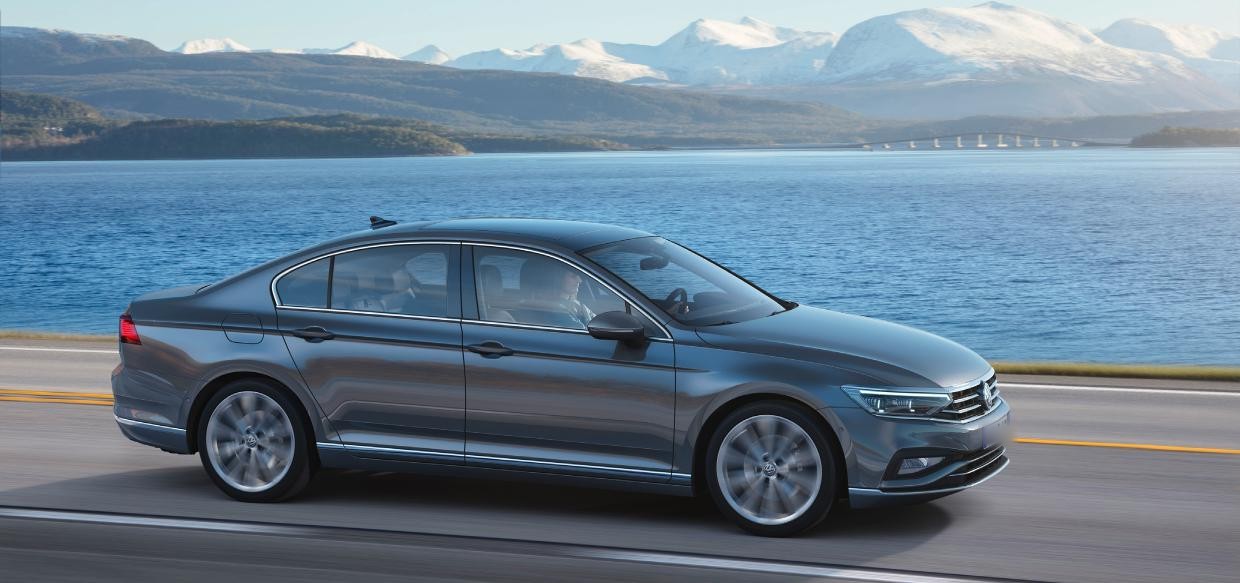
The Volkswagen Passat is one of the most common large cars on the Irish used market, and one of the easiest to buy badly. Two B8 Passats can sit beside each other on the same forecourt, both diesel, both automatic, both with the same tax disc — and one of them carries a four-figure bill the other does not.
This guide covers the B8, on sale here from 2015 to 2023. It separates the engines, gives the Irish motor tax figures, and sets out the three things that actually decide whether a used Passat is cheap or expensive to own: the belt, the gearbox, and the emissions system.
Which Passat you are looking at
The Irish B8 range changed shape twice.
2015 to 2019. Diesel dominated: the 1.6 TDI 120hp and the 2.0 TDI in 150hp and 190hp forms, plus a rare 2.0 TSI petrol and the GTE plug-in hybrid.
2020. The facelift. Same engine families, new front, new infotainment.
2021 to 2023. The range shrank hard. Volkswagen Ireland's own product guide for these years lists only three powertrains: the 2.0 TDI 122, the 2.0 TDI 150 EVO and the GTE. No 1.6 TDI, no petrol.
That matters when you are searching. A 2022 Passat advertised as a 1.6 is almost certainly a UK import, and a UK import brings its own VRT and history questions.
Passat motor tax in Ireland
Before the figures, one warning that will save you money and confusion.
Do not calculate the band yourself from the CO2 number in a brochure or a review. Ireland taxes cars registered from January 2021 on their WLTP CO2 figure, and cars registered between July 2008 and December 2020 on the older NEDC figure. Through 2019 and 2020 the paperwork was in transition: Volkswagen Ireland's own MY2020 Passat guide prints CO2 figures labelled WLTP next to tax bands derived from the NEDC value. Both numbers are correct. They are simply measured on different scales.
So a 2020 Passat 2.0 TDI can honestly be listed at 141g/km and still cost €190 a year. Run that 141 through the pre-2021 table yourself and you get €400 — and you would be wrong.
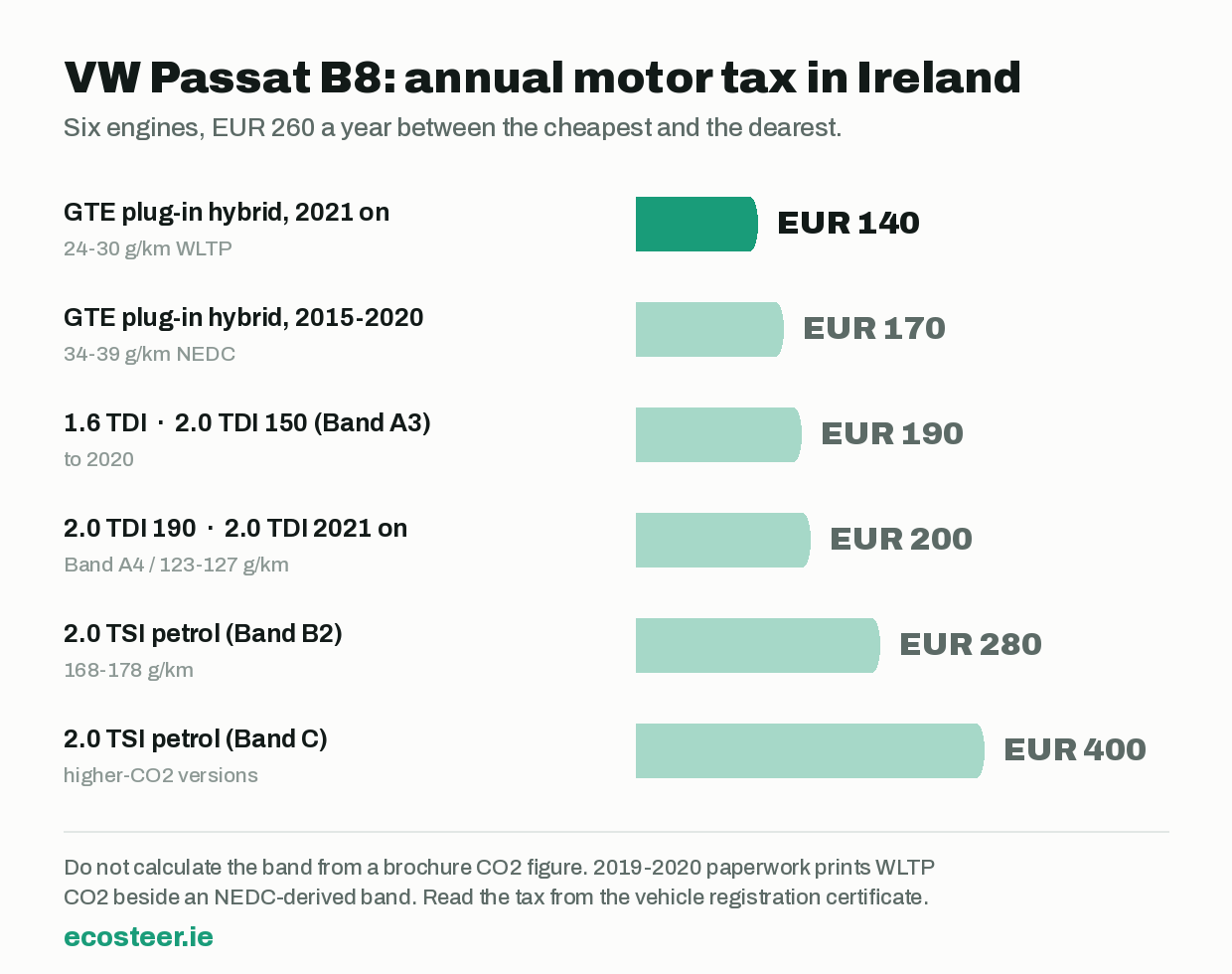
- 1.6 TDI 120hp, 2015-2016 — 105g/km NEDC: €190 a year.
- 1.6 TDI, 2020 model year — Band A3: €190 a year.
- 2.0 TDI 150hp, to 2020 — Band A3 or A4 depending on body and gearbox: €190 or €200.
- 2.0 TDI 190hp DSG, 2020 model year — Band A4: €200 a year.
- 2.0 TSI 190hp petrol — Band B2 or C: €280 or €400.
- 2.0 TDI, 2021 on — 123-127g/km WLTP: €200 a year.
- GTE plug-in hybrid, 2015-2020 — 34-39g/km NEDC: €170 a year.
- GTE plug-in hybrid, 2021 on — 24-30g/km WLTP: €140 a year.
Look at the last two lines. A 2021 GTE is cheaper to tax than a 2020 GTE, even though the cars are near enough identical. That is not an error. It is what happens when two different tables meet two different measurement standards, and it is worth €30 a year to the buyer who notices.
Check the CO2 printed on the vehicle registration certificate, and check the tax actually being paid. Trim, wheels and gearbox all move the number. We have seen the same pattern on the Kia Niro, where wheel size alone changed the band, and on the Volkswagen Golf.
The belt, and the myth about it
Almost everybody gets this backwards, so here it is plainly.
The 1.6 TDI and the 2.0 TDI run a timing belt. Volkswagen's four-cylinder diesels stayed on belts throughout this generation. The 2.0 TSI petrol runs a chain. The GTE's 1.4 TSI runs a belt.
Volkswagen's official interval for the EA288 diesel belt is 210,000km with no time limit. That figure is real, and it is also the reason people get caught out.
Two things sit behind it. First, the Irish trade generally works to four or five years regardless of mileage, because rubber ages whether the car moves or not. Second, and more important: the water pump is driven by that belt, and it fails well before the belt does. Irish owners report water pump failures a long way short of 210,000km. When it goes, you are paying the belt labour anyway — so the job is always belt and pump together, never belt alone.
On cost, be careful what you believe. UK quotes for belt plus water pump on a four-cylinder Passat run around £365 at an independent and £615 at a franchised dealer, for two to three hours of labour. Irish owners on Boards.ie quote €300 to €400. Neither is a price list. Get a written quote from an independent before you assume.
DSG: which one, and has it been serviced
This is the single biggest hidden cost in a used Passat, and the answer depends on which gearbox is in the car.
The dry-clutch DQ200 seven-speed went behind the smaller engines. It has no scheduled oil service.
The wet-clutch boxes do. The 2.0 TDI initially kept the older six-speed DQ250 from the previous Passat; from 2017 the seven-speed DQ381 replaced it. The GTE uses a DQ400e, a different unit again with the electric motor sitting between engine and gearbox.
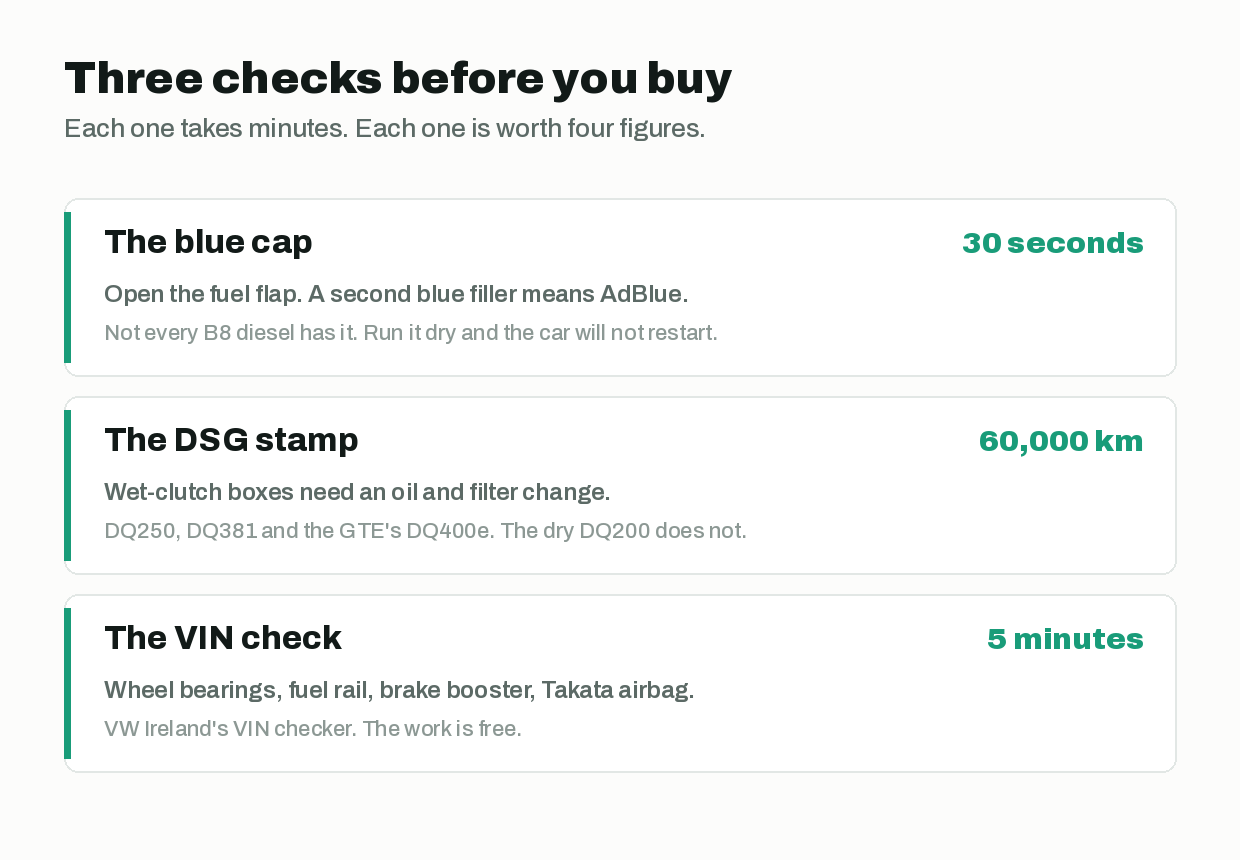
Every wet-clutch box needs an oil and filter change at roughly 60,000km. Skip it and you get shuddering, delayed shifts, and eventually mechatronic unit failure — which is not a small bill. Irish owners report paying around €400 at a Volkswagen dealer and around €200 at a gearbox specialist for the service itself.
Ask for the stamp. A wet-clutch Passat past 60,000km with no DSG service record should be priced as if the service is due, because it is.
AdBlue: not every diesel has it
Another common mistake. Not all B8 diesels use AdBlue.
The 2.0 TDI 190 and the BiTDI 240 were listed with SCR from launch. The 1.6 TDI 120 and the 2.0 TDI 150 were not. Volkswagen's twin-dosing SCR system — two injection points, two catalysts — arrived on the 2.0 TDI in summer 2019 and worked its way across the range from there. Volkswagen gives no clean changeover date for the Passat.
So do not go by the year. Open the fuel flap and look for a second, blue filler cap. That settles it in five seconds.
If the car does have it, know what running dry means. In Volkswagen's own words, when the red AdBlue warning appears there is no range left, and the car will not restart once the ignition is switched off until it has been topped up. Volkswagen states plainly that this is not a fault — it is how the system is required to behave. Owner data suggests roughly 11,000 to 14,000km on a tank, though Volkswagen publishes no Irish figure.
Short journeys and the DPF
If the Passat will spend its life doing ten-minute trips, buy the petrol or the GTE instead.
Active regeneration runs roughly every 300 miles and needs five to ten minutes to finish. Clearing a DPF warning light takes about ten minutes at over 40mph. A car that never gets that never completes a regeneration, and the soot only accumulates. The AA's advice is blunt: if your driving is mainly town-based and stop-start, avoid a diesel with a particulate filter. Replacement starts at around £1,000 plus labour.
A leaking or sticking EGR valve produces the same symptom and is often the real cause, so a blocked DPF on a low-mileage car deserves a proper diagnosis before anyone quotes you for a filter.
The GTE, honestly
The plug-in Passat is the cheapest to tax and the most misunderstood.
The pre-facelift car carries a 9.9kWh battery; the 2020 facelift moved to 13kWh. Volkswagen claimed 50km for the first and 56km WLTP for the second. An Irish road test of the pre-facelift car returned about 40km in real use. Treat the brochure figures for the later car with the same discount.
It charges on AC only. Maximum 3.7kW, Type 2, no rapid charging at all. A 22kW public post gives you exactly the same three hours as a home wallbox. If your plan was to top up at a fast charger on a long run, the GTE cannot do it.
There is a reliability caveat worth stating. What Car? rates the GTE poorly, citing software glitches, and reports owners meeting long delays, steep out-of-warranty repair costs and patchy hybrid expertise at dealers. The Passat range as a whole scored 82.2 per cent in that survey — nineteenth out of twenty executive cars — with faulty sensors and electrical glitches the recurring theme, worsening with age.
Charged every night for a short commute, the GTE is a genuinely cheap car to run at €140 to €170 a year. Left unplugged, it is a heavy petrol Passat carrying a battery for nothing.
Recalls: check the VIN, not the year
The B8 has a long recall list. Rather than memorise year ranges — which are build dates and will mislead you if you are working from an Irish reg plate — take the VIN and check it.
The items that matter most to a used buyer are the 2015 front wheel-bearing casing recall, which could cause sudden loss of steering; a 2017 rear wheel-bearing housing recall; a 2015 fuel rail leak with fire risk; 2018 and 2019 recalls covering the brake pedal pushrod and the electromechanical brake booster; and the Takata airbag campaign, which Volkswagen Ireland says primarily covers inflators fitted between 2004 and 2018.
Volkswagen Ireland runs a VIN checker and the replacement work is free. The Road Safety Authority also publishes a recall register by manufacturer and year. Five minutes on either one before you travel to see a car is time well spent.
What to check on a used Passat
Service history, fully stamped. The RAC says it plainly for this generation, and the What Car? survey explains why: the recurring faults are electrical and emissions-related, and they get more expensive with age.
The blue cap. Thirty seconds tells you whether you are buying into AdBlue.
The DSG stamp at 60,000km on any wet-clutch car.
Cold start and low-speed crawl. Listen for rattle on a petrol; feel for shunting or shudder from the DSG in traffic.
The electronic handbrake. Owners report it failing to disengage. Test it twice.
Exhaust smoke. Blue or white smoke on a 2.0 TDI, with oil contamination, is a reported complaint on this generation and not something to negotiate around.
Front Assist. Drive it in traffic. Phantom braking is a documented complaint.
The CO2 on the VRC, and the tax actually paid. Not the advert.
Verdict
Long motorway miles, and you want the space: the 2.0 TDI, at €190 to €200 a year, with a belt-and-pump record and a DSG stamp.
A charger at home and a short commute: the GTE, at €140 to €170, on the condition that you plug it in every night and accept that it will not fast-charge.
Town-only driving: not a B8 diesel at all. The DPF will beat you.
Whichever one you land on, the VIN check takes five minutes and the blue-cap check takes thirty seconds. Both happen before you travel, not after you have paid.
Frequently asked questions
How much is motor tax on a Volkswagen Passat in Ireland?
It depends on the engine and the registration year. A 1.6 TDI or a 2.0 TDI 150 registered up to 2020 is generally €190 or €200 a year. A 2.0 TDI 190 is €200. A 2021-on 2.0 TDI is €200. The GTE plug-in hybrid is €170 if registered between 2015 and 2020 and €140 if registered from 2021. The rare 2.0 TSI petrol is €280 or €400. Always check the CO2 figure on the vehicle registration certificate rather than calculating from a brochure.
Does the Volkswagen Passat 2.0 TDI have a timing belt or a chain?
A belt. Volkswagen's four-cylinder diesels used a toothed timing belt throughout the B8 generation. The 2.0 TSI petrol is the one with a chain. Volkswagen's official belt interval for the EA288 diesel is 210,000km with no time limit, but the water pump is driven by the same belt and commonly fails much earlier, so the job is done as belt and pump together.
Do all Passat diesels use AdBlue?
No. The 2.0 TDI 190 and the BiTDI 240 had SCR from launch, while the 1.6 TDI 120 and the 2.0 TDI 150 did not. Volkswagen's twin-dosing system arrived on the 2.0 TDI in summer 2019 and spread across the range with no clean changeover date. Open the fuel flap and look for a second blue filler cap. If the AdBlue runs out completely the car will not restart once the ignition is switched off.
How often does a Passat DSG need servicing?
Wet-clutch gearboxes need an oil and filter change at roughly 60,000km. That covers the six-speed DQ250 fitted to early 2.0 TDI cars, the seven-speed DQ381 from 2017, and the GTE's DQ400e. The dry-clutch seven-speed DQ200 fitted behind smaller engines has no scheduled oil service. Skipping the service on a wet-clutch box leads to shuddering, delayed shifts and eventually mechatronic failure.
What is the real electric range of a Passat GTE?
The pre-facelift car has a 9.9kWh battery and an Irish road test returned about 40km against a 50km claim. The 2020 facelift moved to 13kWh with a 56km WLTP claim. The GTE charges on AC only at up to 3.7kW and has no rapid charging capability, so a public fast charger gives it no advantage over a home wallbox.
Looking for a used Passat?
Ecosteer lists used cars from across all 32 counties in one place, with petrol, diesel, hybrid and electric side by side and specialist tools for hybrid and EV buyers. On a car like the Passat, where the same model name covers a diesel, a petrol and a plug-in hybrid with a €260 a year spread in motor tax between them, being able to compare the three in one search is the whole point.
If you are selling rather than buying, private ads on cars under €3,000 are free on Ecosteer. Photos, description, national reach, no listing fee.
Comments
No comments yet — be the first to join the conversation.