Volkswagen Golf Ireland Buyer's Guide: The Diesel and the Mild Hybrid Pay the Same Tax
The 116hp Golf diesel and mild-hybrid petrol both pay €190 motor tax. Which Golf to buy in Ireland, DSG checks, Mk8 software, NCT fails and running costs.
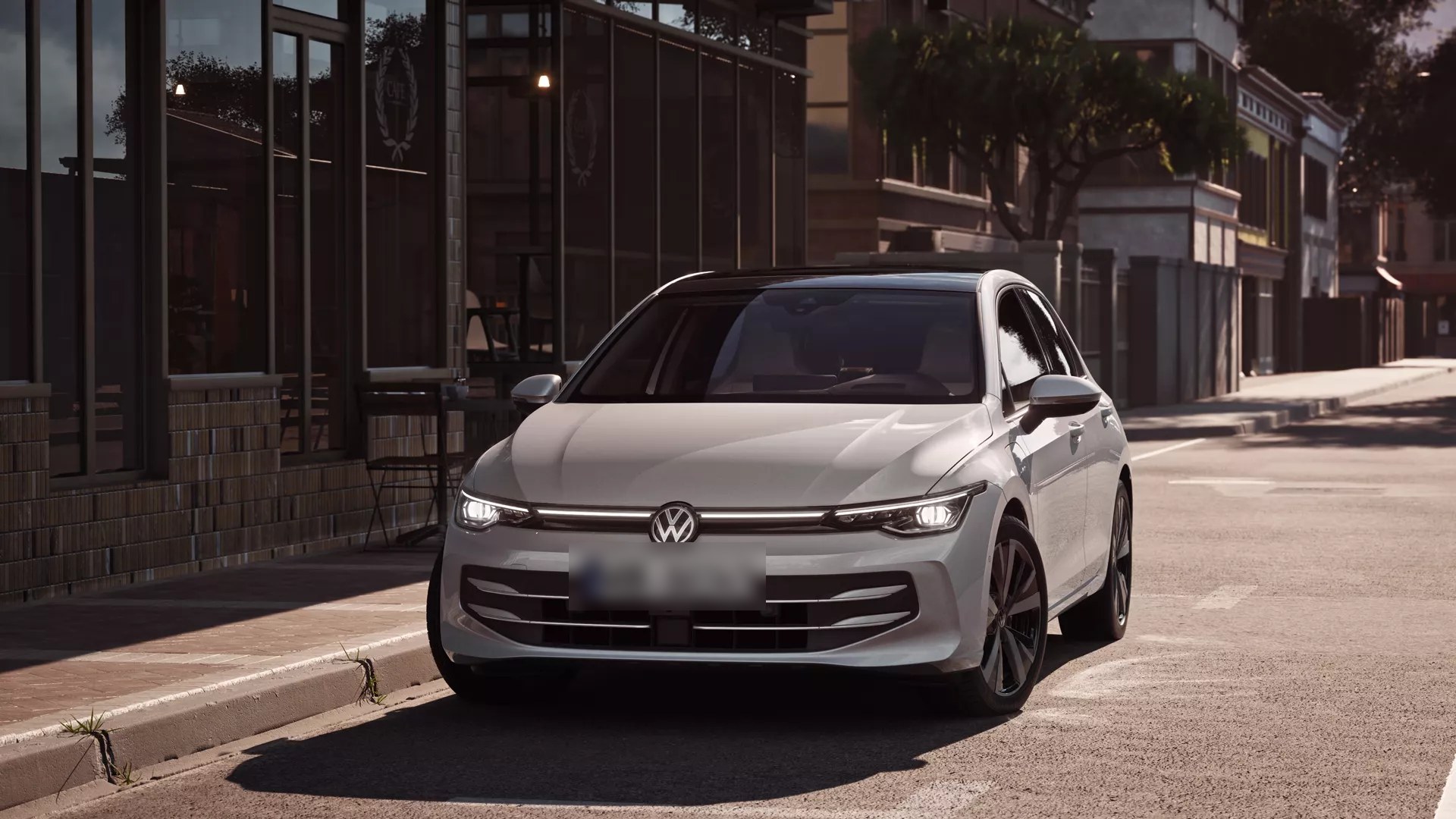
The Volkswagen Golf is still the car Irish buyers look for first. It is the most searched model on the biggest Irish classifieds site, it has a Volkswagen dealer in almost every county, and it keeps its value better than most family hatchbacks. That popularity is the reason to buy one carefully: plenty of Golfs are sold, so plenty of tired ones are sold too.
The number that surprises most buyers is on the motor tax bill. On the current Irish price list the 116hp 2.0 TDI diesel and the 116hp 1.5 TSI mild hybrid both pay €190 a year in motor tax, while the 150hp petrol and diesel versions pay €200. The plug-in eHybrid pays €140. So the tax gap between diesel and petrol has almost vanished, and the choice should come down to how you drive, not the tax band.
Volkswagen Golf Ireland overview
Two generations matter to Irish used buyers. The Mk7 arrived in 2013 and was facelifted as the Mk7.5 in 2017; it sold until 2020. The Mk8 replaced it in 2020 and was updated in 2024 (often called the Mk8.5), bringing back physical controls that owners of early Mk8s asked for.
The Golf shares its platform, engines and gearboxes with the Skoda Octavia, Seat Leon and Audi A3. If you want more boot space for similar money, read our Skoda Octavia buyer's guide; the gearbox advice below applies to both.
New Golf prices in Ireland start at €34,630 for the Life 1.5 TSI 116hp manual and run to over €45,000 for the eHybrid, before delivery charges. Used Mk7.5 cars typically sit between about €12,000 and €30,000 depending on age, engine and mileage.
Volkswagen Golf engine options and Irish running costs
1.5 TSI and 1.5 TSI mild hybrid (eTSI)
The 1.5 TSI petrol is the default choice. On the 2026 Irish price list the 116hp manual is rated 122-128 g/km and 5.4 l/100km. The mild-hybrid version with the 7-speed DSG is rated 116-119 g/km and 5.1-5.2 l/100km. Real mixed Irish driving usually lands 15-30% above those official figures. The 1.5 can shut down two cylinders on light throttle to save fuel; you will rarely notice it.
2.0 TDI diesel
The 2.0 TDI 116hp is rated 114-115 g/km and 4.3-4.4 l/100km. It suits drivers who cover long motorway distances. It does not suit short town trips: the diesel particulate filter needs regular hot runs to clean itself, and a city-only diesel is the classic Irish recipe for DPF and EGR warning lights.
1.5 eHybrid plug-in
The eHybrid pairs the 1.5 petrol with a battery of about 19.7 kWh net and is rated 25-26 g/km, which puts it in the €140 tax band. It only makes financial sense if you can charge at home and most of your trips are short. There is no SEAI grant for a private buyer of a plug-in hybrid.
Where the Golf falls short
Early Mk8 cars (2020-2021) had slow, crash-prone infotainment and touch-sensitive climate controls that many owners found frustrating. Software updates fixed most of it, but a car that has missed its updates still behaves badly. The Golf is also not the roomiest car in its class; an Octavia or Leon estate carries more for the money.
If you are choosing between a Mk7.5 and an early Mk8 at the same price, the Mk7.5 usually wins for a buyer who wants a simple, proven car: physical buttons, a mature infotainment system and gearboxes whose weak points are well understood by independent garages. The early Mk8 wins on safety equipment and refinement, but only once its software is up to date.
Volkswagen Golf motor tax in Ireland
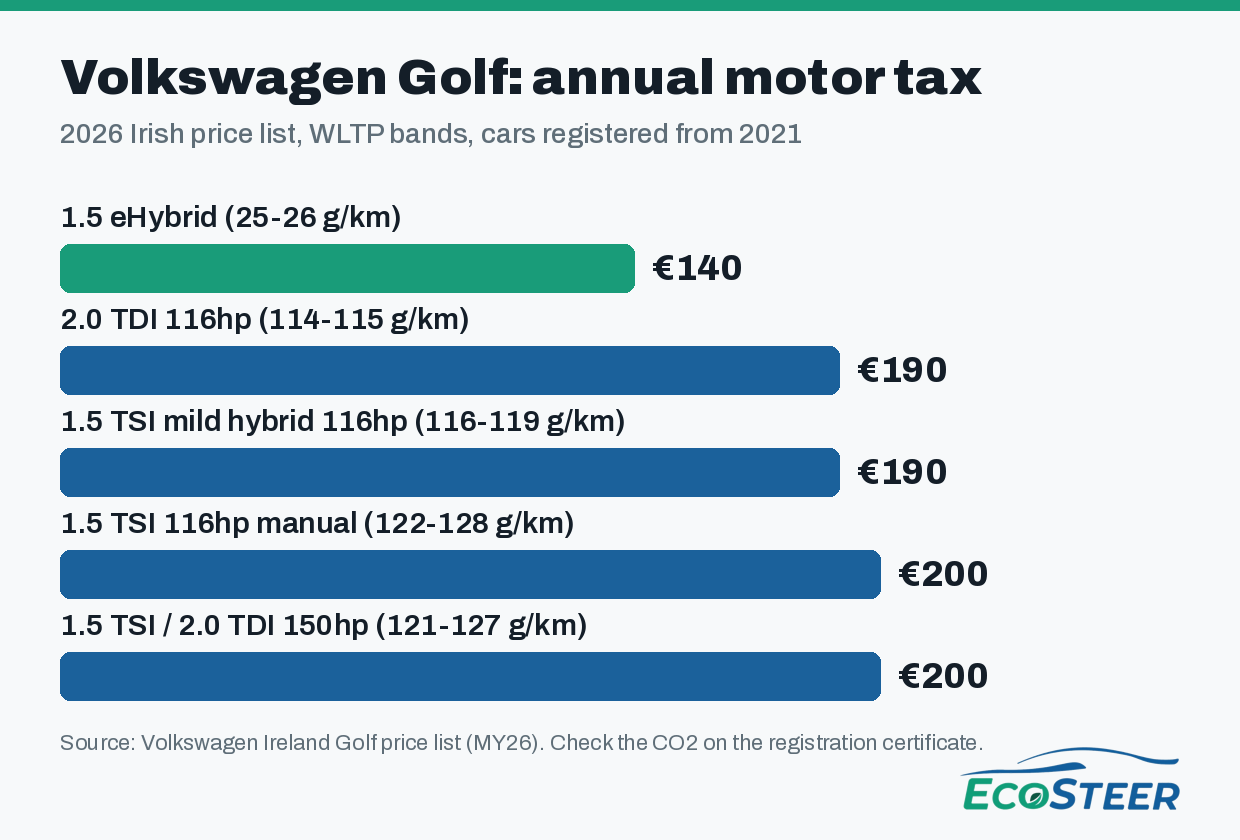
- 1.5 TSI 116hp manual: 122-128 g/km, €190-€200 depending on the exact version on the certificate.
- 1.5 TSI mild hybrid 116hp DSG: 116-119 g/km, €190.
- 2.0 TDI 116hp: 114-115 g/km, €190.
- 1.5 TSI 150hp and 2.0 TDI 150hp DSG: 121-127 g/km, €200.
- 1.5 eHybrid: 25-26 g/km, €140.
Tax is charged on the CO2 figure printed on the vehicle registration certificate, not the brochure figure. Wheel size and trim can move a car across a band line, so always check the certificate of the exact car.
Cars registered between July 2008 and December 2020 are taxed on the older NEDC table, where the bands are different: 101-110 g/km is €190, 111-120 g/km is €200 and 121-130 g/km jumps to €270. A Mk7.5 diesel or 1.0 TSI will often sit in the lower bands, but a petrol with a higher figure can cost noticeably more to tax than a newer car. NEDC and WLTP figures are measured differently and cannot be compared directly.
What to check before buying a used Volkswagen Golf
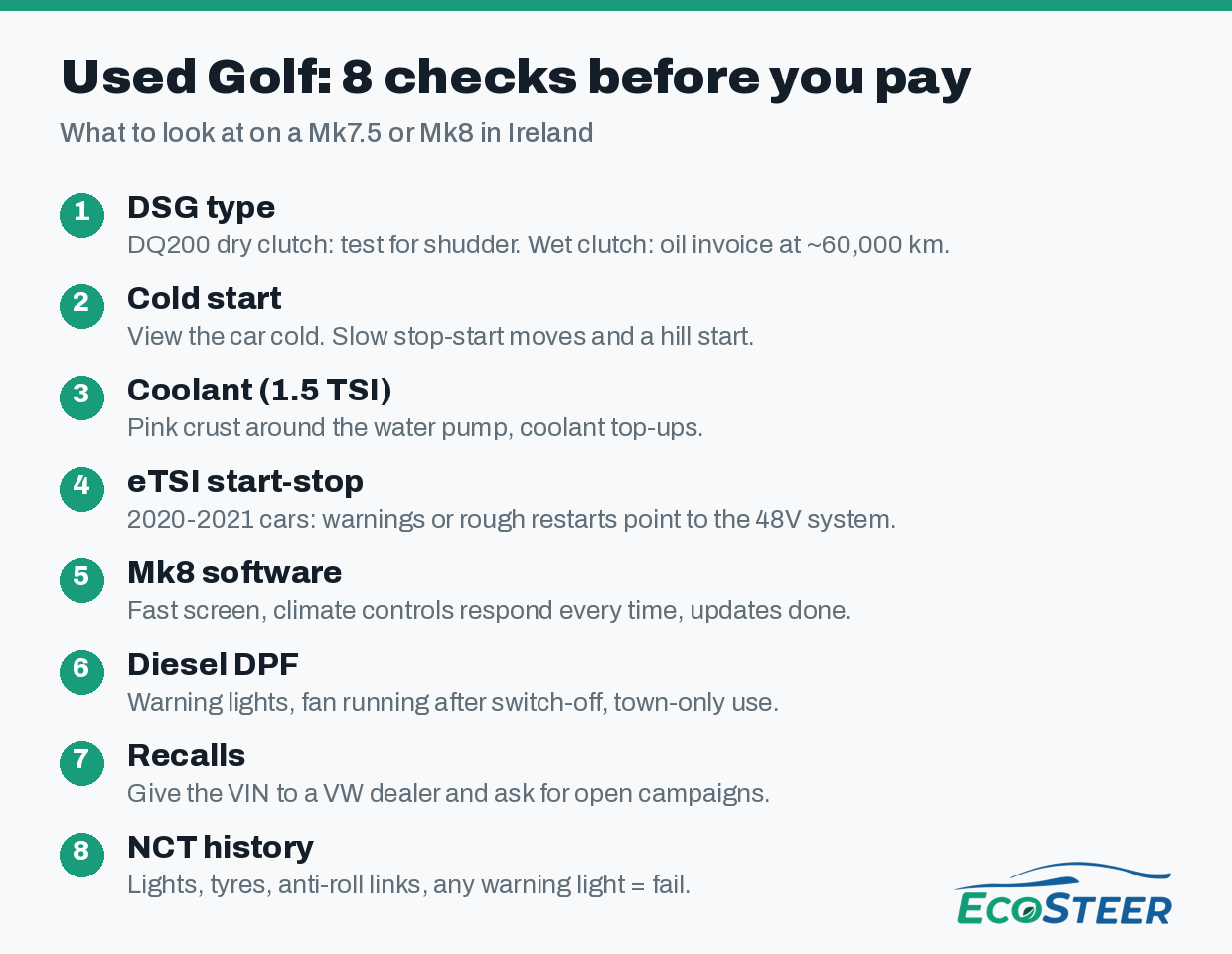
Which DSG gearbox is fitted. Lower-powered petrol Golfs use the 7-speed DQ200 dry-clutch DSG. Volkswagen does not specify a fluid change for it, so the key check is behaviour: shudder when pulling away, jerks at car-park speed or a delay between pressing the throttle and moving. The wet-clutch DSGs used with the 2.0 TDI and more powerful engines need an oil service at about 60,000 km. Ask for the invoice, not a verbal promise. Mechatronic repairs can run into the thousands.
Test the gearbox cold. Many DSG faults hide once the oil is warm. Arrange the viewing so the car has not been driven, then do slow stop-start manoeuvres and a gentle hill start.
Coolant leaks on the 1.5 TSI. The EA211 petrol family is known for water pump and coolant flange seepage. Look for pink crust around the pump area and ask whether the coolant has needed topping up.
Mild-hybrid start-stop. On 2020-2021 eTSI cars, a "start-stop system unavailable" warning or rough restarts can point to problems with the 48-volt system. Make sure start-stop works during the test drive.
Mk8 software. Check that the infotainment responds quickly and the climate controls react every time. Ask whether the car has had its software updates at a Volkswagen dealer.
Diesel DPF history. Ask what kind of driving the car has done. A warning light, frequent fan running after switch-off or a recent forced regeneration are reasons to walk away or negotiate.
Recalls. Give the VIN to a Volkswagen dealer and ask for a list of open recalls and campaigns before you pay.
What fails a Golf at the NCT. The usual failures are headlight aim, tyres worn close to the limit, worn anti-roll bar links from rough roads and any engine or emissions warning light, which is an automatic fail. On diesels, a DPF or EGR fault code will cause a fail. On plug-in hybrids, hybrid system faults must be cleared. An oil leak from the gearbox can also draw the tester's attention.
Volkswagen parts and service network in Ireland
Volkswagen has one of the densest dealer networks in the country, and because the Golf shares so many parts with Skoda, Seat and Audi, independent specialists know these cars well. Typical annual servicing runs from about €350 to €700 depending on the service and garage. Budget separately for DSG oil changes on wet-clutch gearboxes.
Verdict: is a used Volkswagen Golf a good buy in Ireland?
Yes, if you buy the right one. A late Mk7.5 with full service history is the value pick for most buyers. A 2022-or-later Mk8 avoids the worst of the early software problems. Choose the 1.5 TSI for mixed and town driving, the 2.0 TDI only if you do real mileage, and the eHybrid only if you can charge at home. Whatever you pick, the gearbox and the paperwork matter more than the tax band.
For a comparison with an SUV at similar money, see our Nissan Qashqai buyer's guide and our Mazda CX-5 buyer's guide.
Frequently asked questions
How much is motor tax on a Volkswagen Golf in Ireland?
On the current Irish price list most Golfs pay €190 or €200 a year. The 1.5 eHybrid pays €140. Cars registered before 2021 are taxed on the older NEDC table, so check the CO2 on the registration certificate.
Is the Golf diesel cheaper to tax than the petrol?
Barely. The 116hp 2.0 TDI and the 116hp 1.5 TSI mild hybrid both pay €190. The diesel's advantage is fuel use on long runs, not tax.
Which Golf DSG needs an oil change?
The wet-clutch DSGs fitted to the 2.0 TDI and more powerful engines need an oil service at around 60,000 km. The 7-speed DQ200 dry-clutch box has no scheduled fluid change from Volkswagen.
Which Mk8 Golf years are best?
Cars built from 2022 onward have fewer software problems than the 2020-2021 cars. The 2024 update brought back physical controls.
Is a plug-in Golf eHybrid worth it in Ireland?
Only if you can charge at home and most of your journeys are short. Private buyers receive no SEAI grant for a plug-in hybrid, and on long runs it behaves like a heavier petrol car.
Buying or selling? Use Ecosteer
Ecosteer is an Irish marketplace for used cars of every fuel type: petrol, diesel, hybrid and electric, from all over the country in one place. Buyers weighing up a hybrid or electric car get specialist tools built for that decision.
Selling a car worth less than €3,000? Private ads for cars under €3,000 are completely free on Ecosteer. Browse or list your car on Ecosteer.
Comments
No comments yet — be the first to join the conversation.