
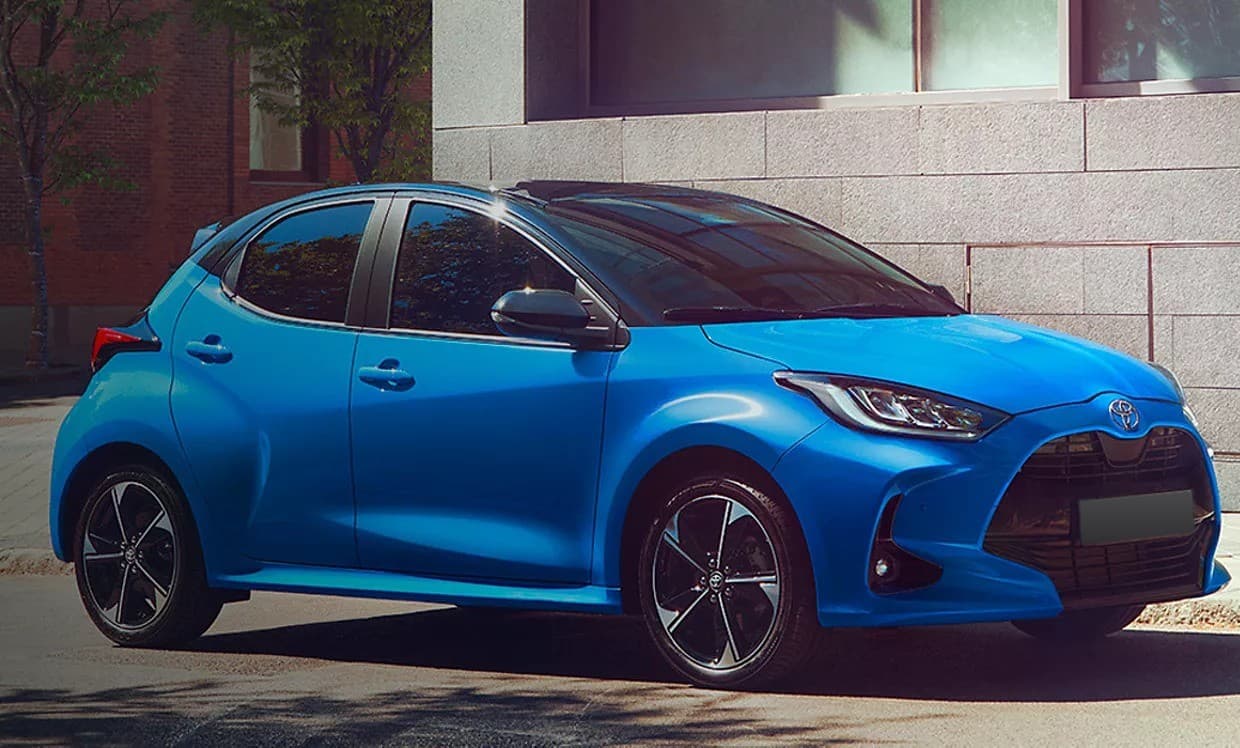
Quick Summary
- Four generations since 1999, and both the first and the fourth were named European Car of the Year (2000 and 2021).
- The Yaris Hybrid arrived in 2012 as the first full hybrid in Europe's small car class, and the current Irish range is hybrid only, with 116 or 130 DIN hp.
- Older cars use 1.0 and 1.3 or 1.33 petrols and a 1.4 D-4D diesel. The fourth generation has no diesel.
- Toyota Ireland's Relax cover can run to 10 years or 185,000 km, and hybrid battery cover can be renewed up to the car's 15th anniversary with a yearly Hybrid Service.
- Several recalls have affected the Yaris in Ireland, including Takata airbags on 2001 to 2008 cars, so ask a Toyota dealer for a VIN check.
Looking for one? Browse used Toyota cars for sale on EcoSteer and compare prices from sellers around Ireland.
Toyota Yaris in Ireland at a glance
The Toyota Yaris has been one of the core small cars on Irish roads since 1999, so a used Toyota Yaris in Ireland is easy to find in every age and price bracket. It was Toyota's first global model designed in Europe mainly for Europe, and the cars sold here have been built at Toyota's plant in Valenciennes, France, since 2001.
Cars from 1999 to 2011 are simple petrols and 1.4 D-4D diesels, third generation cars (2011 to 2020) add the first Yaris Hybrid, and fourth generation cars are mostly hybrids with far more safety technology. This guide covers the hatchback only; the Yaris Cross has its own page.
Generations and production years
| Generation | Code | Years | What changed |
|---|---|---|---|
| First | XP10 | 1999 to 2005 | Three and five-door hatchback with a 1.0 VVT-i petrol. European production at Valenciennes from January 2001. A 1.4 D-4D diesel arrived in 2002 and the range was restyled in 2003. |
| Second | XP90 | 2006 to 2011 | Larger body, Easy Flat folding rear seats and up to nine airbags, including the class's first driver's knee airbag. Updated in 2009 with a 1.33 Dual VVT-i petrol with Stop and Start, revised 1.0 and 1.4 D-4D engines and light styling changes. |
| Third | XP130 | 2011 to 2020 | On sale in Ireland from September 2011 with a 50 mm longer wheelbase and a bigger boot. Yaris Hybrid added in 2012. Revised in 2014 with a new face, a stiffer body and a seven-inch Toyota Touch 2 screen, then again in 2017 with new styling, a 1.5 petrol and Toyota Safety Sense as standard. |
| Fourth | XP210 | 2020 to date | First small car on Toyota's GA-B (TNGA) platform, with a new 1.5 three-cylinder hybrid. Petrol models reached Ireland in August 2020 and the hybrid that October. Updated for 2024 with the more powerful Hybrid 130 and a 12.3-inch digital instrument display on higher grades. |
Engines sold in Ireland
Official outputs for the main engines. Older Toyota figures are in bhp, newer ones in DIN hp (equal to PS).
First generation (1999 to 2005)
- Petrol: 1.0 VVT-i (67 bhp) and 1.3 VVT-i (86 bhp).
- Diesel: 1.4 D-4D (74 bhp) from 2002.
- Five-speed manual, with an automatic or the MultiMode automated manual on some versions.
Second generation (2006 to 2011)
- Petrol: 1.0 VVT-i (69 DIN hp), 1.3 VVT-i (87 DIN hp) and, from 2009, 1.33 Dual VVT-i (101 DIN hp).
- Diesel: 1.4 D-4D (90 DIN hp).
- Five-speed manual at launch, with MultiMode optional on the 1.3 and diesel. From 2009 the 1.33 and diesel got a six-speed manual or six-speed MultiMode.
Third generation (2011 to 2020)
- Petrol: 1.0 VVT-i (69 hp) and 1.33 Dual VVT-i (99 hp) at the Irish launch. In 2017 a 1.5 Dual VVT-iE (111 DIN hp, 82 kW) replaced the 1.33.
- Diesel: 1.4 D-4D (90 hp).
- Hybrid: 1.5 petrol with an electric motor, 100 DIN hp (74 kW) combined, from 2012.
- Five-speed manual on the 1.0, six-speed manual on the 1.33 and diesel, a Multidrive S CVT automatic option on the 1.33, and an e-CVT automatic on the hybrid.
Fourth generation (2020 to date)
- Petrol at launch: 1.0 (72 PS, five-speed manual) and 1.5 three-cylinder (125 PS, six-speed manual or CVT).
- Hybrid: 1.5 three-cylinder with a lithium-ion battery under the rear seat, 116 DIN hp (85 kW), e-CVT automatic.
- Hybrid 130: 130 DIN hp (96 kW), added with the 2024 update.
- Toyota Ireland's current range is hybrid only: 116 hp on Luna, Luna Sport and Platinum, 130 hp on GR Sport and Premiere Edition.
Interesting facts
- European Car of the Year, twice. The original Yaris won the 2000 award with 344 points, Toyota's first win. The fourth generation won again in 2021, and Toyota says every Yaris generation has made the shortlist.
- A hybrid first. Toyota launched the Yaris Hybrid in 2012 as the first full hybrid in the European B-segment. By 2021, over 80% of European Yaris buyers were choosing the hybrid.
- Made in France. The first European-built Yaris left Valenciennes on 31 January 2001, and more than 4.6 million had been built in Europe by the end of 2022.
- Safety benchmark. In 2020 the fourth generation was the first car rated under Euro NCAP's revamped protocols and scored five stars (adult 86%, child 81%, vulnerable road users 78%, safety assist 85%). It was also the first Toyota fitted with a centre airbag.
- Featherweight engine. Toyota called the second generation's 1.0 litre the world's lightest production combustion engine, at 67 kg.
Known problems and recalls
Takata airbag recalls (2001 to 2008 cars)
In May 2015 Toyota Ireland recalled almost 27,000 vehicles over Takata airbag inflators, including Yaris built April 2004 to November 2007 and a driver's airbag action on Yaris built July 2003 to November 2005. In October 2019 a further 11,943 Avensis, Corolla, Avensis Verso and Yaris cars in Ireland, built February 2001 to July 2008, were recalled because the front passenger inflator could rupture. Older cars should have this work on record.
Power window switch (2006 to 2008 cars)
In October 2012 Toyota recalled cars built September 2006 to December 2008 because a poorly lubricated window switch could become sticky and, in some conditions, cause a fire. Around 36,000 Toyotas in Ireland were affected, and 9,232 Yaris owners were contacted.
Fourth generation recalls
- 2022 (EU): radar sensor installation on Yaris built 6 July 2020 to 21 June 2021, which could stop the pre-collision system from warning or braking.
- July 2025: software could wear out the memory in the 12.3-inch instrument display, leaving it blank at start-up. It covered 19,592 Toyotas of several models in Ireland.
What owners report
What Car? found owners of early second generation cars reporting clutch judder, synchromesh wear and erratic early MultiMode changes. The third generation topped the small car class in its 2023 used reliability survey, and 12-volt battery faults were the top fourth generation hybrid complaint in 2025.
See the full list on the RSA recalls page.
Buying a used Toyota Yaris in Ireland: what to check
- NCT history. Check the current certificate and look for repeat fails on brakes, suspension or emissions.
- Service history. Toyota network servicing matters, because Relax cover and hybrid battery cover both depend on it. Relax is available up to 10 years or 185,000 km from first registration.
- VIN recall check. Ask a Toyota dealer to confirm all recalls are done, especially the Takata airbag work on 2001 to 2008 cars.
- Hybrid health. Ask for a recent Hybrid Health Check report. It covers system diagnostics, battery health, a battery insulation test, the 12-volt battery and the cooling system. Look for any hybrid warning lights on the test drive.
- Gearbox. On second generation manual and MultiMode cars, pull away gently on a slope and in slow traffic. Judder or jerky changes need a closer look.
- Diesels. On a 1.4 D-4D, check for engine warning lights and ask how the car was used.
- Imports. Relax cover only applies to cars originally built for a UK or European market, so a Japanese import may not qualify. On UK imports, confirm VRT has been paid.
- Motor tax. Cars registered before July 2008 are taxed on engine size, July 2008 to December 2020 on NEDC CO2 bands, and from January 2021 on WLTP bands. Fully electric cars pay a flat €120, but every Yaris has a petrol or diesel engine. Check on motortax.ie.
Is it right for you?
If you want a compact, easy to park car that is cheap to run, the Yaris is a safe bet. A 2012 to 2020 hybrid suits town driving, while a fourth generation hybrid adds far stronger safety. The rear seats and boot are small, so growing families may need something bigger.
When you are ready, browse used Toyota cars on EcoSteer.
Frequently asked questions
Is a used Toyota Yaris a good buy in Ireland?
Yes, for most buyers. The Toyota Yaris is common in Ireland, has a strong reliability record in owner surveys and is well supported by Toyota dealers. Check the NCT record, service history and open recalls before you buy.
Which Toyota Yaris models are hybrid?
The Yaris Hybrid has been offered since 2012 in the third generation (100 DIN hp), and the fourth generation from 2020 offers 116 DIN hp and, from 2024, 130 DIN hp hybrids. The current Irish range is hybrid only.
How long is the hybrid battery covered on a used Yaris?
Hybrid components carry Toyota's 5 year or 100,000 km cover from new. On top of that, each Hybrid Service at a Toyota dealer adds a year or 15,000 km of Hybrid Battery Extended Care, renewable up to the car's 15th anniversary with no total mileage limit.
What are the common problems with the Toyota Yaris?
Older cars had Takata airbag and power window switch recalls, and some second generation cars suffered clutch judder or jerky MultiMode changes. Fourth generation hybrids have had 12-volt battery complaints and recalls for the radar sensor and 12.3-inch display.
How much is motor tax on a Toyota Yaris in Ireland?
It depends on the first registration date. Cars before July 2008 are taxed on engine size, cars from July 2008 to 2020 on NEDC CO2 bands, and cars from 2021 on WLTP CO2 bands. Check the registration on motortax.ie for the exact rate.
Toyota Yaris guides
- Toyota Yaris Ireland Buyer's Guide: No Cambelt, Four Gearboxes, and the Hybrid Battery Paperwork
- Toyota Corolla Common Problems in Ireland: Recalls, Hybrid Checks and What to Look For
- Toyota Avensis Common Problems in Ireland: Recalls, Airbags and What to Check
- Toyota Auris Common Problems in Ireland: Recalls and What to Check
Discussion
No comments yet — be the first to join the conversation.