Toyota Yaris Ireland Buyer's Guide: No Cambelt, Four Gearboxes, and the Hybrid Battery Paperwork
Every Yaris engine uses a timing chain, so there is no cambelt bill to budget for. What matters is which of four gearboxes you are buying, the motor tax on each version, the recalls, and the service history that keeps the hybrid battery cover alive.
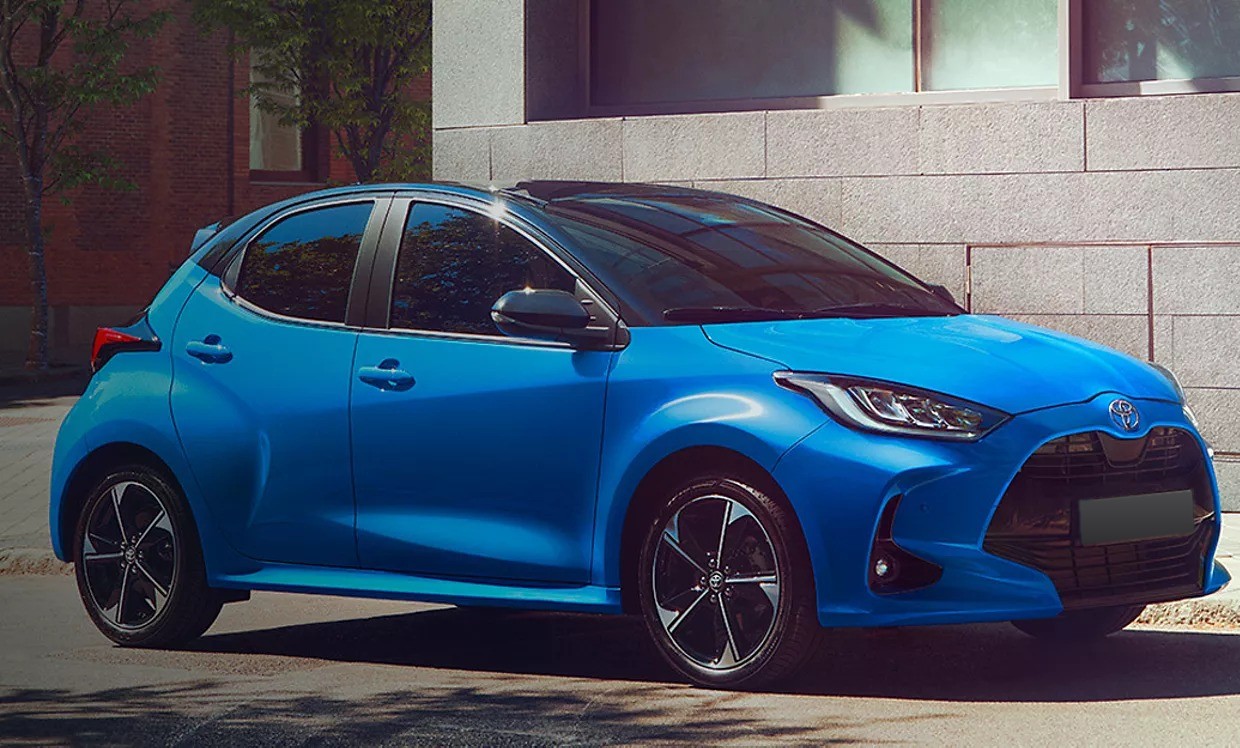
The Toyota Yaris has a reputation as the used car you cannot really get wrong. That reputation is mostly earned. But "a Yaris" covers four quite different cars on Irish forecourts — the little 1.0 petrol, the 1.33 and later 1.5 petrol, the 1.4 D-4D diesel, and the hybrid — across two generations, and each one has its own short list of things worth checking before you hand over money.
This guide covers the third-generation Yaris (2011 to 2020, facelifted in 2014 and 2017) and the fourth generation that arrived here in September 2020. It is not about the Yaris Cross, which is a different car.

No cambelt on any of them
Start with the good news, because it is genuinely useful when you are comparing a Yaris with a Polo, a Clio or a Fiesta. Every engine Toyota fitted to these two generations of Yaris uses a timing chain, not a belt. That covers the 1.0 (1KR-FE), the 1.33 (1NR-FE), the 1.5 hybrid (1NZ-FXE), the 1.4 D-4D diesel (1ND-TV), the fourth-generation 1.5 petrol and hybrid (M15A) and the 1.6 turbo in the GR Yaris.
There is no cambelt job anywhere on a Yaris service schedule, so there is no four-figure belt bill waiting at 100,000 km. A seller's service history is still worth reading carefully, but you are not looking for a belt invoice.
On the hybrid there is a second bonus. The third-generation hybrid uses an electric water pump and has no auxiliary drive belt at all, which removes another common wear item.
The 1.33 is the one engine with homework
The 1.33 Dual VVT-i petrol (1NR-FE), sold from 2011 until the 1.5 replaced it in 2017, has two documented quirks.
- A rattle on a cold start. Toyota's own technical bulletin describes a brief chain rattle on cold start as a characteristic of the engine rather than a fault. Where it persists, the repair is a new chain and a modified tensioner arm. Listen at the viewing with the engine stone cold — ask the seller not to warm it up before you arrive.
- Oil consumption. Early 1NR-FE engines could use oil because of piston rings sticking, sometimes well before 100,000 km. Toyota covered it under a technical bulletin and changed the rings and pistons in early 2013 production. On a 2011 or 2012 1.33, ask whether any engine work was done under that bulletin, and pull the dipstick yourself.
The same engine is also known for carbon build-up that shows as hard starting, a rough idle or long cranking. None of this makes the 1.33 a bad buy; it makes it the one Yaris engine where the history and a cold start matter most.
Four gearboxes, and only one of them is a worry
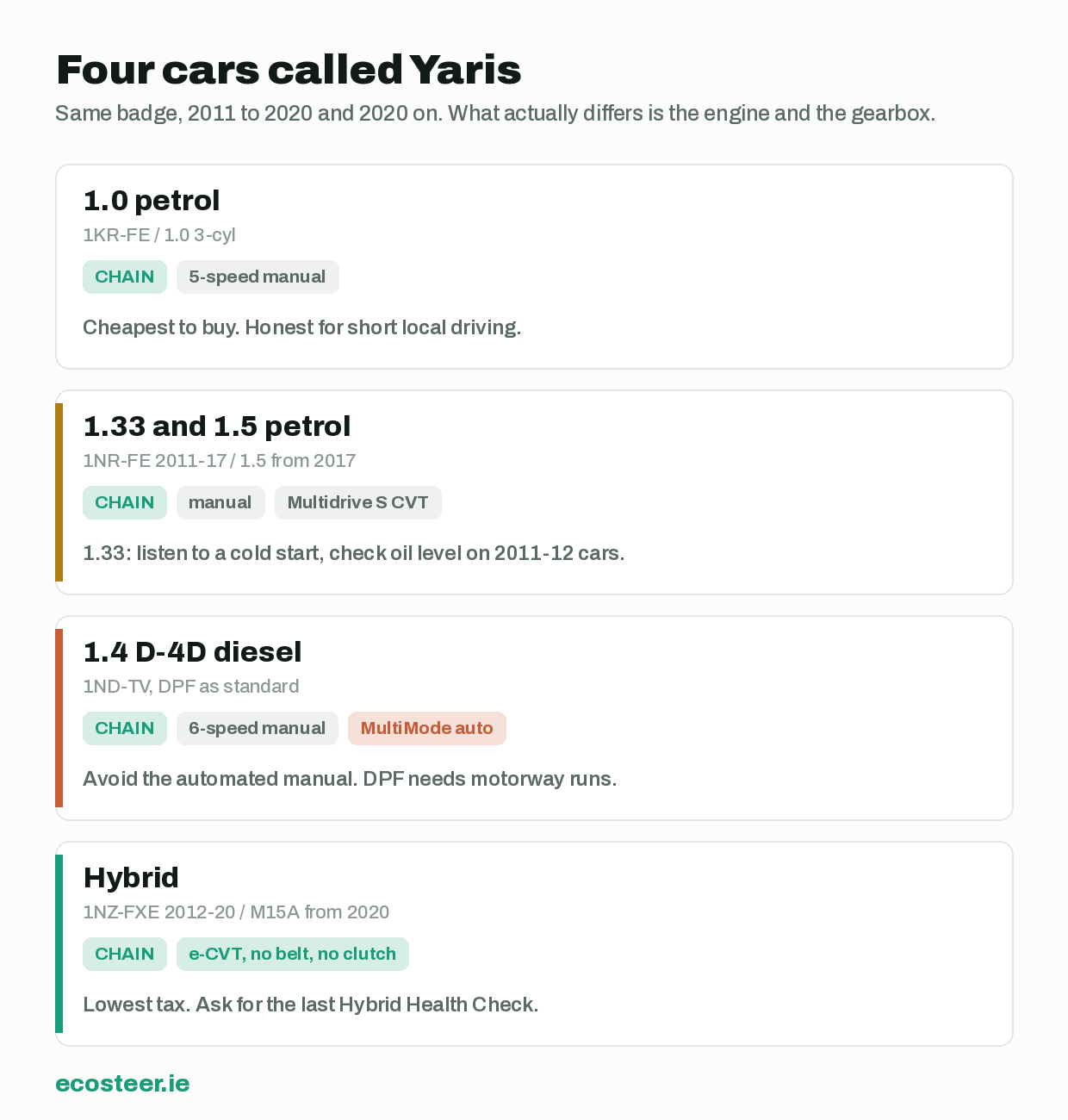
Three different automatic gearboxes were fitted, and they are routinely confused in adverts.
- Multidrive S (1.33 petrol). This is a genuine belt-and-pulley CVT with a seven-step manual mode. It was sold in Ireland, listed at launch as "MultiDrive 7". We could not find a documented pattern of failures for it in the Yaris. Toyota treats the fluid as an inspection item rather than giving a fixed change interval, so a fluid change in the history is a bonus rather than an expectation.
- The hybrid's e-CVT. Despite the name, this is not a belt CVT at all. Toyota's own description is a single casing holding the motor, the generator and a planetary power-split device, with no chains in the reduction gearing. There is no belt and no clutch pack to wear out, and it is the most robust automatic in the range.
- The MultiMode automated manual (1.4 D-4D only). This is a manual gearbox with a robot doing the clutch, and it is the one to be careful with. Owners and specialists report failures of the clutch actuator (worn bushings, burnt motors, worn brushes), rapid clutch wear and ageing position sensors, often logged as fault code P0810. Parts need calibrating with Toyota's diagnostic software after replacement. We could not confirm that Toyota Ireland sold this gearbox here, so if you find one, it may well be an import — treat it with extra caution.
- The fourth-generation 1.5 petrol CVT. A belt CVT with a physical launch gear, fitted to the non-hybrid 1.5 from 2020.
The plain manual gearboxes are the usual five- and six-speed units. On the D-4D, budget for the clutch: one UK owner reported a main-dealer clutch bill of £1,500.
Motor tax, version by version
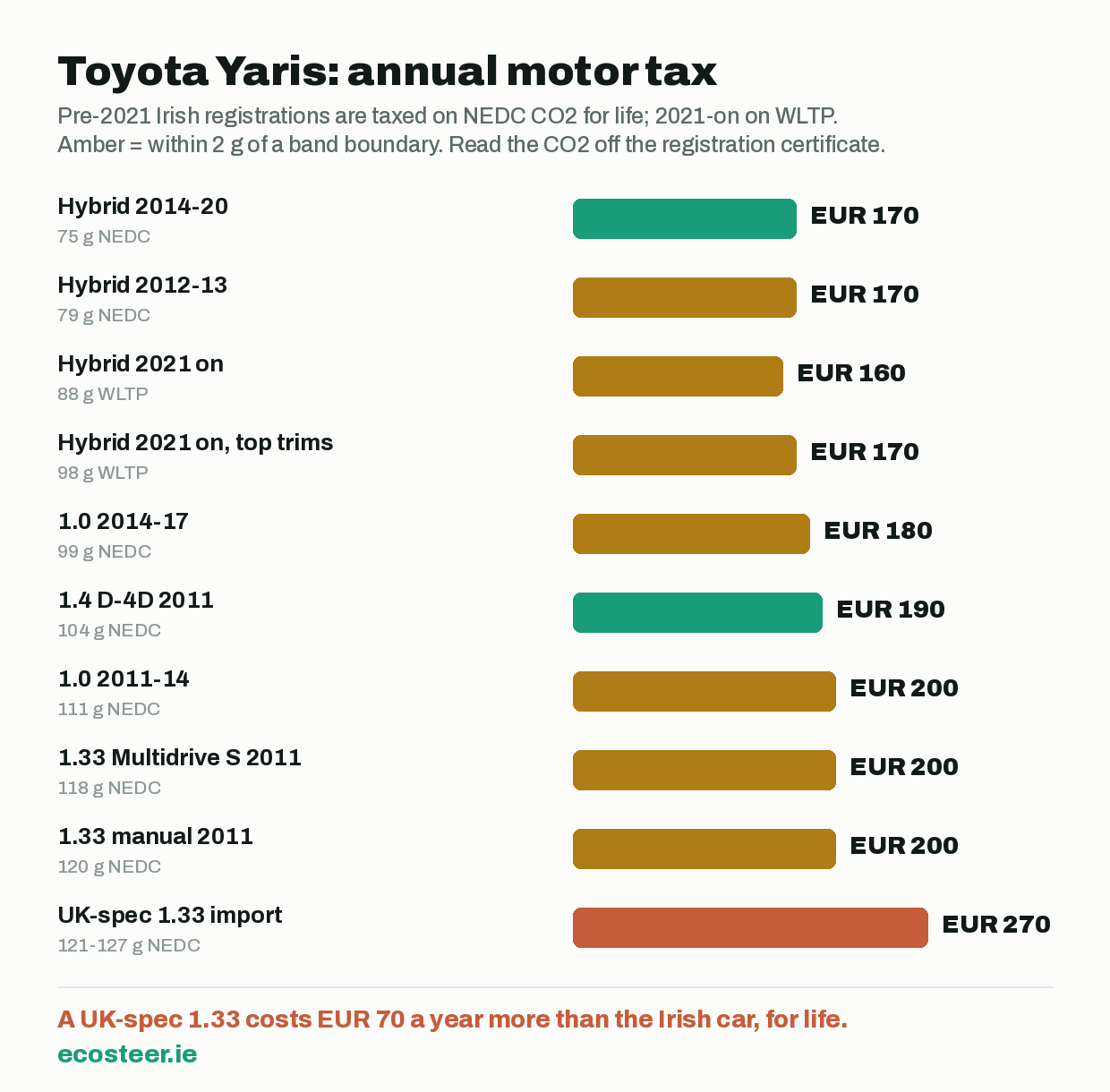
Ireland taxes a car first registered here between July 2008 and December 2020 on its NEDC CO2 figure, for life. A car first registered from January 2021 is taxed on its WLTP figure. For an import, the date of first registration anywhere decides which table applies, not the date it arrived in Ireland.
Most Yaris versions sit low, but a surprising number sit within a gram or two of a band boundary — which is why you should read the CO2 line on the car's own registration certificate rather than trusting a brochure, a review or the advert.
- 1.0, 2011 to 2014: 111 g/km in the Irish launch figures, which is band A4 at €200. Toyota's European figure for the same engine is 110 g/km, which would be A3 at €190. One gram decides it — check the logbook.
- 1.33 manual, 2011: 120 g/km, band A4, €200 — right at the top of the band.
- 1.33 Multidrive S, 2011: 118 g/km, band A4, €200.
- 1.4 D-4D, 2011: 104 g/km, band A3, €190.
- Hybrid, 2012 to 2013: 79 g/km, band A1, €170 — one gram under the A2 boundary.
- 1.0, 2014 to 2017: 99 g/km, band A2, €180 — one gram under 100.
- Hybrid, 2014 to 2020: 75 g/km on most trims, band A1, €170. The 2017 Luna Sport on bigger wheels is 82 to 83 g/km, which puts it in band A2 at €180.
- Fourth-generation 1.0, registered in 2020: 101 g/km NEDC, band A3, €190. The same car registered in 2021 is taxed on its 127 g/km WLTP figure, €200.
- Hybrid, 2021 on: 88 g/km WLTP on the core trims, €160; up to 98 g/km on the better-equipped versions, €170. The Hybrid 130 added in 2023 is 96 g/km, €170.
- GR Yaris, 2021: 186 g/km WLTP, €600.
One trap is worth spelling out. A UK-specification 1.33 was homologated at 121 to 127 g/km, depending on trim. Registered in the 2008–2020 window, that is band B1 at €270 a year — €70 more than the Irish car at 118 to 120 g/km, every year, for as long as it is on the road.
The hybrid battery, and the paperwork that protects it
The third-generation hybrid uses a 144-volt nickel-metal hydride battery. The fourth generation moved to lithium-ion.
Toyota Ireland covers hybrid components, including the battery, for five years or 100,000 km. After that, cover continues through Hybrid Battery Extended Care: each time the car passes a Hybrid Health Check during a service at a Toyota dealer, the battery is covered for another year or 15,000 km, renewable up to the car's fifteenth year. Taxis are limited to five renewals.
The condition that matters to a buyer is continuity. Toyota's wording is that the next service and check must be done before a year or 15,000 km have passed "to ensure that you remain in contract and there is no gap in cover". A hybrid Yaris that has missed a service, or been serviced outside the Toyota network, may have no battery cover at all.
So for any hybrid older than five years, ask for the last Hybrid Health Check report and its date. If the car is a UK import, ask a Toyota Ireland dealer, with the VIN, whether it can join the Irish scheme — we could not find that stated anywhere, and it is not something to assume.
We could not source an Irish price for a replacement hybrid battery, so we are not going to quote one.
Recalls, with the Irish numbers
The Competition and Consumer Protection Commission published Irish volumes for two recalls that touch the cars in this guide:
- Driver airbag inflator, Yaris built January 2015 to January 2017: approximately 6,932 vehicles in Ireland (Yaris and Hilux combined), for an inflator without the moisture-absorbing agent.
- Rear centre seat-belt anchor, Yaris built July to August 2020: 127 vehicles in Ireland.
The EU's Safety Gate system lists several more Yaris campaigns without Irish volumes, including a rear brake fluid leak on 2013 builds, a side-airbag sensor harness that can crack on cars built mid-2014 to early 2017, a front strut mount bearing on 2015 to 2016 builds, a DC-DC converter fault that can shut down the hybrid system on hybrids built February 2018 to April 2019, and a 12-volt battery terminal fault on cars built October 2021 to October 2022 that can cause loss of power steering. A Toyota dealer can check any VIN against all of them in a minute, free of charge.
What to look at on the car itself
- Brakes. Brake fluid leaks at the calipers or the rear brake pipe connectors are a known item, and some third-generation versions have rear drums rather than discs. Brakes are an NCT test item.
- Suspension. Worn suspension mount bearings show as knocking over bumps. Steering and suspension are the single largest NCT failure category nationally.
- Corrosion. Early third-generation cars can show rust at the front crash bar and around the engine mounts.
- Fourth-generation 1.5 petrol. The EGR cooler on this engine can leak coolant into the cylinders; Toyota's bulletin attributes it to fuel quality. Look for unexplained coolant loss and white smoke on start-up.
- Hybrid. A battery that never seems to recover charge, or power that dips under load, needs a Toyota diagnostic check before purchase.
Diesel, petrol or hybrid for Irish driving
Few 1.4 D-4D Yarises were sold here, because the diesel cost noticeably more new — €17,600 at launch in 2011, against €14,760 for a 1.0. Every D-4D has a diesel particulate filter as standard, and a DPF that never sees a sustained run will eventually block and put the car into limp mode. Unless you do regular motorway mileage, there is no case for the diesel in a car this size.
The hybrid is the strongest all-rounder: the lowest tax band, the most robust gearbox, no belt of any kind, and real-world economy in the 3.6 to 4.5 litres per 100 km range in Irish testing of the third-generation car. The plain 1.0 is the cheapest to buy and perfectly honest for short local driving.
What they cost
On 8 October 2026 DoneDeal listed over a thousand Yarises. A sample of asking prices on that day — not an average, and not a valuation:
- 2013 1.0, 69,000 km: €7,950
- 2015 Hybrid, 122,000 km: €10,950
- 2017 Hybrid Luna, 95,000 km, Toyota dealer: €16,950
- 2019 Hybrid Luna, 64,000 km, Toyota dealer: €18,950
- 2022 1.0 Luna, 116,000 km: €13,950
- 2023 Hybrid Luna, 76,000 km: €19,950
If the car came from the UK
A UK Yaris is easy to spot by its trim name. Irish cars were sold as Terra, Aura, Luna, Sol, Lounge, Luna Sport, Premier and Platinum. Names such as TR, SR, Icon, Excel, Design or Dynamic point to a UK car.
If you are importing one yourself rather than buying one already registered here, two figures matter. Revenue charges VAT at 23% on vehicles imported from Great Britain since January 2021. And if no CO2 figure is supplied at registration, Revenue's system assigns 999 g/km, which means the top VRT rate of 41%. Get the CO2 documented before the car leaves the UK.
The short version
- No cambelt on any Yaris in this guide — every engine is chain-driven.
- 1.33 petrol: listen to a cold start, check the oil level, and ask about bulletin work on 2011 and 2012 cars.
- Automatic: the hybrid's e-CVT is the safest; the diesel's automated manual is the one to avoid.
- Tax: read the CO2 off the registration certificate. Several versions sit a gram from the next band, and a UK-spec 1.33 costs €70 a year more.
- Hybrid older than five years: ask for the last Hybrid Health Check. A gap in the service chain can mean no battery cover.
- Short local driving: buy the petrol or the hybrid, not the diesel.
The Yaris deserves its reputation. The trick is knowing which of the four cars you are actually looking at.
Comments
No comments yet — be the first to join the conversation.