Volkswagen Polo in Ireland: belt or chain, the dry DSG, and the motor tax trap
A Polo 1.2 TSI 90 built before the 2014 facelift has a timing chain with a known fault. The same badge after the facelift has a belt. Which engine, which gearbox, and why the 2019-2020 brochure makes the motor tax look up to 320 euro a year dearer than it is.
There are over two thousand Volkswagen Polos for sale in Ireland on any given day, and the badge on the back of one tells you almost nothing about what it will cost you to own.
Here is the clearest example. A "Polo 1.2 TSI 90" built before the 2014 facelift has a timing chain, and it is one of the engines with a documented chain-stretch problem. A "Polo 1.2 TSI 90" built after the facelift has a timing belt, and a completely different set of things to check. Same badge, same power output, same body. Different engine.
This guide is organised around the things that actually decide the bill: which timing drive your car has, whether the gearbox is the dry seven-speed, and what the motor tax really is - because for 2018 to 2020 Polos, Volkswagen Ireland's own brochure prints a CO2 figure that will make you overestimate the tax by up to €320 a year.
Belt or chain: it depends on the engine, not the model year
The Polo generations on Irish forecourts are the fifth generation (type 6R from 2009, facelifted to 6C in 2014) and the sixth (type AW, from 2018). Across those cars, both timing systems were used, sometimes in the same showroom at the same time.
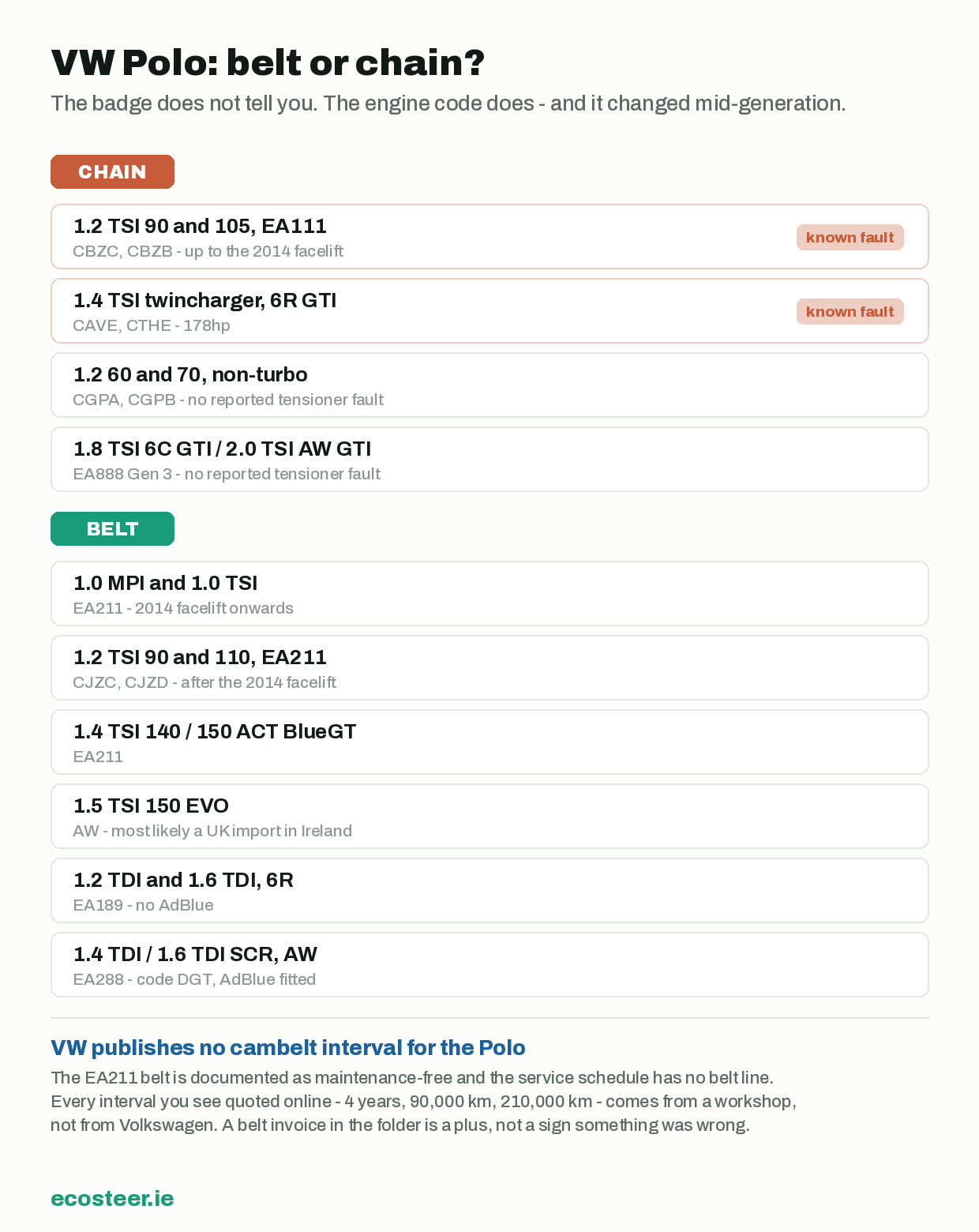
The dividing line is the engine family, not the year:
- EA111 petrol engines - chain. This covers the 1.2 TSI 90 and 105 (codes CBZC and CBZB) fitted to the pre-facelift 6R, and the 1.4 TSI twincharger in the 6R GTI (CAVE, CTHE).
- EA211 petrol engines - belt. This covers everything from the 2014 facelift onwards: the 1.0 MPI, 1.0 TSI 95 and 110, the 1.2 TSI 90 and 110 (CJZC, CJZD), the 1.4 TSI 140 and the 1.4 TSI 150 ACT BlueGT.
- The naturally aspirated 1.2 three-cylinder - chain. The 60 and 70 horsepower non-turbo petrol (CGPA, CGPB) is chain-driven, and is not one of the engines with a reported tensioner problem.
- The 1.8 TSI in the 6C GTI and the 2.0 TSI in the AW GTI - chain. These are EA888 third-generation engines. Volkswagen lists the AW GTI's chain as maintenance-free.
- Every diesel - belt. The 1.2 TDI and 1.6 TDI in the 6R, the 1.4 TDI, and the 1.6 TDI SCR in the AW are all belt-driven. The AW 1.6 TDI SCR is engine code DGT.
The engine code is printed on the vehicle's registration certificate and on the block. On a 2013 or 2014 car that is the single most useful thing you can ask the seller to photograph, because that is the year the changeover happened.
What interval should the belt be done at? Volkswagen does not say
This is worth being precise about, because there is a lot of confident nonsense online.
Volkswagen does not put a cambelt replacement in the Polo's service schedule for the belt-driven petrol engines. Independent VW specialists report that the EA211 belt is documented as maintenance-free, and that the digital service schedule either omits belt replacement entirely or shows a date decades away. A professional technician publication puts it the same way: you will not find "replace timing belt" called out anywhere on the maintenance chart, because Volkswagen's position is that the belt lasts the life of the engine. There is no cambelt interval published on volkswagen.ie for any Polo engine either.
Independent workshops do not accept that. The common recommendation is a visual inspection of the belt at around 160,000 km, and a number of German and UK specialists work to shorter change intervals of their own - figures between 90,000 km and 210,000 km circulate, none of which traces back to a Volkswagen document.
So the honest position for a buyer: if someone quotes you "four years or 40,000 miles" as Volkswagen's figure for a 1.0 TSI Polo, they are quoting a workshop, not Volkswagen. A belt-drive Polo with a belt invoice in the folder is not over-serviced; it is a car whose owner decided not to rely on a design claim. Treat it as a plus, not as evidence something was wrong.
The water pump is not on the timing belt - and that matters
On the EA211 petrol engines the water pump is not driven by the timing belt. It is integrated into the thermostat housing and driven by a separate small toothed belt off the exhaust camshaft, at the other end of the engine. Belt suppliers still advise doing both at the same time, because the labour overlaps.
The practical consequence is a paperwork trap: on a petrol Polo, a water pump invoice does not mean the cambelt was done, and a cambelt invoice does not mean the water pump was done. Read the invoice, not the summary line in the advert. On the 1.6 TDI the pump is a conventional belt-job item and leaks are a known fault, so there the two really should appear together.
One myth to discard while we are here: some used-car articles claim the Polo 1.0 TSI runs a wet belt immersed in engine oil. It does not. Wet belts are a Ford EcoBoost and PSA PureTech design. The EA211 belt runs dry.
The chain engines that actually fail
Two Polo engines have a well-documented timing chain problem, and neither of them is a modern car.
The 1.2 TSI EA111. A major parts manufacturer states that 1.2 TSI engines built before October 2011 (codes CBZA, CBZB, CBZC) are susceptible to chain elongation; the warning sign is a rattling noise from the engine bay, and the worst case is the valves meeting the pistons. The revised parts introduced after 2011 use a wider chain, redesigned sprockets and a larger tensioner, and properly maintained post-2011 engines are described as not susceptible. Other independent sources widen the risk window to roughly 2009 to 2014 and report failures at surprisingly low mileage. Replacement is quoted at €700 to €1,300 in mainland Europe; Irish labour rates apply on top of that.
There is also a Volkswagen service action referenced against this fault, TPI 15D8. We could not retrieve the document itself, so treat that number as something to quote to a dealer when asking whether a specific VIN is covered, not as a promise that it is.
The 1.4 TSI twincharger in the 6R GTI. Chain problems on this engine were commonplace, with defective tensioners causing stretch and engine damage, in some reported cases within the first 20,000 km. Volkswagen improved the chain drive during 2010. Repair is quoted at €700 to €1,400 if the chain has not jumped, and €2,000 to €6,000 or more if it has. Volkswagen goodwill coverage for the fault had ended by 2018.
There is one recall that is genuinely a timing-drive recall, and it applies to the belt engines rather than the chain ones. Volkswagen code 15H2, published in August 2019, covers Polos built between December 2013 and March 2015 with EA211 engines: the belt pulley on the cam gear could break and the camshaft adjuster screws could loosen, dropping engine oil onto the road. Worth a VIN check on any 2014 or 2015 petrol car.
The dry seven-speed DSG, and the campaign most sellers have never heard of
If the Polo you are looking at is an automatic, find out which gearbox it has. The seven-speed DSG in the Polo is the DQ200, a dry-clutch unit. It is not the same as the wet-clutch DSG in bigger Volkswagens, and it does not behave the same way.
Two things follow from that.
First, there is no scheduled oil service. Volkswagen designates the DQ200 as lubricated for life. Specialists disagree and change the gearbox oil anyway, typically around 100,000 km, to protect the selector fork bearings. Volkswagen Ireland's own inspection and service page says nothing about DSG oil at all. So a DQ200 Polo with no gearbox service history is not a neglected car by Volkswagen's standards - but a DQ200 Polo with a gearbox oil change in the folder has had money spent on it that the schedule never asked for.
It is worth knowing that the DQ200 has two separate fluid circuits - gearbox oil and mechatronic hydraulic fluid - which use different products. Mixing them destroys seals. This is a job for someone who has done it before.
Second, there is a Volkswagen campaign. Campaign 35E5 covers the DQ200 fitted to vehicles produced from October 2008 to November 2014, including the Polo. Over time the pressure accumulator in the mechatronic unit can crack, the unit loses hydraulic pressure, and the car loses drive. The remedy is inspection, replacement of the faulty hydraulic components and a control unit software update, free of charge, at around four hours of labour. If you are looking at a 6R DSG, this is the single question to put to a Volkswagen dealer with the VIN.
The failure has a recognisable signature on a diagnostic scan. The codes to look for are P17BF, P189C, P1895, P0841, P0562 and P1604. Symptoms are no drive or no reverse, dropping out of gear, a transmission warning light, and limp mode. A pre-purchase scan on an automatic Polo is not optional.
Dry clutch packs themselves are quoted at 120,000 to 180,000 km of life, shorter in heavy city use. European specialist prices, for comparison rather than as Irish quotes: mechatronic replacement at a dealership €1,800 to €2,500; a reinforced accumulator repair kit under €300 in parts; clutch replacement from around €1,200; a DSG oil change around €150. We could not source an Irish garage quote for any of these, so treat them as continental comparators with Irish labour on top.
Motor tax, and the 2018 to 2020 brochure trap
Ireland runs two CO2-based motor tax tables. A car first registered here between July 2008 and December 2020 is taxed for life on its NEDC CO2 figure. A car first registered from 1 January 2021 is taxed on its WLTP figure. The original registration date decides which table applies, including on imports - a car first registered abroad in 2019 is taxed on the NEDC table even if it lands in Ireland years later.
For most Polos the news is good, because the 1.0 and 1.2 petrols sit low. Irish road tests give these figures:
- 1.2 TSI 90 Comfortline Plus (2014 facelift): 110 g/km, band A3, €190
- 1.0 MPI 75 Beats (2016): 108 g/km, band A3, €190
- 1.4 TSI ACT 150 BlueGT (2015): 110 g/km, band A3, €190
- 1.0 TSI 95 DSG (2017): 105 g/km, band A3, €190
- 1.0 MPI 65 Comfortline (2018): 108 g/km, band A3, €190
- 1.6 TDI 95 SCR (2017-18): 97 g/km, band A2, €180
- GTI 2.0 TSI 200 DSG (2018): 134 g/km, band B2, €280
Notice that three of those figures are exactly 110 g/km. That is the top of band A3. One gram more and the car is band A4 at €200 - and a different wheel size, a different trim or a DSG instead of a manual is enough to move it. On a pre-facelift 1.2 the risk is larger: one Irish road test of a 1.2 70hp recorded 128 g/km, which is band B1 at €270, only two grams above the band boundary at 130. Never quote Polo tax from the badge.
Why a 2019 or 2020 Polo looks dearer to tax than it is
This is the part worth reading twice, because it is the most common way an Irish buyer mis-prices one of these cars.
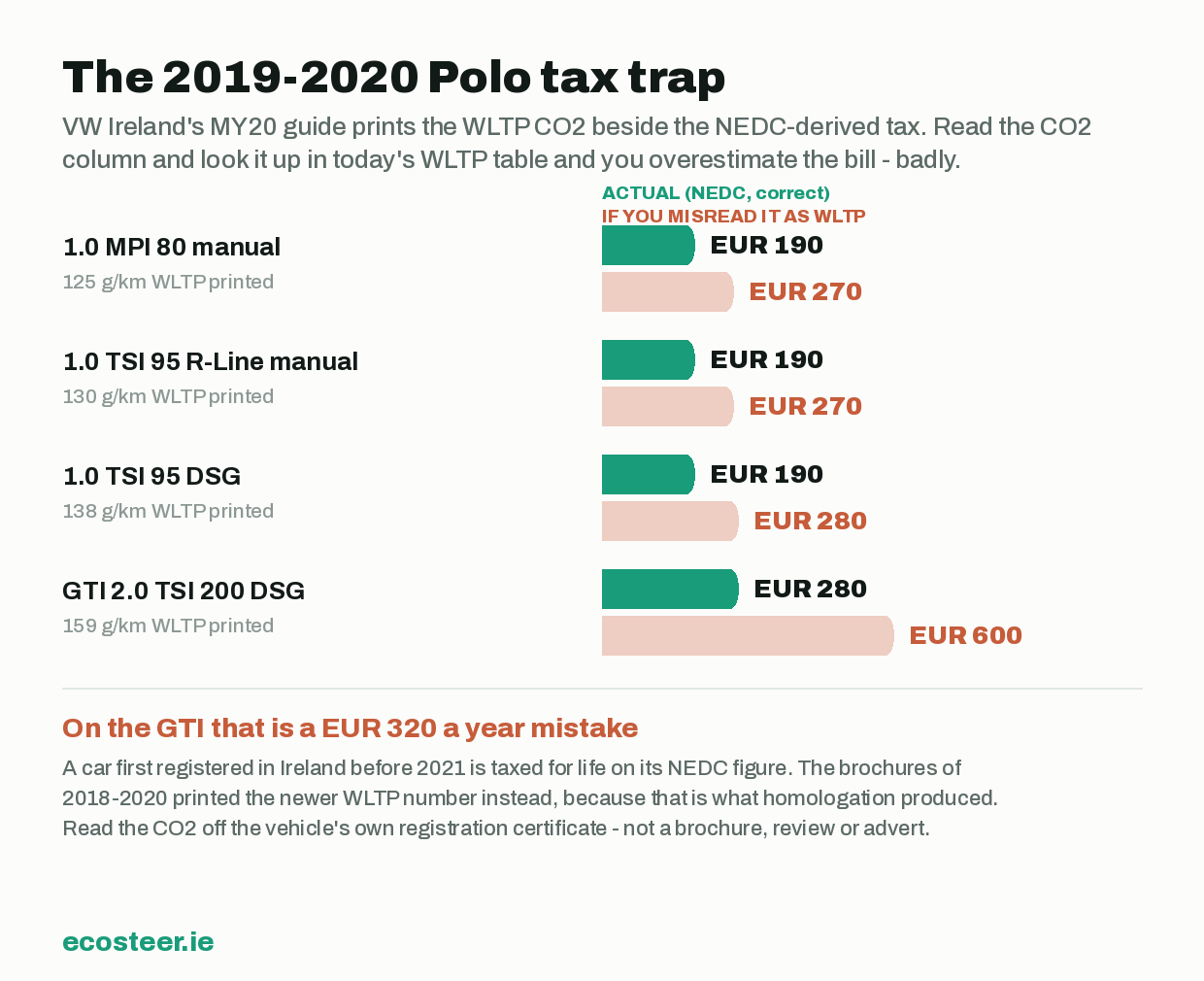
Volkswagen Ireland's own MY20 Polo product guide prints the WLTP CO2 figure in one column and the NEDC-derived annual tax in the next. The two do not correspond, and if you take the CO2 number and look it up in today's WLTP table you get a much bigger figure:
- 1.0 MPI 80 manual: brochure prints 125 g/km and €190. Read as WLTP, 125 g/km would be €270.
- 1.0 TSI 95 DSG: brochure prints 138 g/km and €190. Read as WLTP, that would be €280.
- 1.0 TSI 95 R-Line manual: brochure prints 130 g/km and €190. Read as WLTP, €270.
- GTI 2.0 TSI 200 DSG: brochure prints 159 g/km and €280. Read as WLTP, that would be €600.
The €190 and €280 figures in the brochure are the correct ones for a 2020 Irish registration, because they come from the car's NEDC-correlated value - roughly 108 g/km for the MPI and around 139 for the GTI - not from the WLTP number sitting beside them. On the GTI the gap between the two readings is €320 a year, every year, for as long as the car is on the road.
So: for any 181, 182, 191, 192, 201 or 202 Polo, do not take the CO2 figure from a brochure, a review or a dealer advert. Read it off the vehicle's own registration certificate. It takes thirty seconds and it is the difference between walking away from a car and buying it.
2021-on cars
From 2021 the figures map straight onto the WLTP table and the picture is simple. Across the MY22, MY24 and MY25 Irish guides the pattern is consistent: 1.0 MPI 80 manual around 119 to 124 g/km; 1.0 TSI 95 manual 116 to 119 g/km, which is €190; 1.0 TSI 95 DSG 121 to 127 g/km, which is €200. The manual-versus-DSG difference is only €10 a year, but it is real and it holds across every model year.
One caution: the MY25 guide contains two figures that do not match the published table - it shows €200 against 119 g/km and €190 against 123 g/km, where the table gives €190 and €200 respectively. Those look like brochure errors. Under the current table, 111 to 120 g/km is €190 and 121 to 130 g/km is €200. Again: tax off the certificate.
Recalls, with the Irish numbers
The Polo has a long recall list across these generations. These are the ones with published Irish volumes from the Competition and Consumer Protection Commission, which is a far better source than a US campaign number:
- Parking brake, 2016 to 2018 build. Wear of the brake lining and settlement of the rear drum brake causing inadequate parking brake function. Approximately 2,000 cars in the Republic of Ireland. Volkswagen code 46H9.
- Brake booster, built 22 September 2019 to 6 February 2020. Incorrectly closed non-return valves in the vacuum lines allow oil into the brake booster and damage its membrane, which can cause loss of braking assistance. Approximately 1,093 cars in the Republic of Ireland. Volkswagen code 47P7.
- Towing eye, built 1 October 2015 to 29 October 2017. A poorly welded towing eye that could break off during towing. Approximately 4,021 Polos in Ireland.
- 1.2 TDI fuel filter cover, 2010 to 2014. Engine vibration cracking the fuel filter cover, with a fuel smell in the cabin and, in extreme cases, a fire risk. 1,256 Polo 1.2 TDIs in Ireland, repaired free of charge.
- Cam gear belt pulley, built December 2013 to March 2015, EA211 engines - the timing-drive recall described above. Volkswagen code 15H2.
Separately, Takata airbag campaigns touch the Polo repeatedly across model years from 2005 to 2017, and again on 2022 to 2025 cars for a different gas generator fault. Volkswagen Ireland runs a VIN check for the Takata campaigns, for the natural gas campaign, and for the EA189 diesel matter - which in a Polo means the 6R 1.2 TDI and 1.6 TDI. Two recall checks cost nothing and both of the brake campaigns above are NCT test items.
Diesel, petrol, and short Irish journeys
Be blunt about this one. A diesel Polo is the wrong car for a fifteen-minute commute.
On the 6R 1.6 TDI, DPF clogging has been observed at 70,000 to 80,000 km on cars used exclusively for urban running, because short trips never let the engine reach its operating temperature. EGR valve clogging goes with it. The 75 horsepower version puts additional strain on the DPF and turbo. If your driving is city-only, the 1.0 MPI or 1.0 TSI petrol is the correct answer, not a diesel with a cheaper tax disc.
Petrol cars are not entirely exempt. The later 1.0 TSI has a petrol particulate filter, which also regenerates more often in city-only use, driving consumption up and eventually triggering emissions warnings. A twenty to thirty minute run at steady speed every few hundred kilometres is the cheap preventative. Full filter replacement is quoted at €1,000 to €1,800 in Europe.
AdBlue depends on the generation. The 6R diesels - the 1.2 TDI and the 1.6 TDI EA189 - have no SCR system and no AdBlue. The AW 1.6 TDI does: Volkswagen describes both the 80 and 95 horsepower versions as having an SCR catalytic converter, with an 11-litre AdBlue tank alongside the DPF. If you are told a diesel Polo "doesn't need AdBlue", check which generation you are standing in front of.
Oil consumption, honestly
Volkswagen's own stated threshold for normal oil consumption is around half a litre per 1,000 km, and the owner's manual permits up to one litre per 2,000 km. That is a high bar, and it means "it uses a bit of oil" is not automatically a fault.
Where it is a documented defect is the 6R GTI's 1.4 TSI, with a piston ring design issue and reports of up to a litre per 1,000 km, alongside cracked pistons from low-speed pre-ignition. On the 1.0 TSI, oil use is better described as a characteristic of small three-cylinder turbos than a defect: it is typically noticed past 60,000 to 80,000 km and especially on motorway cars, and the sensible response is to check the level every 1,000 to 1,500 km and service sooner than the long official interval. On the 1.2 TSI EA111, rising oil consumption is more often a symptom of chain stretch than a problem in its own right.
At the viewing: pull the dipstick yourself, note where the level sits, and ask when oil was last topped up.
Wear items and NCT points specific to the Polo
Nationally, the three biggest NCT failure causes are tyres at 14.3% of tests, suspension at 10.9% and steering at 8.5%, across nearly 1.75 million tests. Tyres alone have risen sharply. On a Polo specifically, the recurring items reported by specialists are:
- Sill corrosion from road salt and debris behind the mud flaps, which is a structural NCT item and an expensive repair. Look hard at this on a coastal car.
- Mirror indicator failure from water getting into the LED units - a lighting item at the test.
- Cracked gearbox mount (the aluminium link), a broken engine mount bolt on GTI and TDI cars, and on the 6C a factory-related engine mount frame weld that cracks.
- Power steering pump failure, where fluid leaks reach the electronics and assistance disappears.
- On the 6R 1.6 TDI: rear axle bearings and bushes knocking, water pump leaks before belt intervals, injector copper seal degradation showing as black oily residue around the injectors, and a dual-mass flywheel life of 150,000 to 200,000 km.
- An assortment of electrical nuisances: boot lid harness chafing at the hinge, boot lock microswitches, window regulator cables, blower motor and resistor, and corroded window switch panels.
For reference, the NCT is first due at four years old, then every two years to ten years and annually after that. The test is €55 and a retest €28.
If it is a GTI
The three Polo GTIs are three different cars, and the differences are all mechanical.
The 6R GTI (2010 to 2014) is the one to be most careful with. It is the 1.4 TSI twincharger at 178 bhp and 250 Nm, and it was sold with the seven-speed DSG only - no manual was offered. That gearbox is the dry DQ200, which specialists rate at around 250 Nm, so the car sits exactly at the gearbox's rated ceiling with no manual alternative. Combine that with the EA111 chain tensioner history and the documented oil consumption and this is the highest-risk Polo of either generation.
The 6C GTI (2015 to 2017) is the 1.8 TSI at 190 bhp, chain-driven EA888. The six-speed manual gets the engine's full 320 Nm; the seven-speed DSG is limited to 250 Nm. Same quoted 0 to 100 km/h time, but a torque-capped gearbox.
The AW GTI (2018 to 2020) is the 2.0 TSI at 200 PS with 320 Nm from 1,500 rpm, and importantly it uses a six-speed DSG - the wet-clutch unit, not the DQ200. Chain drive, listed as maintenance-free. 134 g/km NEDC, band B2, €280 a year.
One import note: Volkswagen Ireland's MY22, MY24 and MY25 product guides contain no GTI at all, and no Irish guide lists the facelift 207 horsepower GTI. A facelift GTI on Irish plates is most likely an import, so confirm how and when it was registered here.
The short version
- Get the engine code. On a 2013 or 2014 car it decides whether you are looking at a chain engine with a known fault or a belt engine without one.
- Pre-October-2011 1.2 TSI: listen for a rattle at start-up and budget for the chain if there is no history.
- Belt engines: Volkswagen publishes no interval. A belt invoice is a plus, and a water pump invoice is not the same thing.
- Automatic: establish it is the DQ200, check campaign 35E5 against the VIN if it is a 2008 to 2014 car, and get a diagnostic scan.
- Pre-2021 car: read the CO2 off the registration certificate. On a 2019 or 2020 Polo the brochure figure will mislead you by up to €320 a year.
- City-only driving: buy the petrol.
- Two free checks: the recall VIN check and a look underneath at the sills.
The Polo earns its reputation. It just isn't one car, and the paperwork is what tells you which one you are buying.
Comments
No comments yet — be the first to join the conversation.