Skoda Kodiaq in Ireland 2026: The Seven-Seater Sum That Still Adds Up
The Kodiaq is the only true seven-seater left in Ireland's top ten. Here is the Irish arithmetic - what the third row actually costs you in boot space, why the PHEV has double the battery of its rivals, 2,500kg of towing, five-year running costs, and the one service item that decides whether a used one is a bargain or a bill.
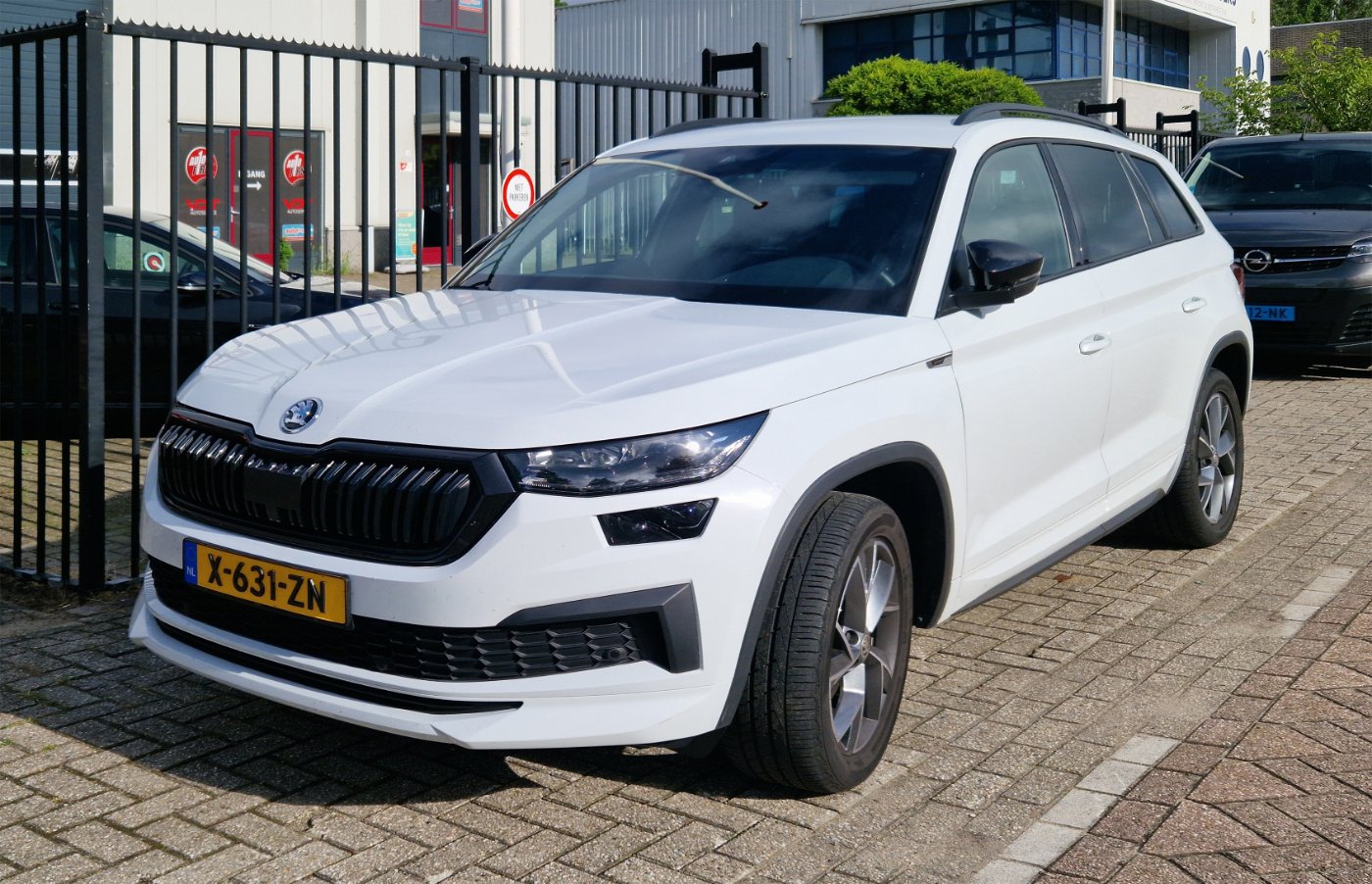
Skoda Kodiaq. Photo: Renee Kools, CC BY 4.0.
The Skoda Kodiaq is the only genuine seven-seater still holding a place in Ireland's top ten. Every other car up there - the Yaris Cross, the Tucson, the Sportage, the Corolla - seats five and stops there. If you have three children, or two children and grandparents who need collecting, the shortlist gets very short very quickly.
Here is the Irish arithmetic on what the Kodiaq actually costs, what the third row really gives you, and the one line in the service book that decides whether a used one is a bargain or a bill.
The boot maths nobody explains in the showroom
A seven-seater is really three cars depending on which seats are up. The Kodiaq is unusually honest about it:
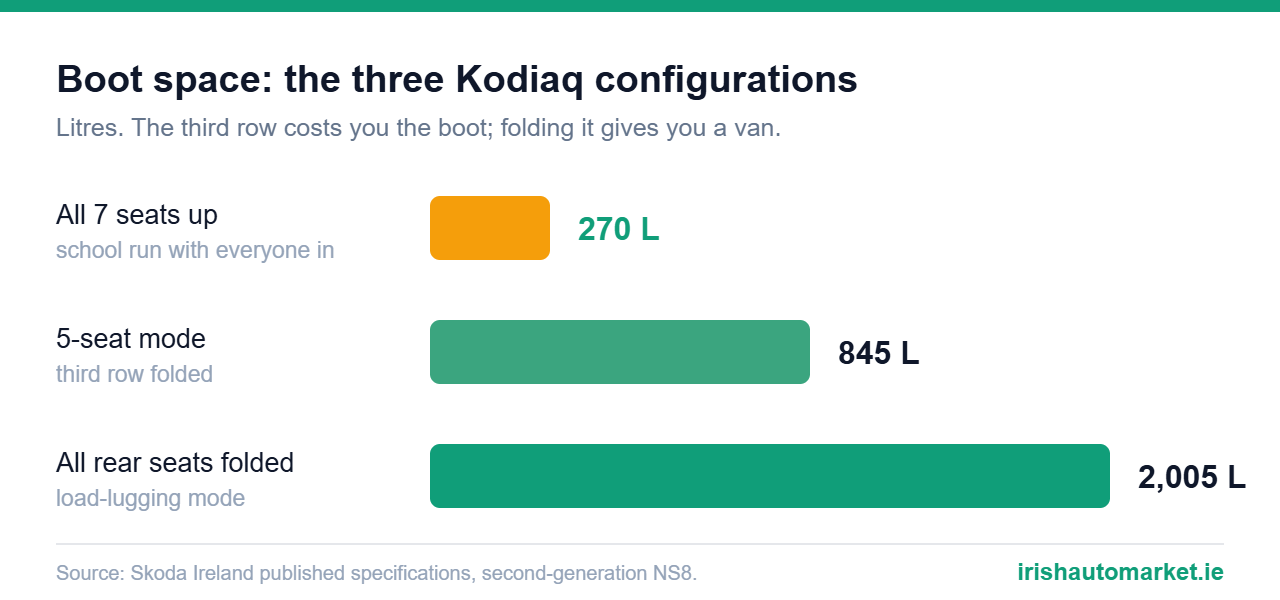
With all seven seats in use you get 270 litres. That is a couple of soft bags and a folded buggy - not a week's shopping for seven people. Fold the third row and you are at 845 litres, which is considerably more than a typical mid-size family SUV manages with five seats.
The realistic pattern for most Irish families: third row up for the school run and the occasional extra passengers, folded flat the other 90% of the time. Bought that way, the Kodiaq is a very large five-seater that happens to seat seven when it has to.
Is the third row actually usable?
For adults up to around 1.80m, yes - on trips under about 45 minutes. Beyond that both headroom and legroom start to tell. Children are fine indefinitely. If you regularly carry seven adults on long journeys, the larger Korean seven-seaters have more third-row space, though they cost several thousand euro more and tow considerably less.
Which engine, and why the PHEV is unusual
| Engine | Power | Real fuel use | Motor tax | Towing (braked) |
|---|---|---|---|---|
| 2.0 TDI 150 | 150hp | 6.0-6.5 L/100km | EUR 270 (148 g/km) | 2,300 kg |
| 1.5 TSI MHEV | 150hp | 7.0-7.5 L/100km | Check motortax.ie | 2,000 kg |
| 2.0 TDI 200 4x4 | 193hp | 6.5-7.0 L/100km | Check motortax.ie | 2,500 kg |
| 1.5 TSI iV PHEV | 204hp | use-dependent | ~EUR 140 | 2,000 kg |
The PHEV deserves a proper look. Most plug-in hybrid family SUVs carry a battery of 13 to 15 kWh, which buys you 50 to 60 kilometres of electric range. Skoda fitted the second-generation Kodiaq with 25.7 kWh - roughly double - for around 110km WLTP of electric running. It also takes 50 kW DC charging, which is a first for a Skoda plug-in.
The practical consequence: a typical Irish daily round trip of 30 to 60 kilometres runs almost entirely on electricity. It behaves less like a conventional plug-in hybrid and more like a short-range EV with a petrol engine for the long weekends. That is only true if you charge it, of course - and that is the whole ballgame with any plug-in.
Towing: where the Kodiaq is genuinely in a different class
The 2.0 TDI 200 4x4 tows 2,500 kg braked. For context, the mainstream hybrid family SUVs sold in Ireland mostly sit at 1,500 to 1,650 kg. If you have a caravan, a horse box or a plant trailer, that gap is not a detail - it is the decision.
What it costs to run
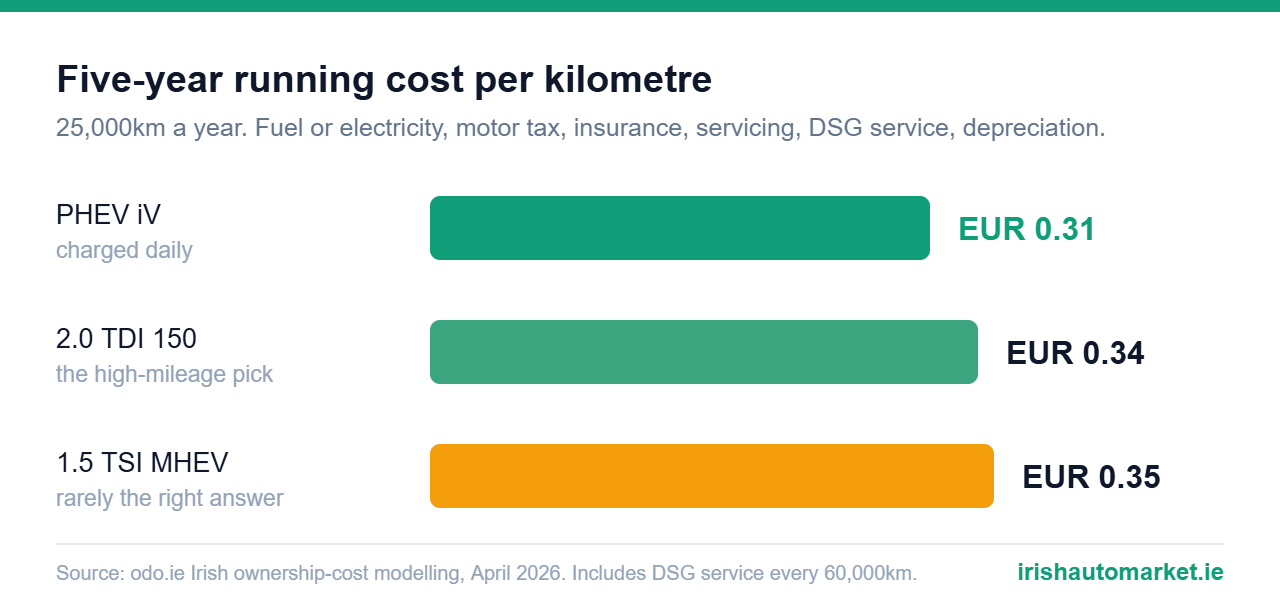
Annual cost at 25,000km
| Item | 2.0 TDI 150 | PHEV (charged daily) |
|---|---|---|
| Fuel / electricity | ~EUR 2,800 | ~EUR 1,400 |
| Motor tax | EUR 220 | EUR 140 |
| Insurance | EUR 800-1,500 | EUR 900-1,600 |
| Servicing (incl. AdBlue) | EUR 380-480 | EUR 420-520 |
The PHEV comes out cheapest over five years - but only with charging discipline. Without a home charger you are carrying 250kg of battery for nothing, and the diesel becomes the obvious choice. Be honest with yourself about that before you sign.
The service item that decides everything on a used one
The Kodiaq uses a DSG automatic gearbox. It needs an oil service every 60,000km. That costs EUR 180-280 at a dealer, or EUR 120-180 at a competent independent.
Skip it, and the clutches and the mechatronic unit wear. A failed mechatronic is a EUR 2,000-plus repair. When you look at a used Kodiaq, the DSG stamp in the service book is not a nice-to-have - it is the single most valuable line in the document. A car with it is cheap to keep. A car without it is a gamble with a known price.
The rest of the used checklist
- Work both third-row seats through the full fold mechanism. Issues here are common on high-mileage cars.
- On diesels: ask about the driving pattern. A city-only diesel with an unhappy particulate filter can fail the NCT smoke test.
- On the PHEV: ask for the MySkoda charging logs. If the previous owner never plugged it in, you are buying a heavy petrol car.
- If a tow bar is fitted, ask what was towed and how often. Regular towing near the limit accelerates wear on everything.
- Skoda dealer service stamps for warranty validity, and check the VIN for outstanding recalls at skoda.ie.
- 12V battery age - typically weak by year five, and the usual cause of a dashboard full of frightening warnings that a EUR 120-180 part clears.
Trims: where the value sits
Irish pricing runs from around EUR 44,000 for Selection up to roughly EUR 55,000 for the Laurin & Klement flagship. Ambition is the value pick at about EUR 48,000 - heated front seats, virtual cockpit, wireless charging, 18-inch wheels. Sportline adds styling and a firmer ride. Laurin & Klement adds genuine luxury but the price gap is hard to justify unless you specifically want the Nappa leather and ventilated seats.
One thing to check at order time: confirm the third row is actually specified. Buying a Kodiaq without it rather defeats the exercise.
NCT notes
- Generally good first-time pass rates - VW Group build quality holds up.
- Tyre wear on 19 and 20-inch wheels. Rotate every 10,000km.
- Diesel particulate filter - if the car only ever does short urban trips, expect trouble at the smoke test. Give it a proper motorway run before you book.
- Engine warning light is an automatic fail under Phase 2. Run an OBD scan first.
The Road Safety Authority and NCTS publish the full criteria, and motor tax for any registration can be checked at motortax.ie.
The verdict
The Kodiaq is the sensible answer to a problem that does not have many sensible answers. Genuine seven-seat capability, a boot that becomes enormous when you fold the third row, towing that nothing else in the price bracket approaches, and a plug-in version with double the usual battery.
Buy the 2.0 TDI 150 in Ambition trim if you cover real distance or tow. Buy the PHEV if you have a home charger and the discipline to use it. Budget for the DSG service every 60,000km and it will be a cheap car to keep for the seven or eight years your family actually needs the extra seats.
Buying? Browse Skoda listings on Ecosteer.
Selling? Place your ad on Ecosteer - free for cars under EUR 3,000, ultra-low fees above that.
Dealers: Join the Ecosteer dealer network or call +353 87 170 8603.
Sources: SIMI new car registration data 2026; Irish ownership-cost data Skoda Kodiaq Ireland guide, April 2026; Skoda Ireland published specifications for the second-generation NS8; Department of Transport motor tax CO2 schedule; Euro NCAP. Lead photo by Renee Kools, licensed CC BY 4.0 via Wikimedia Commons. Figures are general guidance - verify motor tax on the specific registration at motortax.ie and current pricing with Skoda Ireland before purchase. Not affiliated with Skoda Ireland. This article is information, not financial advice.
External sources for the Skoda Kodiaq in Ireland
- Skoda Ireland — Kodiaq model page and downloadable Irish price list
- CompleteCar.ie — Skoda Kodiaq 2.0 TDI (2024) review: Irish pricing, 148 g/km CO2 and full technical specifications
- CompleteCar.ie — Motor road tax prices in Ireland explained
- motortax.ie — check the exact tax due on a specific registration
- Road Safety Authority — vehicle owner information
- NCTS — National Car Test criteria
Motor tax note: the 2.0 TDI 150 is rated at 148 g/km WLTP, which places it in the 141-150 g/km band at EUR 270 per year under the post-2021 schedule. Always confirm the figure for the exact registration on motortax.ie before you buy.
Comments
No comments yet — be the first to join the conversation.