Skoda Octavia Ireland Buyer Guide: The Automatic With No Service Interval Is the One to Check
Ireland's second best-selling car has two very different DSG gearboxes, and the one Skoda says never needs a fluid change is the one with the expensive failure record. Motor tax bands, diesel versus petrol, and the checks to do before you buy.
The Skoda Octavia was Ireland's second best-selling new car in 2025, behind only the Hyundai Tucson. That matters to you as a used buyer for a simple reason: there are a lot of them, they arrive on the market in a steady stream, and you can afford to be fussy about which one you take.
Being fussy on an Octavia mostly means being fussy about the gearbox. And there is a quirk here that catches people out. Skoda fits two completely different automatics to this car, and the one the manufacturer says never needs a fluid change is the one with the expensive failure reputation. The one with a proper service schedule is the tougher unit. Most buyers assume the opposite.
Skoda Octavia Ireland overview
The fourth-generation Octavia (2020 onwards) is the one you will find most of on forecourts now, with plenty of the third-generation car (2013-2020) underneath it at lower money. Both are built in Mlada Boleslav in the Czech Republic on the VW Group MQB platform, which is the same architecture as the Golf. In practice that means parts are everywhere and any independent garage that touches VWs can work on it.
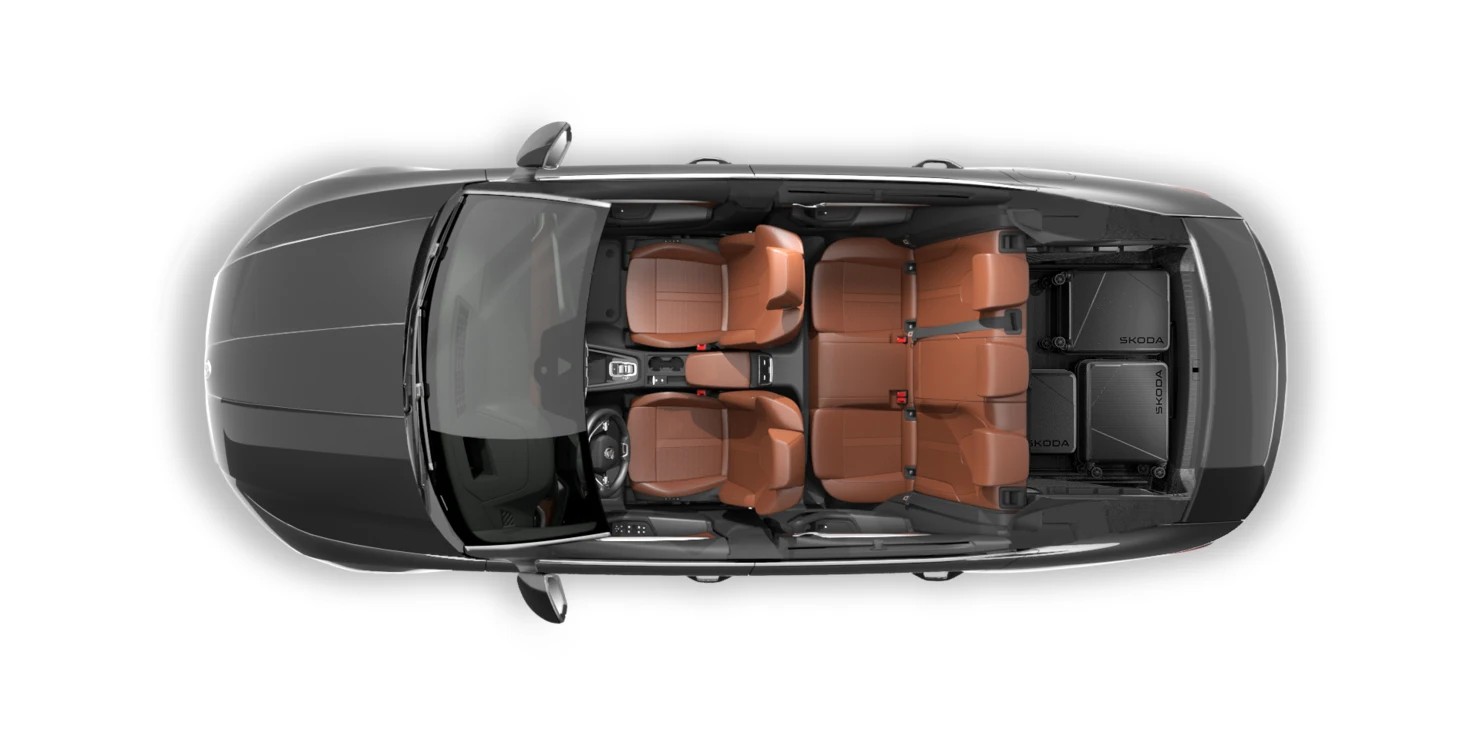
The numbers that sell the car are the boot figures. The hatchback holds 600 litres with the rear seats up, rising to 1,555 litres folded. The Combi estate holds 640 litres, rising to 1,700. For context, that hatchback boot is bigger than most mid-size SUVs manage, which is the whole argument for buying an Octavia instead of a crossover.
There is no seven-seat Octavia. If you need seven, that is Kodiaq territory — we covered the running costs of that one in our Skoda Kodiaq seven-seater guide.
Skoda Octavia engine options and Irish running costs
The 2.0 TDI diesel
The 150hp 2.0 TDI is the long-distance choice and it is the most efficient engine in the range on paper: around 4.2 litres per 100 km combined and roughly 110 g/km of CO2 on the WLTP test. On a car doing motorway miles it is still hard to beat, and in Ireland it also happens to sit in a slightly cheaper motor tax band than the petrol.
The condition attached is the usual one. A diesel that lives on school runs and short town trips will give you diesel particulate filter trouble, and an Octavia is no exception. If the car you are looking at has 30,000 km on it after four years, ask hard questions about what kind of 30,000 km they were.
The 1.5 TSI petrol
The 150hp 1.5 TSI is the sensible default for anyone not doing big mileage: around 5.3 litres per 100 km and roughly 120 g/km in hatchback manual form. The mild-hybrid e-TEC version with the automatic gearbox is actually a little cleaner again, at about 114 g/km in Combi form, because the 48-volt system lets the engine shut off while coasting.
It is a smooth, quiet engine and it suits the car. The 1.0 TSI three-cylinder below it is fine in a lighter car but feels stretched in an Octavia carrying a family and luggage.
Where the Octavia falls short
It is a deeply competent car rather than an exciting one, and nobody buys an Octavia for the steering. Two more honest criticisms: the fourth-generation car moved most of the climate controls into the touchscreen with a temperature slider that is genuinely awkward to use on the move, and early 2020-2021 cars shipped with buggy infotainment software. Later cars and software updates improved it, but check that the screen you are looking at behaves itself on the test drive rather than assuming it has been fixed.
Road noise on coarse Irish surfaces is also more noticeable than in a Golf, particularly on the larger alloy wheels.
Skoda Octavia motor tax in Ireland
Motor tax on any car registered in Ireland from July 2008 is based on CO2, and cars registered from January 2021 use the newer WLTP bands.
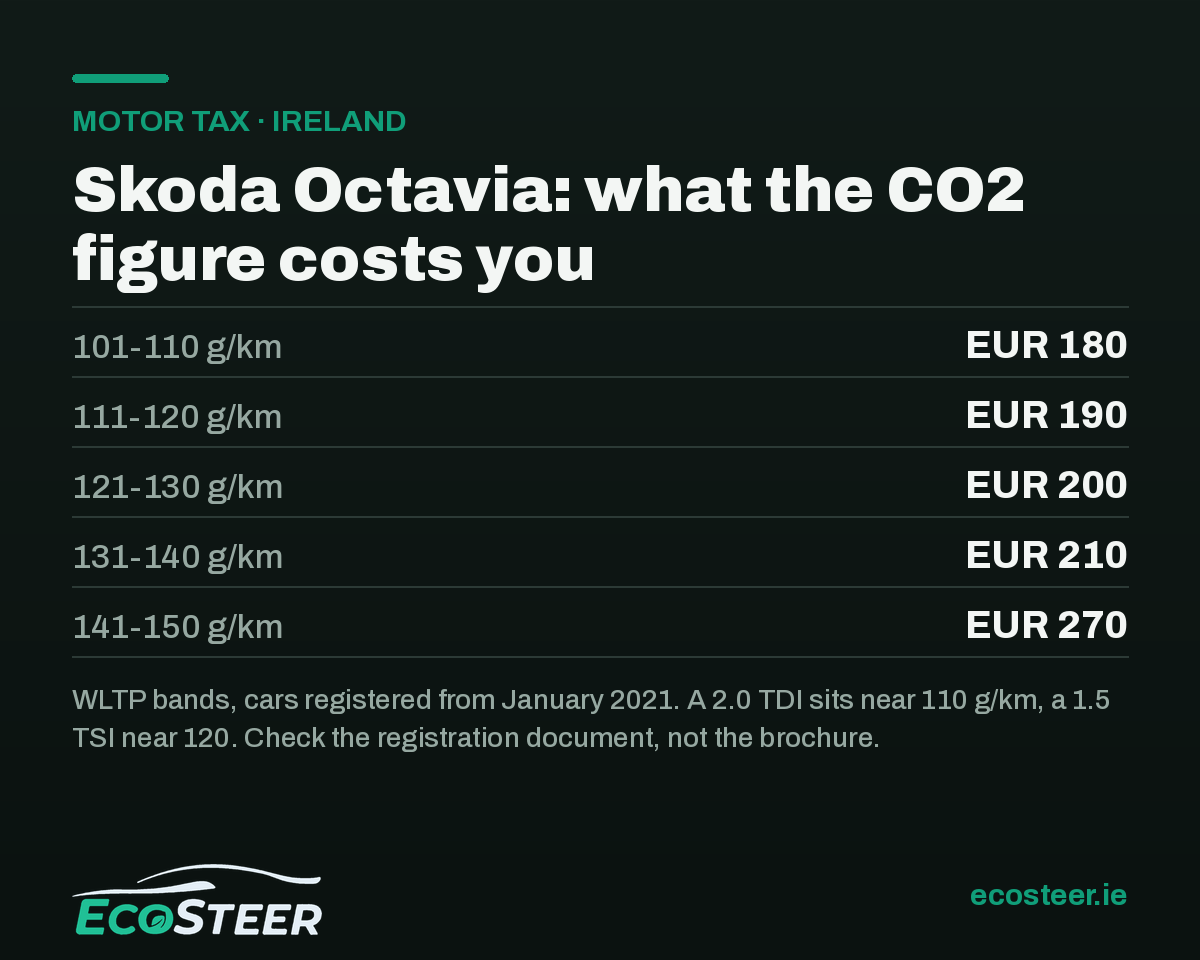
Typical figures on a 2021-on Octavia:
- 2.0 TDI 150: around 110 g/km, which lands in the 101-110 band at €180 a year.
- 1.5 TSI 150 mild hybrid: around 114 g/km, in the 111-120 band at €190 a year.
- 1.5 TSI 150 manual: around 120 g/km, right at the top of that same band at €190 a year.
Here is how fine the margin is. Skoda Ireland's own model page currently lists the Octavia at 111.00 g/km combined. That is one single gram above the 110 boundary — and that one gram moves the car from the €180 band to the €190 band, every year, for as long as it is taxed. Nothing about the car changes. The number on the page does.
So the tax gap between diesel and petrol on a modern Octavia is about ten euro a year. That is nothing, and it should not decide anything. The fuel gap is the one that matters: 4.2 litres per 100 km against 5.3 is roughly 220 litres of fuel a year at 20,000 km. That is real money, and it is the entire diesel argument in one line — provided you actually drive the distances that justify it.
The important practical point is the same one that applies to every car here. Wheel size and trim change the CO2 figure, so do not rely on the brochure. Two cars that look identical on the forecourt can sit either side of a band boundary. The same trap catches Nissan buyers, as we found in our Nissan Qashqai motor tax guide. The figure is printed on the registration document; check the actual car before you agree a price.
Older Octavias registered before 2021 use the earlier NEDC bands, where the steps are much bigger. There, 121-130 g/km is €270 and 141-155 g/km jumps to €400, so a pre-2021 petrol can cost noticeably more to tax than a post-2021 one. Worth checking on any 2015-2020 car before you commit.
What to check before buying a used Skoda Octavia
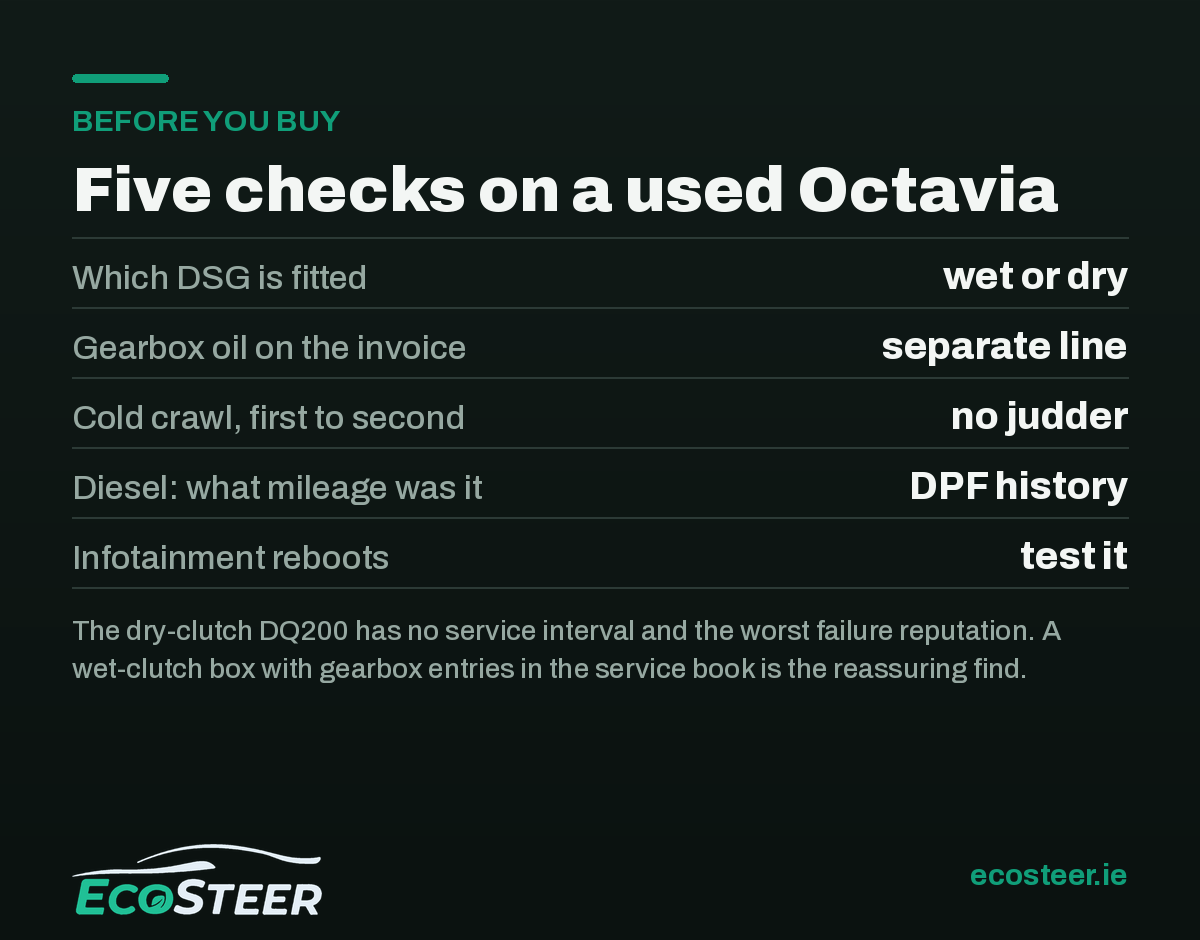
Find out which DSG it has. This is the single most important check. Skoda fits two different automatics — the same pair of gearboxes you will meet across the VW Group, including in our Volkswagen Tiguan buyer guide. The lower-torque engines get the seven-speed dry-clutch DQ200. The 2.0 TDI and the higher-output cars get a wet-clutch box, either the six-speed DQ250 or the seven-speed DQ381.
Here is the counter-intuitive part. The wet-clutch boxes have a published service schedule: fluid and filter at roughly 64,000 km on the DQ250, fluid at roughly 128,000 km on the DQ381. A service costs somewhere in the region of €230 to €350. The dry-clutch DQ200 has no manufacturer service interval at all — and it is the box with the mechatronic-unit reputation, where a failure is four-figure money rather than three. So the gearbox that asks nothing of you is the one to examine hardest, and the one with a service book full of gearbox entries is the reassuring find.
How to test either of them. Start from cold and crawl in traffic. Feel the change from first to second at walking pace: a dry-clutch DSG that judders, hesitates or takes up drive with a thump is telling you something. Then hold a steady 50 km/h on light throttle and listen for a whine that rises with road speed rather than with engine revs. Finally, reverse up a slope — the clutch works hardest there, and any slipping, burning smell or long delay before it bites is a walk-away.
Ask to see the DSG service on the invoice. A routine oil-and-filter service does not touch the gearbox. On a wet-clutch car, look for a separate line naming the gearbox oil. If nobody can tell you when it was last done, price the car as though it is due.
Diesels and short journeys. On a 2.0 TDI, ask what the car has been used for and look through the service record for DPF or EGR work. A car that has spent its life in town will show you eventually. On a long test drive, a regeneration that starts and completes is a good sign; one that keeps aborting is not.
Infotainment and software. On a fourth-generation car, spend a few minutes on the screen before you drive off. Check the reversing camera, pair a phone, work the climate slider, and see whether the system reboots. Early cars had genuine software problems and not all of them have had the updates applied.
Cambelt on the petrols. The 1.0 and 1.5 TSI engines drive their camshafts with a toothed belt, and the guidance on when to change it has shifted between markets and model years. Do not assume "lifetime" means never. Ask the garage that services it which interval they apply to that specific engine code, and factor it in if it is coming up.
What fails an Octavia at the NCT. Nothing exotic. The Octavia fails on the same short list as most Irish cars: lights and bulbs, tyres (tread, sidewall cracking and age), and front suspension and steering wear. On this platform the front drop links and anti-roll bar bushes are the usual culprits, and Irish road surfaces are hard on both. Walk around with the ignition on and check every lamp, then push down firmly on each corner and listen for knocks.
Skoda parts and service network in Ireland
This is one of the Octavia's real strengths. Skoda is a top-three brand in Ireland by volume, the dealer network is wide, and because the car shares its platform and engines with the Golf and the Leon, almost every independent garage in the country has worked on the mechanical parts already. Genuine and aftermarket parts are both cheap and quick to get. Servicing costs sit in the normal range for the class, and outside the main dealer network it is a notably easy car to own.
The one exception is the DSG. Gearbox work is specialist work, and a mechatronic replacement is a bill you want to avoid rather than budget for — which is the whole reason the gearbox checks above come first.
Verdict: is a used Skoda Octavia a good buy in Ireland?
Yes, and for most families it is a more sensible buy than the crossover they were thinking about. You get more boot, better economy and a lower driving position for roughly the same money.
If you do real mileage, the 2.0 TDI with a wet-clutch DSG and a service record that mentions the gearbox is the one to hold out for. If you do school runs and shopping, the 1.5 TSI is the right engine — and if it is an automatic, do the cold-start crawl test properly before you agree anything.
Whichever you choose, check the CO2 figure on the registration document before you talk price, and get a pre-purchase inspection on any automatic.
Frequently asked questions
How much is motor tax on a Skoda Octavia in Ireland?
For cars registered from 2021, a 2.0 TDI typically falls in the 101-110 g/km band at €180 a year, and a 1.5 TSI in the 111-120 band at €190. Older cars use the pre-2021 NEDC bands, where the steps are much larger. Always check the CO2 figure on the specific vehicle's registration document.
Which Skoda Octavia DSG gearbox is the reliable one?
The wet-clutch boxes fitted to the 2.0 TDI and higher-output engines have a published fluid service schedule and a better durability record. The seven-speed dry-clutch DQ200 used on smaller engines has no service interval and is the one associated with expensive mechatronic failures. Test any automatic thoroughly from cold.
Is the Skoda Octavia bigger than an SUV?
In boot terms, usually yes. The hatchback holds 600 litres and the Combi estate 640 litres, which beats most mid-size crossovers. What you give up is the raised seating position, not the space.
Should I buy the diesel or the petrol Octavia?
The motor tax difference is about €10 a year, so it should not decide it. The fuel difference is roughly 4.2 litres per 100 km against 5.3, which favours the diesel strongly on high mileage. If most of your driving is short urban trips, the petrol is the cheaper and less troublesome car to own.
Is the Skoda Octavia expensive to repair in Ireland?
No. Wide dealer network, shared VW Group parts, and plenty of independent garages that know the platform. Parts are cheap and readily available. The exception is DSG gearbox work, which is specialist and expensive.
Buying or selling? Use Ecosteer
Ecosteer lists used cars from across Ireland — petrol, diesel, hybrid and electric side by side, so you can compare an Octavia diesel against a petrol, or against the crossover you were originally looking at, without opening five tabs.
Selling privately? Listing a car priced under €3,000 is completely free on Ecosteer.
Comments
No comments yet — be the first to join the conversation.