Nissan Qashqai Ireland Buyer Guide: The Mild Hybrid Costs More to Tax Than the Full Hybrid
On the current Nissan Qashqai the cheaper 1.3 mild hybrid can cost more in motor tax than the pricier e-POWER hybrid. Irish motor tax bands, used prices, known faults and the checks to do before you buy.

The Nissan Qashqai has been one of Ireland's steadiest sellers for the best part of two decades, and it is one of the few family SUVs you can find at almost any budget — from early cars under €5,000 to nearly-new e-POWER models. That breadth is exactly why it is worth being specific about which one you buy.
There is one quirk that catches people out. On the current car, the cheaper-to-buy 1.3 mild hybrid can cost you more in motor tax every year than the more expensive e-POWER full hybrid. Not a huge amount, but it runs for as long as you own the car, and it is the opposite of what most buyers assume.
Nissan Qashqai Ireland overview
This guide focuses on the current car and what it costs to tax and run. For the full generation-by-generation history from 2007 onwards, see our Nissan Qashqai (2007-2026) Ireland buyer's guide.
The Qashqai effectively invented the family crossover, and the third generation (J12, from 2021) is the one you will find most of on the used market now. It is built in Sunderland, which matters in Ireland because parts supply and independent-garage familiarity are both excellent — this is not a car that leaves you waiting three weeks for a wishbone.
Boot space is 504 litres, which is mid-pack for the class: more than a Juke, less than a Tiguan. There is no seven-seat option. If you need seven, Nissan's answer is the X-Trail, not a bigger Qashqai.

Nissan Qashqai engine options and Irish running costs
What e-POWER gives you
e-POWER is the interesting one and it is not a conventional hybrid. The 1.5-litre petrol engine is not connected to the wheels at all — it runs as a generator, and the car is always driven by the electric motor. There is no gearbox in the usual sense, just single-speed direct drive.
In practice it feels like an EV to drive: instant response, no gear hunting, very quiet at town speeds. It is at its best exactly where most Irish family cars live — school runs, commuting, stop-start traffic. On a long motorway run at a constant 120 km/h the petrol engine is doing all the work, and the efficiency advantage narrows considerably. You do not plug it in.
What the 1.3 DIG-T mild hybrid gives you
The 1.3-litre turbo petrol with 12V mild hybrid assistance comes as a 140hp manual or a 158hp automatic using a CVT. The mild hybrid system is modest — it smooths the stop-start and gives a small assist off the line. It does not drive the car on electricity.
It is cheaper to buy than e-POWER and perfectly competent. The CVT automatic is the version to test properly: under hard acceleration it holds revs high, which some drivers never get used to.
Where the Qashqai falls short
It is a sensible car rather than an exciting one — steering and handling are tuned for comfort, not involvement. Higher trims climb in price quickly, and on the used market a well-specified mid-trim is usually far better value than a top-trim car of the same age.
Nissan Qashqai motor tax in Ireland
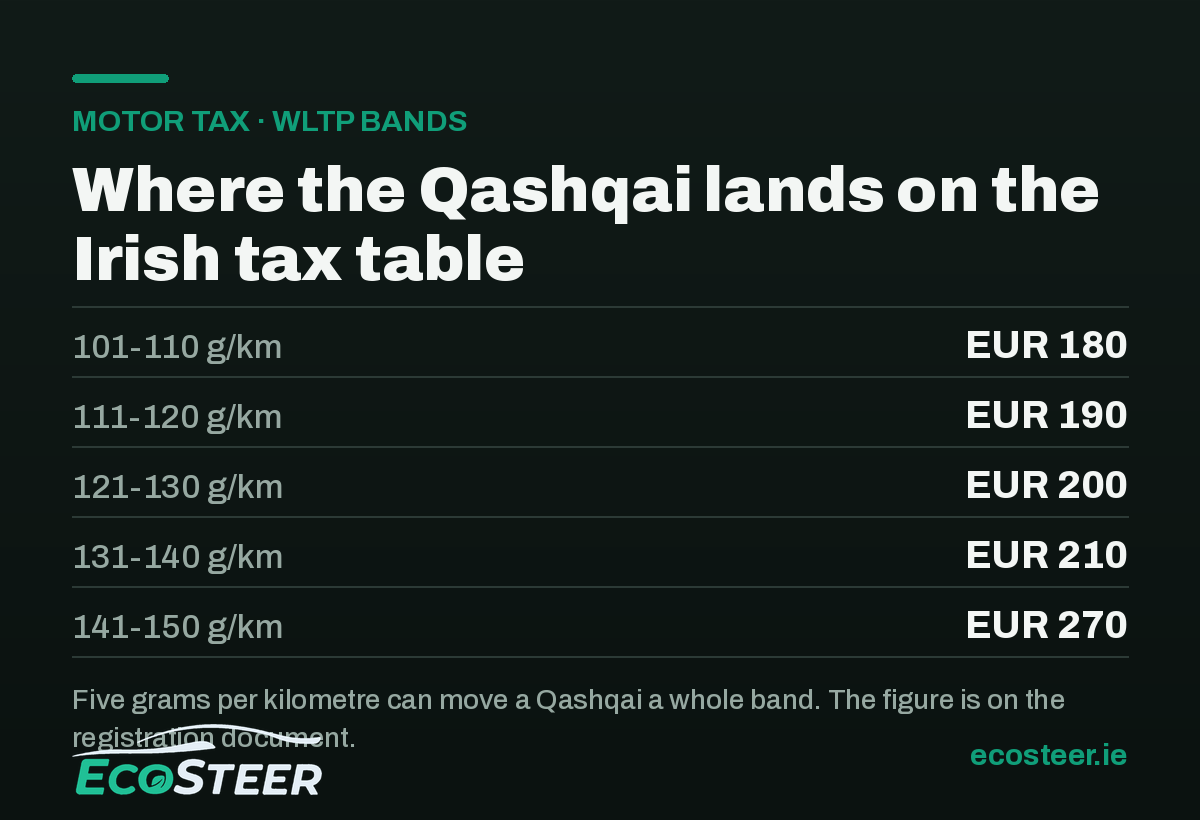
Motor tax on any car registered in Ireland from July 2008 is based on CO2, and cars registered from January 2021 use the newer WLTP bands. This is where the Qashqai gets counter-intuitive.
Typical figures:
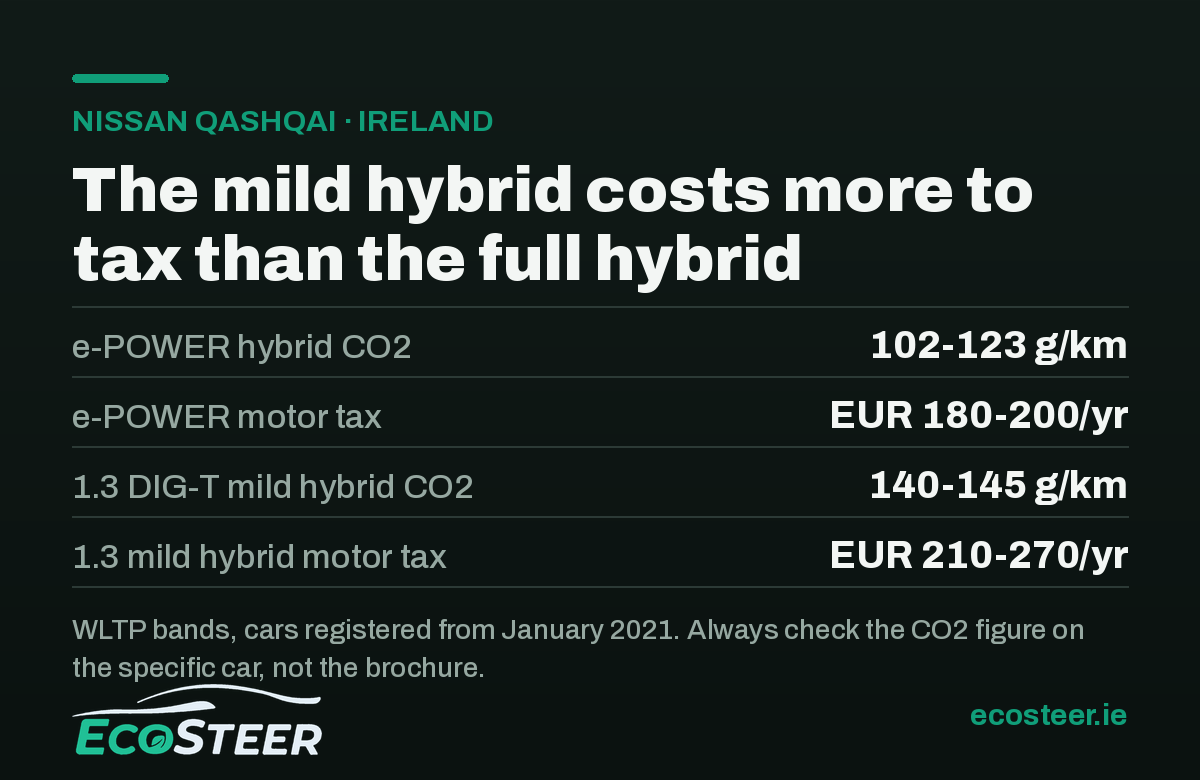
- e-POWER: roughly 102–123 g/km depending on year and wheel size, which lands it in the €180–€200 a year range.
- 1.3 DIG-T mild hybrid: roughly 140–145 g/km, which straddles a band boundary at 140. Below it you pay €210; above it you pay €270.
So the mild hybrid can cost up to about €90 a year more to tax than the e-POWER, despite being the cheaper car to buy. Over five years that is a few hundred euro, which is worth knowing but is not on its own a reason to choose one over the other.
The important practical point: do not rely on the brochure figure. Wheel size and trim change the CO2 number, and a car sitting at 139 g/km and one at 141 g/km look identical on the forecourt but differ by €60 a year forever. The figure is printed on the registration document — check the actual car.
Older Qashqais registered before 2021 use the earlier NEDC bands, where the steps are bigger: 121–130 g/km is €270 and 141–155 g/km jumps to €400. On a 2015–2020 diesel it is well worth checking before you commit.
What to check before buying a used Nissan Qashqai
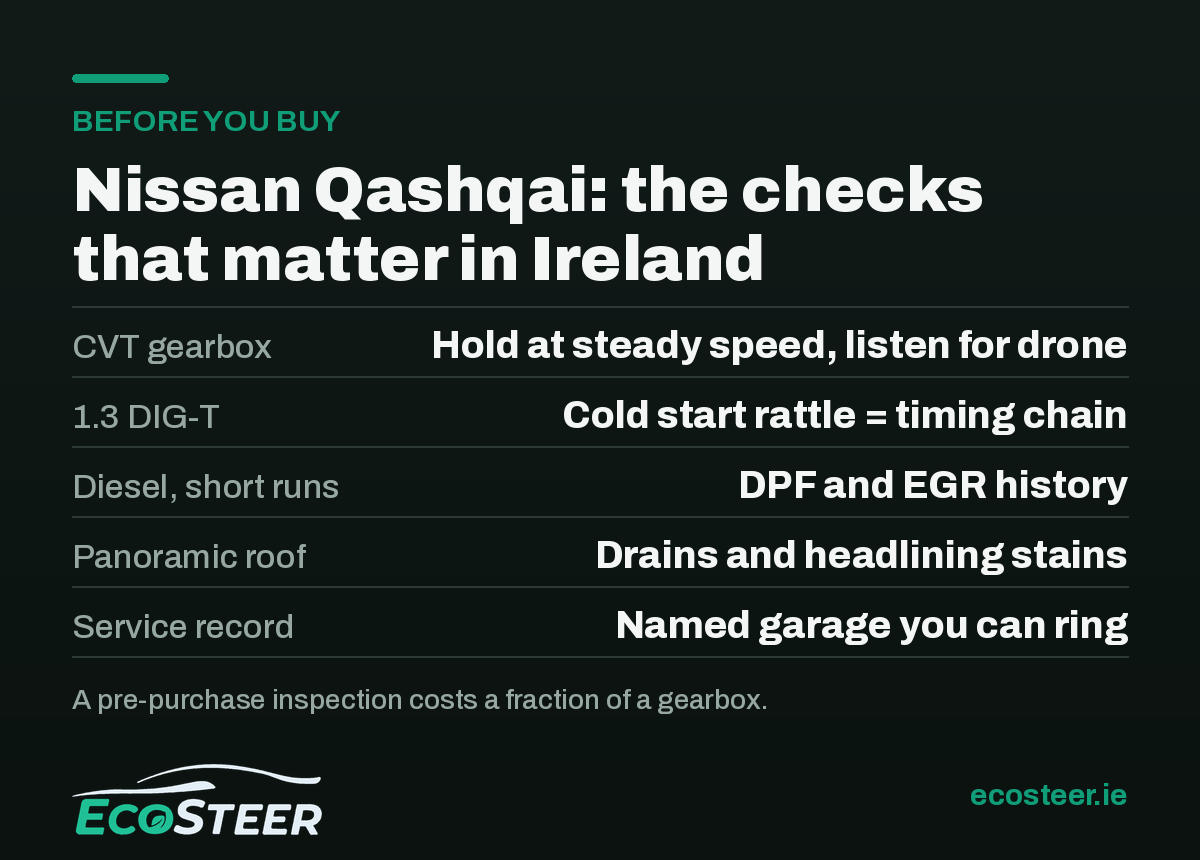
The CVT automatic. This is the single most important check on an automatic Qashqai. Get it properly warm, then hold a steady 80–100 km/h and listen for a rising drone or whine that changes with road speed. Then accelerate hard and lift off. Any shudder, slipping or delay in taking up drive is a walk-away. CVT repairs are gearbox-money, not garage-money.
1.3 DIG-T timing chain. Start it from properly cold — not a car the seller has already warmed up for you. A rattle for a second or two on start-up is the classic early warning. Insist on a cold start; a seller who will not allow one is telling you something.
Diesels and short journeys. If you are looking at a 1.5 or 1.6 dCi, ask honestly what the car has been used for. A diesel that has spent its life on school runs will have DPF and EGR history. Look for a regeneration that completes on a longer drive and check the service record for EGR or DPF work. On the older 1.5 dCi, cambelt intervals are time-based as well as mileage-based, so a low-mileage car that has sat can still be due.
Panoramic roof. Common on higher trims and a known water-ingress point when the drains block. Check the headlining at the corners and in the boot for staining or damp, and look for a musty smell.
Electrics and air conditioning. Owner surveys on the previous generation flagged recurring tyre-pressure warnings, sat-nav quirks and air conditioning needing re-gassing more often than average. None are expensive individually; several together suggest a car that has been neglected.
What fails a Qashqai at the NCT. Nothing exotic — the Qashqai fails on the same short list as most Irish cars: lights and bulbs, tyres (tread, sidewall cracking and age), and suspension and steering wear. On a crossover of this weight, front suspension bushes and drop links are the usual culprits, and our road surfaces are hard on both. Walk around with the ignition on and check every lamp, then push down firmly on each corner and listen for knocks.
Nissan parts and service network in Ireland
This is a genuine strength. Nissan has one of the wider dealer networks in the country, the Qashqai is common enough that independent garages know it well, and parts — both genuine and aftermarket — are cheap and quickly available. Servicing costs sit in the normal range for the class. It is a much easier car to own outside the main dealer network than most of its European rivals.
Verdict: is a used Nissan Qashqai a good buy in Ireland?
Yes, with the usual caveat that the specific car matters more than the model. It is practical, cheap to run, easy to get parts for and holds its value reasonably well.
If most of your driving is urban and you can stretch to it, e-POWER is the better long-term buy: cheaper tax, lower fuel use in town, and no gearbox in the conventional sense to worry about. If you do high motorway mileage or the budget is tight, the 1.3 mild hybrid manual is the sensible pick — and it avoids the CVT question entirely.
Whichever you choose, check the CO2 figure on the registration document before you agree a price, and get a pre-purchase inspection on any automatic.
Frequently asked questions
How much is motor tax on a Nissan Qashqai in Ireland?
For cars registered from 2021, e-POWER versions typically fall in the €180–€200 a year range and 1.3 mild hybrid versions in the €210–€270 range, depending on the exact CO2 figure. Older cars use the pre-2021 bands, where the steps are larger. Always check the CO2 figure on the specific vehicle.
Do you plug in a Nissan Qashqai e-POWER?
No. e-POWER is a self-charging series hybrid. The petrol engine acts purely as a generator for the battery and electric motor, so you fill it with petrol like any other car.
Is the Qashqai CVT gearbox reliable?
It is generally durable when serviced, but it is the most expensive thing on the car to put right, so it deserves a careful test drive. Listen for droning at steady speed and any shudder or slip under acceleration.
How big is the Nissan Qashqai boot?
504 litres with the rear seats up, which is competitive for a family crossover but smaller than a Volkswagen Tiguan. There is no seven-seat version.
Is the Qashqai expensive to repair in Ireland?
No. It is one of the easier cars in its class to own here — wide dealer network, plenty of independent garages familiar with it, and cheap, readily available parts. The exception is the CVT automatic, which is a significant bill if it fails.
Buying or selling? Use Ecosteer
Ecosteer lists used cars from across Ireland — petrol, diesel, hybrid and electric side by side, so you can compare a Qashqai e-POWER against a mild hybrid or a diesel rival without opening five tabs.
Selling privately? Listing a car priced under €3,000 is completely free on Ecosteer.
Comments
No comments yet — be the first to join the conversation.