Hyundai Kona Ireland 2026: Prices, Motor Tax and Which Version Actually Pays
Petrol, hybrid or electric on the same body. Full 2026 price and CO2 table from Hyundai Ireland's own list, EUR 180 hybrid motor tax against EUR 120 for the Electric, 484km of range, the four-star Euro NCAP result, and one tax figure on the price list that does not match the schedule.
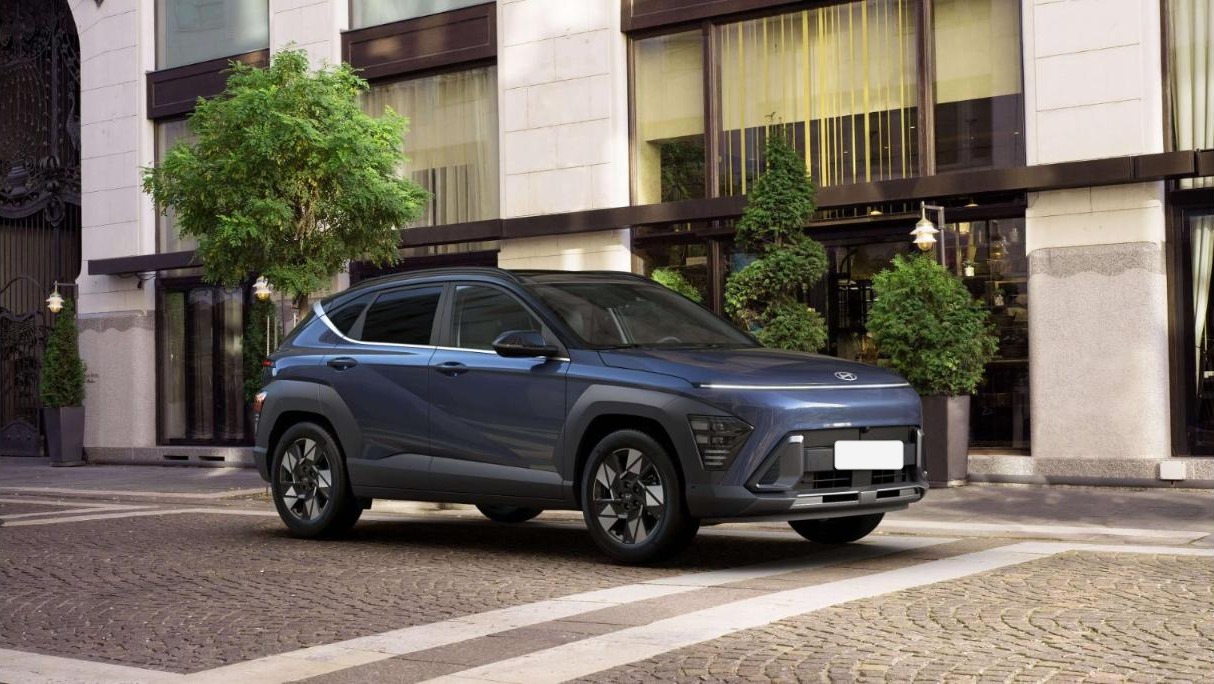
The Hyundai Kona is one of the few cars in Ireland where the fuel choice is genuinely open. Petrol, full hybrid and battery electric all sit in the same showroom, on the same body, within about EUR 5,000 of each other. That is unusual, and it makes the decision harder than it looks.
What follows is the Irish arithmetic, taken from Hyundai Ireland's own 2026 price list and from Irish road tests: what each version costs, what it pays in motor tax, what it returns in the real world, and what to look at before you buy a used one.
Hyundai Kona overview: what changed with the second generation
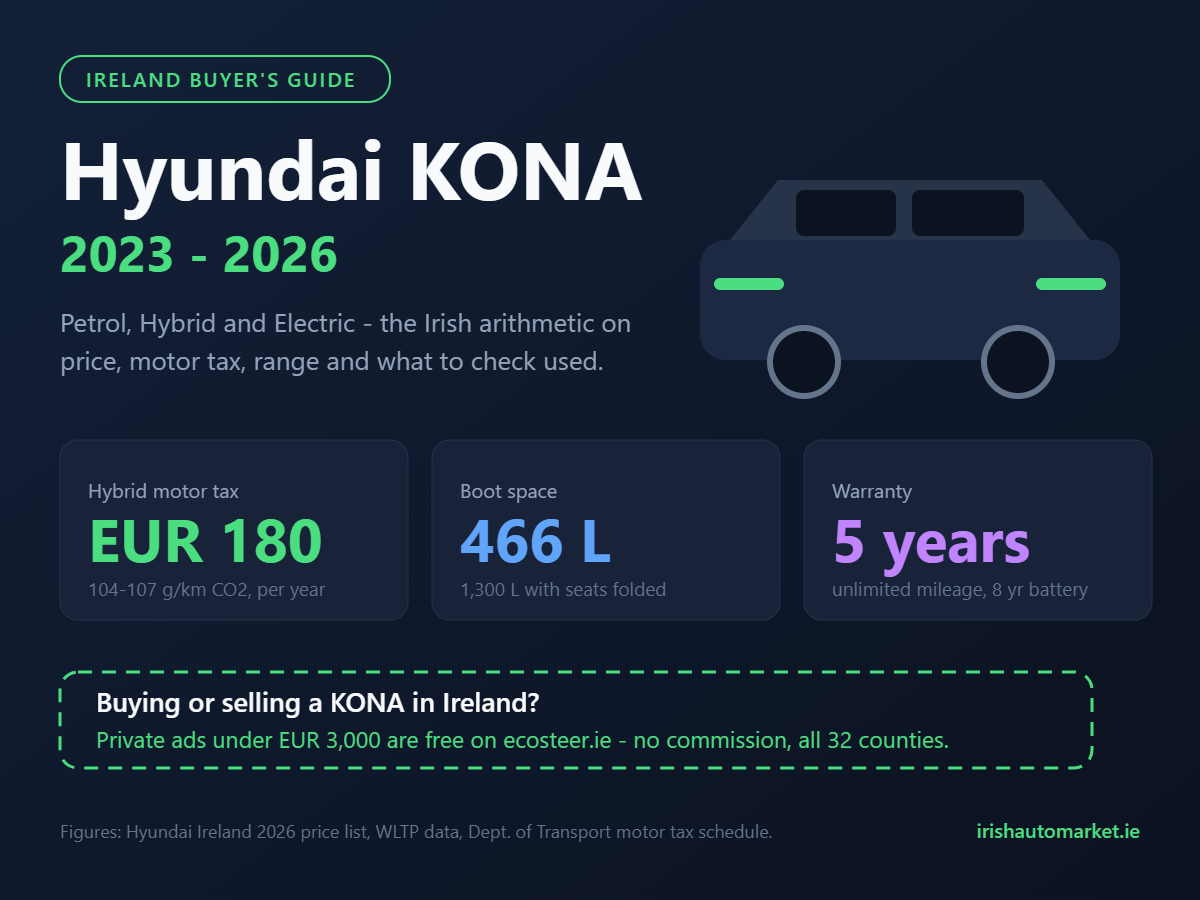
The Kona that arrived in 2023 is a substantially bigger car than the one it replaced. Its wheelbase sits only 20 millimetres short of the Hyundai Tucson, and the boot grew from 361 litres in the old hybrid to 466 litres, rising to 1,300 litres with the rear seats folded. The electric version adds a small compartment under the bonnet for charging cables.
That growth matters for Irish buyers because it moves the Kona out of the supermini-on-stilts category and into genuine family-car territory, while the price stays below the Tucson. It also means a used first-generation Kona and a used second-generation Kona are not really the same proposition, and should not be shopped as if they were.
Hyundai Kona engine options and 2026 Irish prices
These are the recommended retail prices published by Hyundai Ireland for 2026. They exclude metallic paint, delivery and related charges. Electric prices already include the EUR 3,500 SEAI grant for private buyers and government VRT relief.
| Version | WLTP CO2 | Motor tax | Price from |
|---|---|---|---|
| Kona 1.0 T-GDi Signature | 133 g/km | EUR 210 | EUR 33,145 |
| Kona 1.0 T-GDi Elegance | 134 g/km | EUR 210 | EUR 34,895 |
| Kona 1.0 T-GDi N Line | 139 g/km | EUR 210 | EUR 36,645 |
| Kona Hybrid Signature | 104 g/km | EUR 180 | EUR 36,145 |
| Kona Hybrid Elegance | 107 g/km | EUR 180 | EUR 37,895 |
| Kona Hybrid N Line | 107 g/km | EUR 180 | EUR 39,645 |
| Kona Electric Elegance 48 kWh | 0 g/km | EUR 120 | EUR 33,695 |
| Kona Electric Elegance 65 kWh | 0 g/km | EUR 120 | EUR 38,695 |
| Kona Electric Platinum 65 kWh | 0 g/km | EUR 120 | EUR 40,195 |
| Kona Electric N Line 65 kWh | 0 g/km | EUR 120 | EUR 41,345 |
Hyundai Ireland also lists PRO versions of each Kona. These are commercial derivatives and they are taxed at the flat commercial rate of EUR 333 a year rather than on CO2. For a business buyer covering high mileage that changes the sums entirely; for a private buyer it is not relevant.
How the powertrains actually perform
The Kona Hybrid pairs a 1.6-litre naturally aspirated petrol engine with a 32 kW electric motor for a combined 141hp and 265Nm, driven through a seven-speed dual-clutch automatic. Official consumption is 4.7 litres/100km; an Irish week of mixed driving returned 5.6 litres/100km. It is not quick - 0-100km/h takes 11.2 seconds - but it is smooth and quiet, which suits how the car is actually used. Braked towing capacity is 1,300kg.
The Kona Electric 65 kWh uses a 160 kW motor for 218hp and 255Nm, reaching 100km/h in 7.8 seconds. It charges at up to 102 kW on DC and 10.5 kW on AC, and consumes roughly 12.7 kWh/100km. Hyundai Ireland currently quotes 484km of range; the launch figure in 2023 was 514km on 17-inch wheels, so check the exact specification of any car you are looking at rather than assuming the headline number. The cheaper 48.4 kWh version drops to 156hp and 377km.
Hyundai Kona pros
- Genuine choice of powertrain on one body. Very few cars in this class let you take petrol, hybrid or electric without changing model.
- Space that punches above the price. A 466-litre boot and near-Tucson wheelbase, for Kona money.
- Five-year unlimited-mileage warranty, with eight years or 160,000km on the high-voltage battery.
- Fast charging on the electric version. 102 kW DC is competitive in the compact crossover class.
- Standard equipment is generous even at entry Signature and Elegance trim, including twin 12.3-inch screens on the Electric.
Hyundai Kona cons
- Four stars, not five, from Euro NCAP. The 2023 assessment scored 80% adult occupant, 83% child occupant, 64% vulnerable road users and 60% safety assist. Several rivals in this class hold five stars.
- The hybrid is unhurried. 11.2 seconds to 100km/h is fine around town and merely adequate on a motorway slip road.
- The petrol saves less than it looks. About EUR 3,000 less to buy than the hybrid, but EUR 30 a year more in motor tax and materially worse fuel figures.
- No plug-in hybrid option, which rules the Kona out if you specifically want one.
- Trim walk on the Electric is steep - roughly EUR 7,650 between the 48 kWh Elegance and the 65 kWh N Line.
Hyundai Kona motor tax in Ireland: work it out yourself
Every car first registered from 2021 onward is taxed on its WLTP CO2 figure. The relevant part of the schedule looks like this:
| WLTP CO2 | Annual motor tax | Kona version in this band |
|---|---|---|
| 0 g/km | EUR 120 | Kona Electric, all versions |
| 101-110 g/km | EUR 180 | Kona Hybrid (104-107 g/km) |
| 121-130 g/km | EUR 200 | - |
| 131-140 g/km | EUR 210 | Kona 1.0 T-GDi (133-139 g/km) |
One figure worth checking. Hyundai Ireland's 2026 price list shows EUR 200 against the Kona Signature petrol, which is quoted at 133 g/km. Under the post-2021 schedule, 133 g/km sits in the 131-140 band, which is EUR 210 - and the same price list correctly shows EUR 210 for the 134 g/km Elegance directly below it. The gap is only EUR 10 a year, but it is the kind of inconsistency worth resolving before you budget. Check the exact registration on motortax.ie, which is the only figure that binds.
A second trap applies to imports. A Kona first registered abroad is assessed on its original first registration date, so a UK-registered car from 2020 or earlier falls under a different table with different amounts for the same letters.
Hyundai Kona reliability and what to check before you buy
The second-generation Kona is still young on the Irish used market, so long-term fault patterns are thin on the ground. That makes the paperwork more important than the mileage.
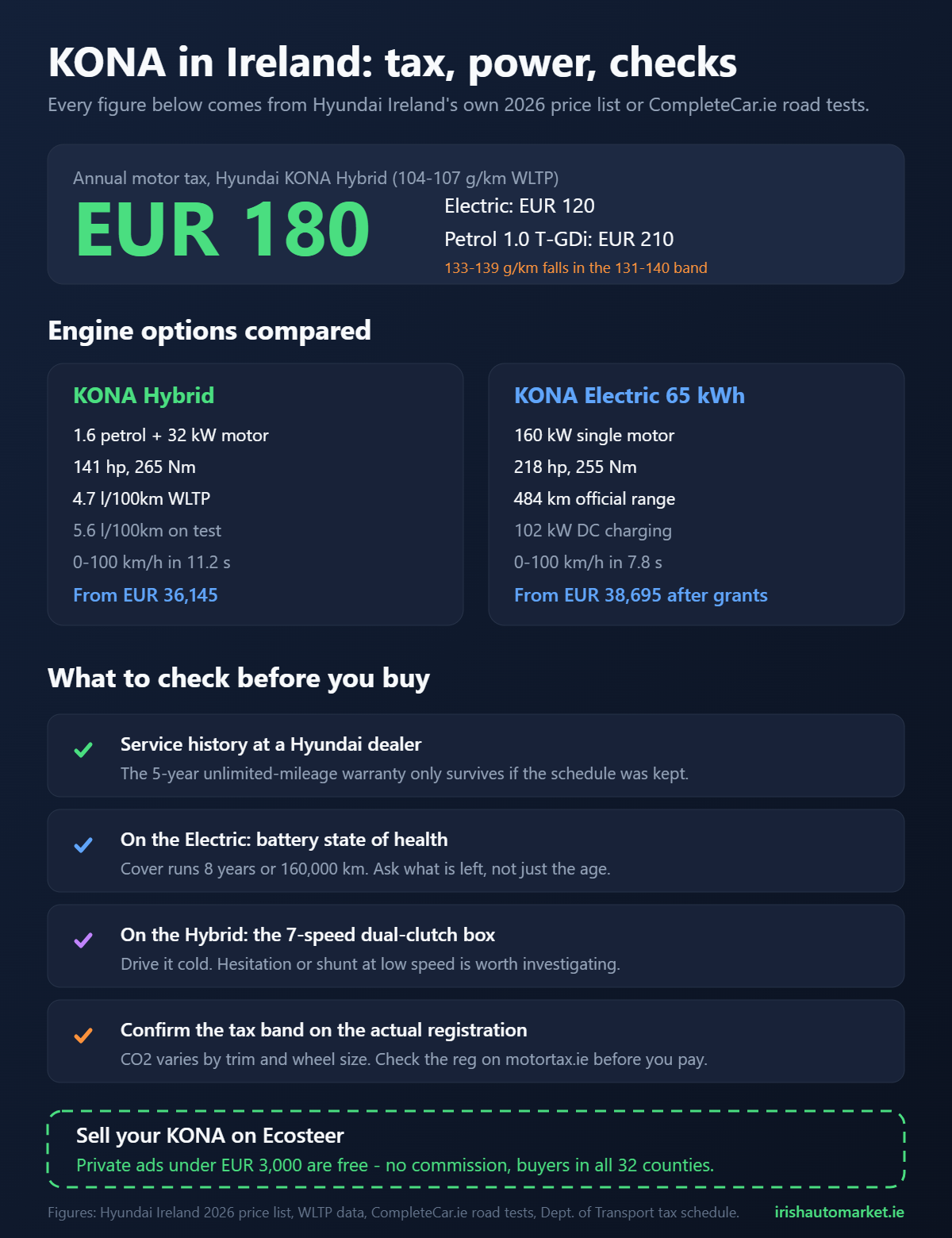
- Hyundai dealer service history. The five-year unlimited-mileage warranty is conditional on the schedule being followed. A car with gaps may still drive perfectly and be worth considerably less.
- On the Electric: battery state of health. Cover runs to eight years or 160,000km, whichever comes first, so what matters is how much of that is left and how the pack has actually been treated. An independent EV battery health check gives you the one figure a standard history report cannot.
- On the Hybrid: the seven-speed dual-clutch gearbox. Drive it from cold. It should be near-imperceptible in normal use; hesitation, shunting or a slipping feel at low speed all warrant a closer look.
- Audio and navigation units are warranted for three years, not five. A screen fault on a four-year-old car is your bill.
- Confirm the CO2 figure on the actual registration. The Kona spans 104 to 139 g/km depending on powertrain, trim and wheel size, which is a EUR 30 swing in annual tax.
- Run a full history check before money changes hands. Our guide to checking car history in Ireland covers finance, write-off and mileage records.
Hyundai Kona service network and warranty in Ireland
Hyundai Ireland runs a nationwide dealer network with a locator on hyundai.ie, and the ownership package is one of the stronger reasons to buy the car. New vehicles carry a five-year unlimited-mileage warranty. Lithium-ion polymer high-voltage batteries are covered for eight years or 160,000km, whichever comes first. Audio-visual navigation and radio units are covered for three years. Commercial vehicles run to five years or 160,000km rather than unlimited mileage. Hyundai Ireland also lists a five-year vehicle health check programme and five years of AA roadside assistance.
For a used buyer, the unlimited-mileage element is the part that matters most. A three-year-old Kona with 140,000km on it still has warranty cover that a rival with a mileage cap would have lost long ago - provided the service history is intact.
Verdict: which Hyundai Kona should you buy in Ireland?
Buy the Hybrid Signature if you have no home charger. At EUR 36,145 and EUR 180 a year, it is the version that asks least of you and gives up least in return.
Buy the Electric 65 kWh Elegance if you can charge at home. At EUR 38,695 after grants it is only about EUR 2,550 more than the hybrid, the tax drops to EUR 120, and the running cost gap over five years is far larger than the purchase gap.
Skip the petrol unless you cover very low annual mileage. It saves EUR 3,000 up front and then hands most of it back in fuel and tax.
The one reservation is the four-star Euro NCAP score. If a five-star rating is non-negotiable for you, that is a legitimate reason to shop elsewhere in this class, and no amount of equipment count changes it.
Hyundai Kona Ireland: frequently asked questions
How much is motor tax on a Hyundai Kona in Ireland?
EUR 120 a year for the Kona Electric, EUR 180 for the Kona Hybrid at 104-107 g/km, and EUR 210 for the 1.0 T-GDi petrol at 133-139 g/km. Commercial PRO versions pay the flat EUR 333 commercial rate. Always confirm the exact registration on motortax.ie.
Is the Kona Hybrid or the Kona Electric cheaper to run?
The Electric, provided you can charge at home. It pays EUR 60 a year less in motor tax and consumes about 12.7 kWh/100km against the hybrid's 4.7 to 5.6 litres/100km. Without home charging the calculation weakens considerably and the hybrid becomes the sensible choice.
How far does the Hyundai Kona Electric go on a charge?
Hyundai Ireland currently quotes 484km for the 65 kWh version. At launch in 2023 the figure was 514km on 17-inch wheels. The smaller 48.4 kWh battery was rated at 377km. Wheel size, weather and driving style all move the real-world number, so treat the official figure as a ceiling.
What warranty does a Hyundai Kona come with in Ireland?
Five years with unlimited mileage on the vehicle, eight years or 160,000km on the high-voltage battery, and three years on audio-visual navigation and radio units. Cover depends on the service schedule being followed at an authorised dealer.
Is the Hyundai Kona a safe car?
Euro NCAP awarded the 2023 Kona four stars, with 80% for adult occupant protection, 83% for child occupants, 64% for vulnerable road users and 60% for safety assist. That is a solid result but short of the five stars several competitors hold.
Buying or selling a Hyundai Kona? Use Ecosteer
Buying: Browse Hyundai listings on Ecosteer, filtered by county, price, mileage and fuel type.
Selling: Place your ad on Ecosteer. Private ads for cars under EUR 3,000 are free, there is no commission, and buyers come from all 32 counties.
Dealers: Find a dealer or join the Ecosteer dealer network.
Before you pay: read our car history check guide, and for any Kona Electric, the EV battery health check.
External sources
- Hyundai Ireland — 2026 new cars price list, with WLTP CO2 and road tax by trim
- Hyundai Ireland — 5-year unlimited mileage warranty and battery cover terms
- CompleteCar.ie — Hyundai Kona Hybrid Irish road test and technical specifications
- CompleteCar.ie — Hyundai Kona Electric 65kWh Irish review
- CompleteCar.ie — Motor road tax prices in Ireland explained
- Euro NCAP — Hyundai Kona 2023 assessment
- motortax.ie — check motor tax due on a specific registration
- Citizens Information — buying a used car in Ireland
Vehicle photography courtesy of Hyundai, used for editorial purposes. Prices and specifications are those published at the time of writing and are subject to change; confirm current pricing with Hyundai Ireland and motor tax on the specific registration at motortax.ie before purchase. This article is information, not financial advice.
Comments
No comments yet — be the first to join the conversation.