Hyundai i30 Ireland Buyer Guide: €180 a Year to Tax the 1.6 CRDi, €200 the 1.0 T-GDi
Used Hyundai i30 GD and PD in Ireland: engines sold here, motor tax from €180 to €280 by version, timing chain and DCT checks, recalls on record, NCT fail items and 8 checks before you pay.
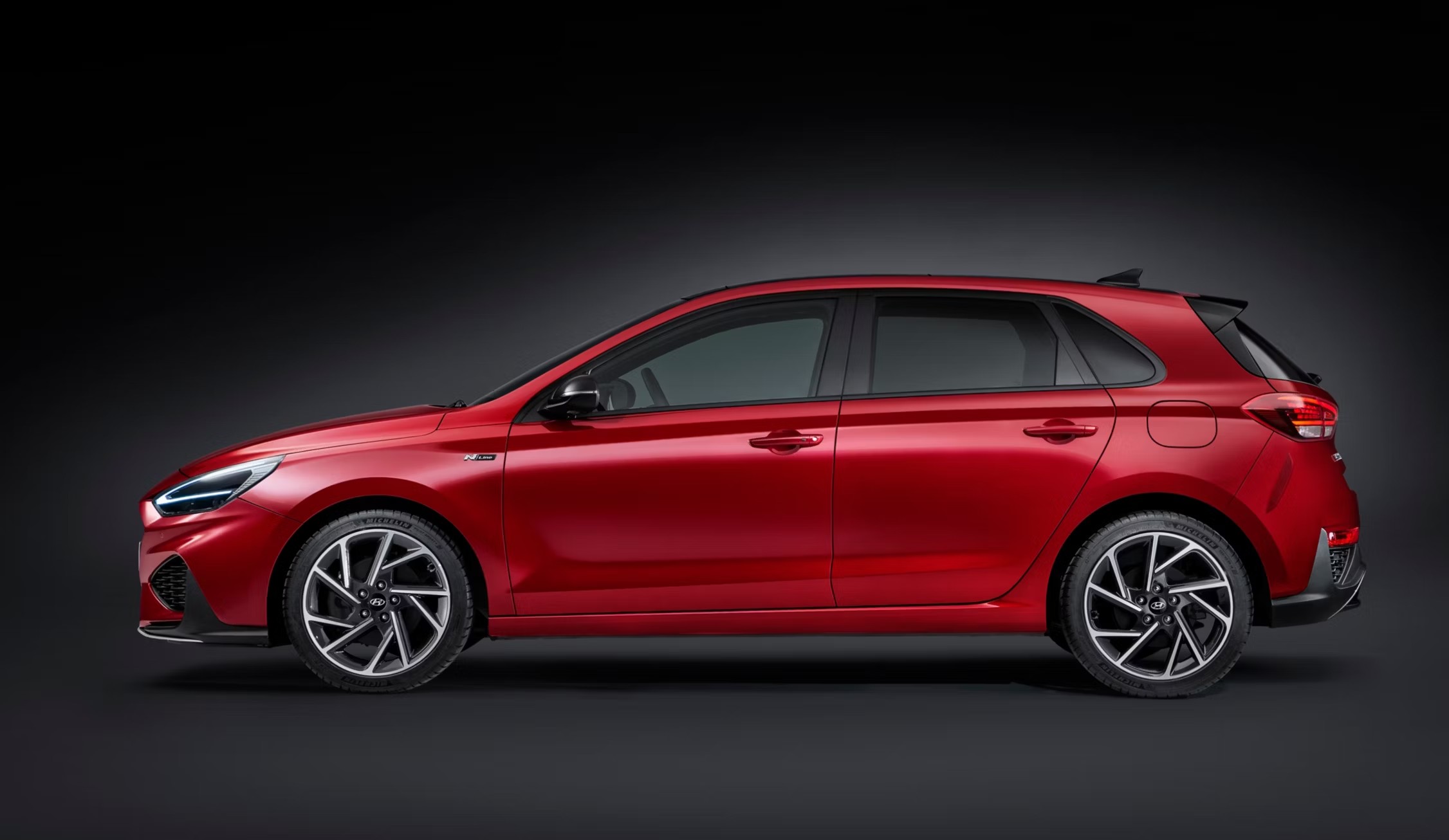
Most used Hyundai i30s in Ireland belong to two generations: the second-generation GD, sold here from 2012 to 2017, and the third-generation PD, launched here in early 2017 and facelifted in 2020. The PD came as a hatchback, a Tourer estate, and a Fastback, and facelifted cars were offered with 48V mild hybrid versions in Europe.
This guide covers the engines sold here, what each version costs to tax, the faults worth checking, what the NCT picks up and how the warranty works for a second owner. Tax figures use published CO2 values and the current Irish tables.
Which Hyundai i30 generations are sold in Ireland?
i30 GD (2012 to 2017). The Irish range at launch in early 2012 had three engines: a 1.4-litre petrol with 100hp, a 1.4 CRDi diesel with 90hp and a 1.6 CRDi diesel with 110hp. Irish launch reviews tested the 1.6 CRDi with a six-speed manual. In Hyundai's UK range, the 2015 update replaced the torque-converter automatic on the 1.6 CRDi with a seven-speed dual-clutch gearbox (DCT), so check which gearbox an automatic GD has. Some 2012-registered i30s are the older first-generation car (FD), built until May 2012.
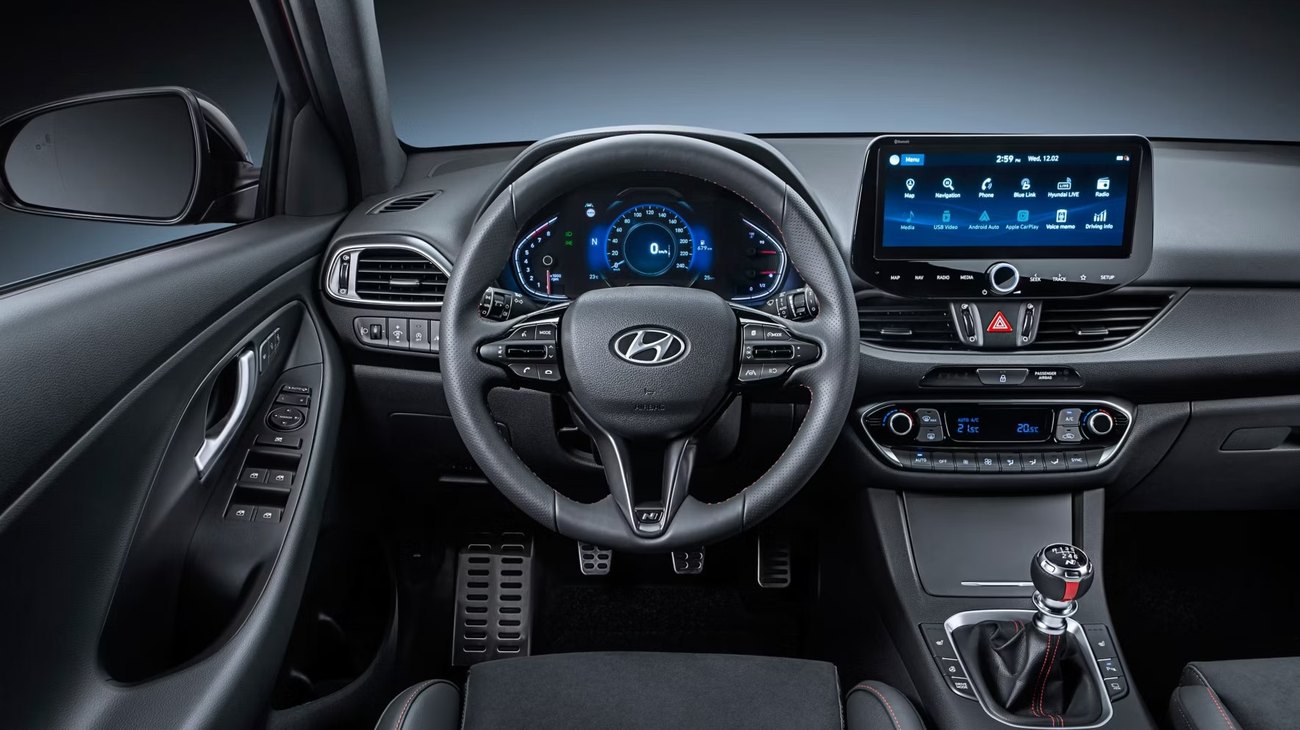
i30 PD (2017 on). The Irish launch line-up had two engines: a 1.0 T-GDi three-cylinder turbo petrol with 120hp and a 1.6 CRDi diesel with 110hp. The diesel came with a six-speed manual or a seven-speed DCT automatic. The Tourer followed in 2017 with the 1.6 CRDi and a 602-litre boot (395 litres in the hatchback). The Fastback arrived early in 2018 with one version: the 1.0 T-GDi 120hp with a six-speed manual.
A late-2018 update brought a new "Smartstream" 1.6 CRDi diesel with SCR exhaust treatment and an AdBlue tank, and a petrol particulate filter on every petrol engine. Hyundai's Irish pricing for the 2020 facelift listed the 1.0 turbo petrol and the 1.6 CRDi diesel, with an N-Line trim available.
48V mild hybrid versions. In Hyundai's European facelift range, 48V was standard on the 136hp 1.6 diesel and 160hp 1.5 T-GDi and optional on the 120hp 1.0 T-GDi, paired with a six-speed "intelligent manual" (iMT) or the DCT. We found no Irish price list confirming which mild hybrids Hyundai Ireland sold, so check the specification of any car described as a hybrid.
How much is motor tax on a used Hyundai i30?
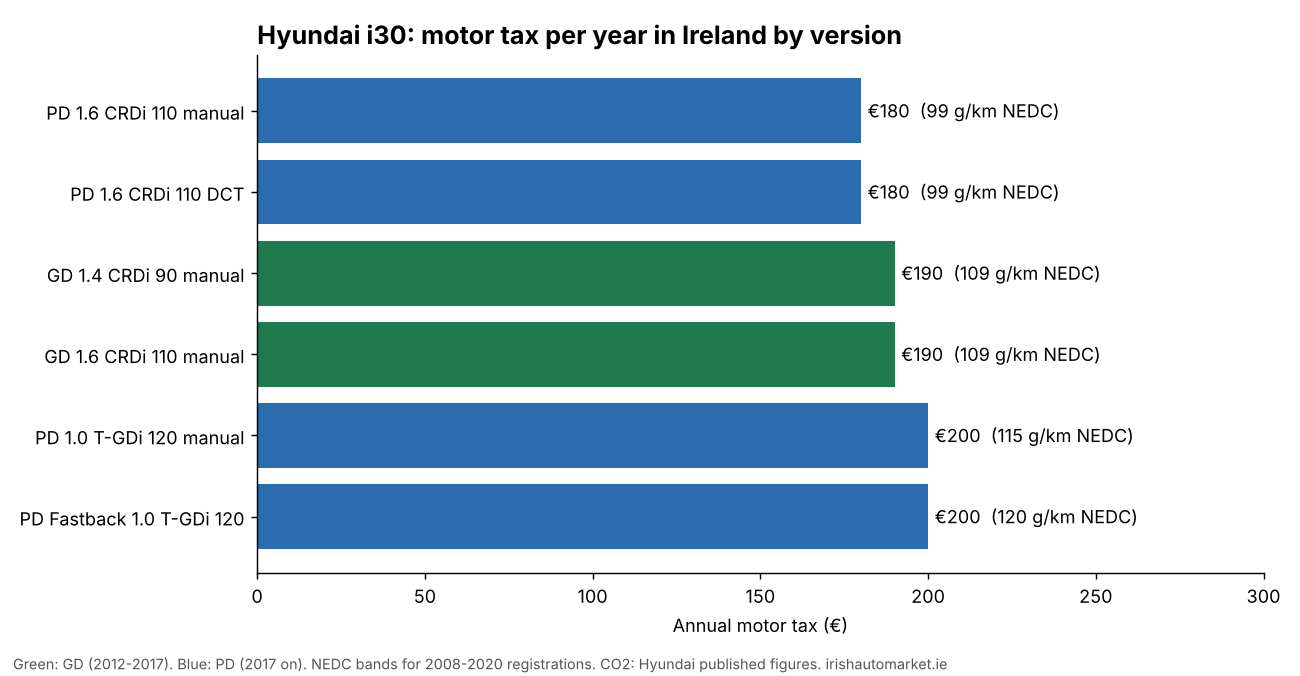
Cars registered in Ireland from January 2008 to December 2020 are taxed on NEDC CO2 bands: A2 (81 to 100 g/km) €180, A3 (101 to 110) €190, A4 (111 to 120) €200, B1 (121 to 130) €270 and B2 (131 to 140) €280. Cars registered from January 2021 use WLTP bands, such as €190 for 111 to 120 g/km, €200 for 121 to 130 and €270 for 141 to 150. WLTP is a tougher test, so the same engine shows higher CO2. Figures vary with trim and wheels, so the CO2 on the car's Vehicle Registration Certificate is the one that counts.
i30 GD (NEDC table, registered 2012 to 2017)
- 1.4 CRDi 90hp manual, 109 g/km: band A3, €190 a year
- 1.6 CRDi 110hp manual, 109 g/km at the Irish launch: band A3, €190 a year
- 1.4 petrol 100hp: old Band B (121 to 140 g/km) at launch, now €270 or €280 a year
i30 PD (NEDC table, registered 2017 to 2020)
- 1.6 CRDi 110hp manual or DCT, hatchback and Tourer, 99 g/km: band A2, €180 a year
- 1.0 T-GDi 120hp manual hatchback, 115 g/km: band A4, €200 a year
- Fastback 1.0 T-GDi 120hp manual, 120 g/km: band A4, €200 a year
i30 PD facelift (WLTP table, registered 2021 on)
- 1.0 T-GDi 48V (UK-spec published figures), 119 to 142 g/km: €190 to €270 a year
- 1.6 CRDi 136hp 48V (UK-spec published figures), 120 to 126 g/km: €190 or €200 a year
- Irish-spec figures can differ, so check the certificate
Most diesel and 1.0 T-GDi i30s cost €180 to €200 a year.
Petrol, diesel or mild hybrid: which i30 engine suits Irish driving?
The 1.6 CRDi is the cheapest i30 to tax and the most economical on paper, at an official 3.8 l/100km (NEDC) for the PD. It also has more pulling power: 280Nm of torque against 171Nm for the 1.0 T-GDi, which helps in the Tourer or with a full load. The catch is short journeys. In an Irish test of the GD 1.6 CRDi, mostly urban driving returned 7.0 l/100km against an official 4.1, and diesel particulate filters can clog when a car rarely gets a long run. Diesels built after the late-2018 update also need AdBlue topped up.
For town and mixed driving, the 1.0 T-GDi is the simpler choice, for €20 a year more in tax. Petrols from the late-2018 update have their own particulate filter, so they also benefit from a regular longer run. On a 48V mild hybrid, the 48V battery is covered by Hyundai's five-year warranty.
What goes wrong with a used Hyundai i30?
Timing chain or belt?
The GD's 1.4 petrol (engine code G4FA) and 1.6 CRDi (D4FB) and the PD's 1.0 T-GDi (G3LC) all use a timing chain rather than a belt, so there is no belt change to budget for. Chains still wear: engine databases note that dirty oil can make the 1.4 petrol's tensioner stick, and report chain stretch on high-mileage 1.0 T-GDi engines. A rattle for a few seconds after a cold start is the warning sign; regular oil changes are the best prevention. Sources disagree on whether the later Smartstream 1.6 CRDi uses a chain or a belt, so ask a Hyundai dealer to confirm.
DCT automatic gearbox
The seven-speed DCT uses two dry clutches. The most reported complaint is judder or hesitation when pulling away, especially in stop-start traffic. Dealers may try a software update first; persistent shudder can point to worn clutches. On a test drive, pull away cold and warm, try a hill start and crawl in traffic.
1.6 CRDi DPF and AdBlue on short trips
The diesel particulate filter cleans itself during sustained driving at speed. A car used mainly for short town trips may not complete that process, leading to warning lights and cleaning or replacement bills. On post-2018 diesels, also check for AdBlue warnings.
Recalls on record
In June 2020 the CCPC published a Hyundai Ireland recall of 2,777 i30s built between May 2007 and May 2012, where an electrical short could cut power to the ABS and ESC module and affect braking. That covers the older FD, but an early 2012 car could fall inside those dates. We found no CCPC notices specific to the GD or PD. Ask Hyundai Cars Ireland customer care (01 460 9800) or an authorised repairer to check the VIN for open recall work.
What should I check before buying a used i30?
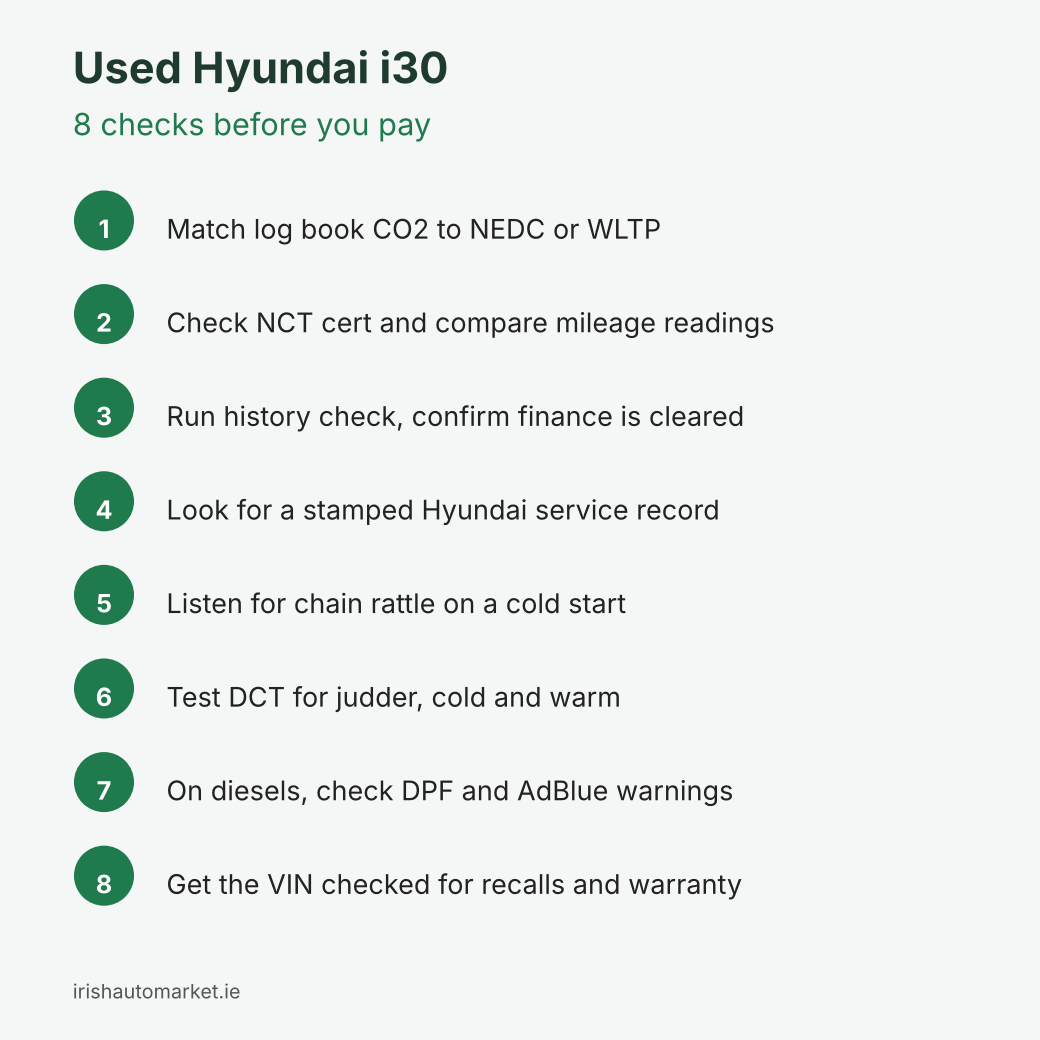
- CO2 and tax: read the CO2 figure on the Vehicle Registration Certificate and match it to the correct NEDC or WLTP table.
- NCT certificate: compare its recorded mileages; falling or inconsistent readings can signal clocking.
- History and finance: run a history check and make sure any hire purchase or PCP finance is cleared.
- Service record: look for regular stamped services to Hyundai's schedule; warranty cover depends on it.
- Cold start: start the engine from cold and listen for a timing chain rattle.
- DCT behaviour: test for judder and hesitant pull-away, both cold and warm.
- Diesel DPF and AdBlue: on a 1.6 CRDi, check for warning lights and ask how the car was used.
- Recalls and warranty: have the VIN checked for open recall work and confirm the first registration date.
What fails at the NCT?
The RSA does not publish i30-specific fail rates, but it lists the most common fail items across all cars: worn tyres, faulty brake lines, seat belt condition, exhaust condition and defective suspension. Age matters: over 80% of four-year-old cars pass their first inspection, against below 40% for cars aged ten or more.
Every GD i30 is now nine years old or more. Cars first need an NCT at four years old, then every two years until their tenth-anniversary test, and every year after that. Before the test, check tyres, lights, wipers, seat belts, the exhaust and, on older cars, the brake lines.
Warranty and servicing
Hyundai Ireland gives private cars originally bought from an authorised Hyundai dealer in Europe a five-year unlimited-mileage warranty from first registration. Cars sourced through Hyundai Cars Ireland also get five years of AA roadside assistance and a free annual health check. Taxis and public service vehicles are excluded. Hyundai's European terms state that the warranty stays with the vehicle and passes to the new owner, and that 48V batteries fall under the five-year cover. Consumable parts such as brake pads, wiper blades and filters are covered for two years or 20,000km.
Every GD is now out of factory warranty, but a PD first registered after October 2021 can still have cover. Claims depend on servicing to Hyundai's schedule, so ask for the full service record with dates and mileages.
Verdict: is a used Hyundai i30 a good buy in Ireland?
For most buyers, yes. Both generations scored five stars from Euro NCAP (GD in 2012, PD in 2017), the common versions cost €180 to €200 a year to tax, and the main engines use timing chains. The 1.6 CRDi suits regular long runs, while the 1.0 T-GDi fits town and mixed use. The Tourer adds a large boot, and a late PD may still carry transferable factory warranty. Listen for chain noise on a cold start, test any DCT carefully and check the service history.
Frequently asked questions
How much is motor tax on a Hyundai i30 in Ireland?
Between €180 and €200 a year for the common versions: €180 for the PD 1.6 CRDi, €190 for the GD diesels and €200 for the 1.0 T-GDi petrol. Cars registered from 2021 are taxed on WLTP figures.
Does the Hyundai i30 have a timing belt or chain?
The GD 1.4 petrol and 1.6 CRDi and the PD 1.0 T-GDi use a timing chain. Sources disagree on the later Smartstream 1.6 CRDi diesel, so confirm its timing-drive service item with a Hyundai dealer.
Does the Hyundai warranty transfer to the next owner?
Yes. Hyundai's terms state that the five-year unlimited-mileage warranty stays with the car and passes to the new owner. It runs from first registration and depends on servicing to schedule.
Is the i30 DCT automatic reliable?
The seven-speed DCT uses dry clutches, and judder when pulling away at low speed is the most reported issue. Test it from cold and warm, and ask for any software update or clutch work records.
Was the i30 Fastback sold in Ireland?
Yes. It arrived early in 2018 with one version: the 1.0 T-GDi 120hp with a six-speed manual, at 120 g/km and €200 a year to tax.
Buying or selling? Use Ecosteer
Ecosteer lists petrol, diesel, hybrid and electric cars side by side, so you can compare an i30 against other family hatchbacks in one search. Selling a car under €3,000? Private sellers list it on Ecosteer completely free. Compare used cars on ecosteer.ie.
External sources
- CompleteCar.ie: motor tax prices in Ireland explained (NEDC and WLTP tables)
- Autobiz.ie: new Hyundai i30, Irish range (2012)
- CompleteCar.ie: Hyundai i30 1.6 CRDi review (2012)
- Rev.ie: Hyundai i30 review (2012)
- Car Enthusiast: 2015 Hyundai i30 update and DCT gearbox
- CompleteCar.ie: Hyundai i30 1.6 diesel DCT review (January 2017)
- CompleteCar.ie: Hyundai i30 1.6 diesel review (October 2017)
- CompleteCar.ie: Hyundai i30 Tourer review (2017)
- CompleteCar.ie: Hyundai i30 Fastback 1.0 T-GDI review (2018)
- Changing Lanes: Hyundai i30 Fastback review (2018)
- CompleteCar.ie: Irish pricing for the 2021 Hyundai range
- Fleet News: 2017 Hyundai i30 specs and CO2
- Fleet News: Hyundai i30 facelift specs and WLTP CO2
- Hyundai press release: i30 2018 update, Smartstream diesel, SCR and petrol particulate filter
- Hyundai press kit: new i30 (2020 facelift) and 48V mild hybrid
- Hyundai: new powertrains and seven-speed DCT
- MyMotorList: Hyundai G4FA 1.4 engine
- MyMotorList: Hyundai G3LC 1.0 T-GDi engine
- Autodoc: i30 GD 1.6 CRDi timing chain data
- Car Checker: Hyundai i30 PD 1.0 T-GDI report
- Car Checker: Hyundai i30 PD 1.6 CRDi report
- Autoscore: Hyundai 1.6 CRDi U3 engine
- CCPC: Hyundai recalls certain i30 passenger vehicles (2020)
- RSA: 25 years of the NCT, common failure items
- Roscommon County Council: NCT test intervals
- CCPC: buying a car
- Hyundai Ireland: 5-year unlimited mileage warranty
- Hyundai Ireland: warranty general terms
- Hyundai Europe: warranty terms and FAQ
- Euro NCAP: Hyundai i30 2012 datasheet
- Hyundai press release: new-generation i30 five-star Euro NCAP (2017)
Comments
No comments yet — be the first to join the conversation.